Monday, April 17, 2006

On cherry blossoms - and other things - in Japan

A couple of weekends ago, cherry blossoms were in peak bloom in Tokyo's Ueno Park, which is pretty much sakura central for Tokyo residents. Just a few locals joined my family and me for a stroll:


The cherry blossom viewing for many people involves claiming a patch of ground with the ubiquitous blue tarp and having food, :


and a drink, or ten:


(I am not sure if he is in his underwear or his speedos. In any event, I reckon it was about 10 to 12 degrees at the time of the photo.)

Cherry blossoms are very pretty, and the weather forecast on TV each night shows where the cherry blossom "front" is over the whole country. (Naturally, the trees in the more northern and colder parts of Japan start flowering later than those to the warmer south.) More information on sakura trees is, as usual, at Wikipedia. (One thing they don't mention is that a spring time treat is a mochi rice sweet that comes wrapped in a sort of pickled sakura tree leaf. I can only imagine that someone centuries ago must have been really hungry to think about how to make these tree leaves edible.)

Ueno Park also has a smallish zoo, but the throng of people there on this visit made it impossible to get good photos. People are herded particularly quickly past the panda bear enclosure, and I had but a glimpse of a reclining black and white body.

By the way, as global warming would have it, Japan's winter this year was (I am told) particularly cold and snowy. Unexpectedly, I ran into snow into the northern part of Honshu only about 10 days ago. This was the scene outside the onsen hotel after a night of gentle snow:


Damn pretty, hey. (This is a good time to note that my problem with Melbourne winters is not that the minimum temperature is so low - the suburbs in Brisbane often have lower overnight temperatures - it's just that Melbourne suffers from a seemingly interminable number of grey, wet, cool to cold days without ever having the off-setting prettiness of snow.)

Onsen are the Japanese hot spring baths, and most are attached to hotels or inns (ryokan) with Japanese style rooms. Wikipedia has a good summary about them here.

Maybe most people have seen these over the years on the travel shows, but I am in a sharing mood:
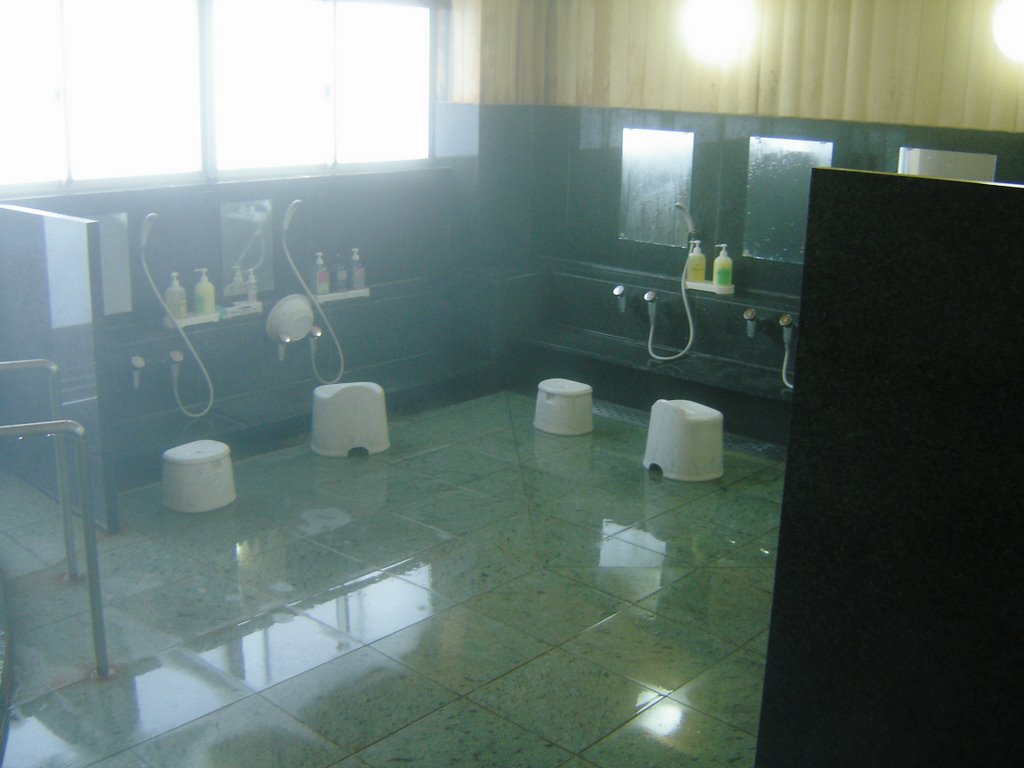


This is the washing area next to the bath itself. You sit on the stools and use the shower or basin to wash yourself before getting in the bath, which in my case looked like this:


This is actually the outside bath, as you can see from the snow in the background. The temperature of the water is usually so high that sitting in it with your head and shoulders in the snowy air is pleasant. (Well, if you splash a bit of water on your shoulders every minute or so.)

There was no one around when I took these photos. They are nearly all gender segregated anyway, although that may not stop a cleaning woman being around if you are having a morning bath!

I can tell you that an absolutely essential part of all Japanese TV shows about travel within the country is the scene in which the host is sitting in the local onsen bath, quickly followed by a discussion of the local area's specialty food. (With host tasting it and saying in an exaggerated way "oishi" or "umai", meaning "delicious".)

The Japanese style room will look something like this (insert your own close relative, you can't have mine):
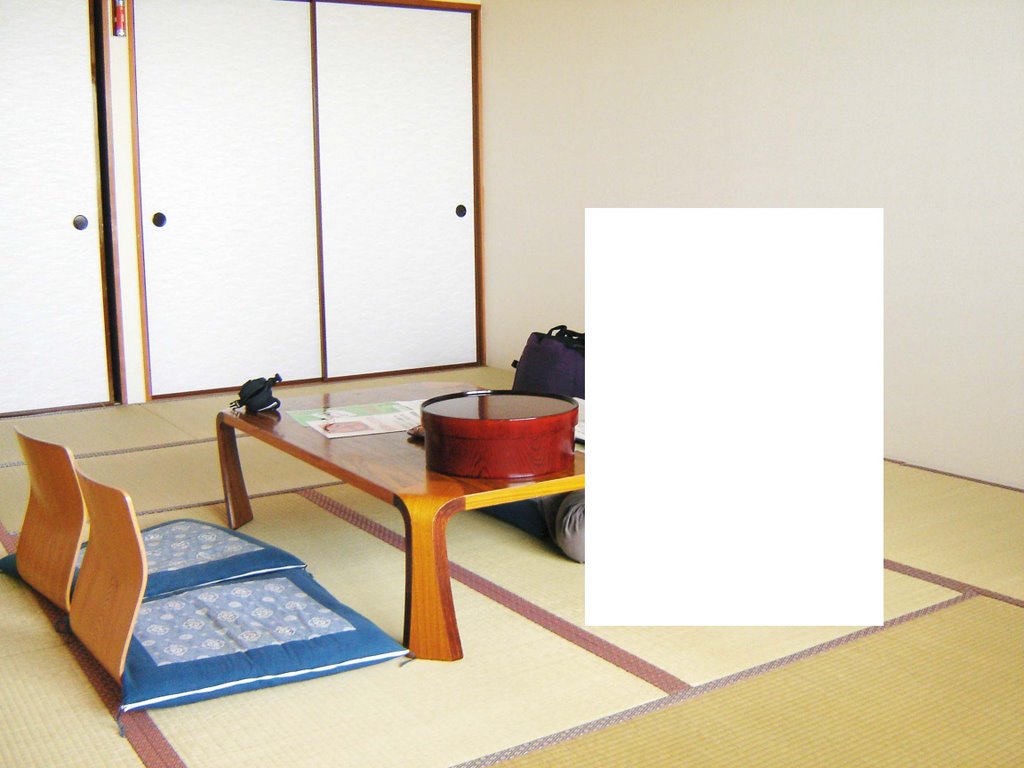


No beds, just futons laid out on the tatami floor in the evening for sleep. Most onsen hotels will include a very nice dinner served in the room with lots of little dishes. This one we stayed at was a "public" onsen, which is cheaper and did not have this option. However, the food served in the dining room smorgasbord style (Japanese call it "viking style", which I find kinda funny) was still very good.

Oh well, I need to catch up on some sleep. More travelogues to come.

(And, just in case you don't realise it yet, clicking on the photos above bring up enlarged versions.)

Back!

The Dominion has returned. Some posts about Japan are in order, over the next few days.

Friday, April 07, 2006

I wonder what the false positive rate is..

This sounds sort of hard to believe, but we are talking Malaysia:

Malaysia will soon begin using eye-scan machines in schools to detect drug usage among teenage pupils after reports that a large number of adult drug users begin their addictions while in school, media reports said yesterday.
Deputy Education Minister Noh Omar said the 200,000-ringgit ($53,333) machines should be able to detect signs of drug use within 24 hours by using light displays to measure eye movement.
A preliminary test of the eye scans is to be conducted next month at a school in
Kuala Lumpur, he said.

Moreover, things have already been just a tad regimented for Malaysian students:

Previously, the government had been conducting random urine tests on teenage students in schools.

Why hasn't at least a private school in Australia tried flying that one?

They also apparently start young in that country:

The government revealed Thursday that a total of 17.7 per cent of drug addicts polled in Kuala Lumpur had started their addictions before the age of 13 with morphine and heroine topping the list of favoured substances.
Authorities said Malaysia has more than 500,000 addicts, but health workers fear the numbers could be much higher.
Despite Malaysia’s tough drug laws, which prescribe a mandatory death sentence by hanging for drug trafficking, drug addiction continues to be on the rise.

I wonder how reliable these figures are. They have a strong smell of 'moral panic' abut them.

Thursday, April 06, 2006

On re-thinking Iraq

The departing editor of The Economist (he's been there 13 years) gets to talk about how the world has changed in the period. On the magazine's decision to support the invasion of Iraq, he writes this:

All of which is the background to the most controversial decision of this editorship: the decision to support the American-led invasion of Iraq in March 2003. Our reasoning began with the fact that the status quo was terrible: doing nothing, whether about Iraq or about the Israeli-Palestinian conflict, was itself a deadly decision. It went on to the risk that Saddam still had a stock of weapons of mass destruction that if left in power he might wish to use or to sell. In the light of September 11th and the dismal results from 13 years of sanctions, we argued that wishful thinking about Saddam would be reckless. The West should invade, remove him from power, and throw its considerable resources behind the rebuilding of a free Iraq.

The ensuing three years, I hardly need to say, have seen a debacle. His WMDs turned out to be a bluff, fooling even his own generals. Elections have been held, a constitution has been written, but no government is in place. Institutions remain in tatters. Whether or not a civil war is under way is largely a semantic issue. Dozens of Iraqis are dying every day, killed by other Iraqis. So does this prove our decision wrong, just as the good outcome in ex-Yugoslavia put our “stumbling” warning in the shade?

This will outrage some readers, but I still think the decision was correct—based on the situation at that time, which is all it could have been based on. The risk of leaving Saddam in power was too high. Outside intervention in other countries' affairs is difficult, practically, legally and morally. It should be done only in exceptional circumstances, and backed by exceptional efforts. Iraq qualified on the former. George Bush let us—and America—down on the latter. So, however, did other rich countries: whatever they thought of the invasion, they had a powerful interest in sorting out the aftermath. Most shirked it.

Sounds reasonable to me.

When prayer seems to fail

Slate writer William Saletan has often been mentioned on this blog, and his latest article on the recent study about prayer and its effect on post surgery recovery is another good, half amusing, half serious, read.

Continuing an anti cat crusade...

If the birds don't give you the flu, maybe your cat will:

It is vital to restrict the spread of bird flu in cats in order to protect human health, scientists warn.

Writing in Nature, scientists from Erasmus Medical Centre, Rotterdam, say the risk is being overlooked.

Wednesday, April 05, 2006

Must cancel my Mars ticket

This does not sound good:

Former NASA Payload Specialist James Pawelczyk told an Experimental Biology 2006 meeting Tuesday in San Francisco every cell in one's body could experience a high energy event with heavy metal ions during the 13- to 30-month Mars round trip.

Must try harder than this

See this story for a really pathetic attempt to increase fathers role in child rearing in Japan. :

Under the revisions -- the latest policy measure aimed at dealing with the anemic birthrate -- expecting fathers, as well as mothers, will receive a notebook to keep records on the health of mother and child from pregnancy through early childhood, LDP members said.

The name of the notebook will be changed from the "maternal and child health handbook" to the "parent and child health handbook."

I have a dream...

A couple of nights ago, I had another one of my `proof of flying` dreams. While many people may have dreams in which they can fly, I am not sure how common my (recurring) variation would be.

In the dream I have the ability to fly. Just need to get myself in the right frame of mind, and I can levitate off the ground and swan around in the air. I never fly too high, just a few metres.

During the dream, I am flying alone and unobserved, and am very aware that people will not believe that I am able to do this. I try to think of ways that I can prove it, and this usually involves a video camera taping myself in action, so to speak.

The details of the most recent dream are already sketchy, but I think I got a good tape of myself flying inside a big building, and was very happy and vindicated that people could now see clearly that I can do this. It was a very good feeling. Then I woke up and felt rather disappointed. I have been having this dream for some years now.

I have always had flying dreams and they have always been nice. However,I find this variation sort of funny/strange, hence this post. Nevertheless, I promise not to make dream reports a regular feature here.   

Monday, April 03, 2006

Tracee gets black

The Age's most easily ridiculed writer would currently have to be Tracee Hutchison. Her article about visiting some blackfellas who set up in Melbourne for the Commonwealth games is a good example:

Have you got any blackfella in you? The man asking the question is in the process of smoking me. It seems a strange question to ask a fair-skinned, pale-eyed, blonde woman. I don't think so.

Just sounds like sale assistant talk to me. Never hurts to butter up the customer.

And for some reason, the Fire Man thinks I've got some kind of blackfella spirit inside me. I feel humbled that this healing man might think so.

Not sure why this should be humbling. Is it because there is something nicer about having that touch of primative purity in your blood?

Part of me wishes there were more whitefellas here feeling what I am feeling and the other part is savouring what I know is an extraordinary moment. It is a moment about trust. A moment that says we mean no harm to each other. A moment that tells me about our black history in the most profound way. And it is so understated it is almost overwhelming.

Yes, I always like it when something becomes so understated it circles back on itself and becomes overwhelming.

I find an older man at the sit-down fire and he wants to know my business. I tell him I've come to sit down. We talk for a while and it emerges that I do a radio show and a bit of writing. I thought so, he says. How can we get our message across?

How did he know she was a broadcaster? More of that ancient aboriginal mystical foreknowledge, or does he just own a radio? (OK, she may not have meant that to sound mystical, but she leaves that interpretation open.)

The smell of gum leaves is still in my clothes as I leave 3CR and I'm wondering if that black spirit the Fire Man talked of is something we all might have more of if we took a little time to sit down for a while.

How very, very twee, Tracee.

The Dominion on Holiday

Warning was intended to be given last week, but time was short.

Opinion Dominion is currently coming to you  via Japan. How often posts will appear is not clear.  There is the added complication of using a Japan Windows computer.  It keeps trying to change things into Japanese,and doing funny things to fonts etc.  So if the formatting is wonky, I apologise in advance.

One thing I am using that seems to work well is Portable Firefox, a version which fits on the smallest USB key and runs from that device (rather than doing the rather impolite act of downloading Firefox on someone else’s hard drive.)  I really hate having to use IE after Firefox, and I also get to run Firefox in english,which always helps the language challenged like me.

I see that Tim Blair has also had a low Internet presence for the last few days.  I am sure there must be a conspiracy theory in there somewhere.  

Wednesday, March 29, 2006

Films from graphic novels/comics

The Australian: Return of people power [March 29, 2006]

You know a film has touched a sensitive nerve when a writer for the Guardian wonders whether sedition laws are appropriately used against it. The story in the Australian (above) gives some background to the film.

The Guardian's film reviewer didn't like it either:

Yet another graphic novel has been bulldozed on to the screen, strutting its stuff for an assumed army of uncritical geeks - a fanbase product from which the fanbase has been amputated. This film manages to be, at all times, weird and bizarre and baffling, but in a completely boring way. Watching it is like having the oxygen supply to your brain slowly starved over more than two hours.

Yet it has made some money in America and at Rotten Tomatoes scored a relatively high approval rating. Seems Americans are not so sensitive about movies involving bombs in the Underground. Just as long as it is not their subway.

Again, I will annoy people by criticising something I haven't seen. I predict, based on the simple fact that it is a movie that is based on a graphic novel, that it will be crap.

Hollywood really, really, has to use better material for its movies than this. Graphic novel material means a high probability that the movie will have good production design, and unrealistic or unconvincing characters.

Comic based movies were OK for a while, I suppose. But it was never a genre that had much depth. They can have a silly charm. But there have been so many dud movies based on Marvel comic heros who no adult has heard of, don't the creative types in Hollywood want to finally leave them alone? How do the writers "pitch" their material convincingly?

By the way, I like animation quite a lot, and this rant does not indicate a simple prejudice against material designed for a younger audience. I understand the appeal of a graphic novel, even though I don't read them. But please stop with the movies based on this kind of stuff.

Gerard Henderson on sedition

Knowing the enemy makes leaders friends - Opinion - smh.com.au

Yesterday's column by GH (above) notes that the Law Reform Commission is looking at the commonwealth sedition laws. Henderson notes:

On March 20 the commission published an issues paper titled Review of Sedition Laws. The issues paper seeks community consultation and the final chapter of the document contains a list of questions to which the authors of the report would like responses. Weisbrot and his colleagues make it clear they have not reached any "definitive conclusions" about their ultimate findings and recommendations.

Even so, the paper indicates that - at this stage, at least - the authors do not share the hyperbolic concern ignited by some of the critics of the federal and state governments when this legislation was canvassed late last year. For example, the paper refers to a "misunderstanding" of the construction of criminal responsibility evident in submissions to the Senate committee and comments that legal distinctions can be difficult "for non-experts and sometimes even for experts".

On a number of key issues the Law Reform Commission gives support to the case presented by the Attorney-General's Department to the Senate committee.

Seems consistent with what I had been saying earlier about the nature of the criticism about the laws.

Tuesday, March 28, 2006

A funny thing happened on the way to the verdict

Moussaoui destroys his own defence - World - theage.com.au

From the above:

The prosecution is seeking the death penalty on the basis that Moussaoui contributed to the deaths of about 3,000 people on September 11 because he did not tell authorities about the planned hijackings.

"The reason you told lies was so you could allow the operation to go forward," prosecutor Robert Spencer demanded of Moussaoui.

"That is correct," Moussaoui replied. ....

Many analysts have said this week could prove decisive for Moussaoui.

They have also expressed fears that testimony from the unpredictable Moussaoui could undo sterling work by defence lawyers who have picked deep holes in the prosecution case for their client's execution.


The sterling work is about as undone as it could possibly be. No "if the glove doesn't fit you must acquit" style slogan is going to work this time.

Monday, March 27, 2006

Child free Europe

BBC NEWS | Europe | The EU's baby blues

The BBC site above fills in some of the gaps in understanding the various reasons behind Europe's dire birth rate, a topic mentioned here quite a few times recently.

The page about Italy's low rate has some surprises:

Laura Callura, 38, who lives in Rome says she is typical of many Italian women.

"I became a mother at 36 and that's not unusual here," she says. "A lot of my friends had their first child between the ages of 33 and 38.

"Here in Italy we start life much later than people in northern Europe. University courses take longer to finish and it's harder for young people to get into the job market.

"I started my first job when I was 25 - but that is quite unusual. Most Italians don't start their career until their late 20s."