Twenty years on: lest we forget the lessons from Chernobyl - Opinion
It would seem that Labor's environment spokesman feels that no changes to Labor's blanket anti-nuclear policies are in the wind. His article above says that the Chernobyl disaster:
"...showed the world that nuclear power was not safe..."
And I suppose that the tens of thousands killed in the process of coal mining shows that it is safer? Comparing known decrepit Russian reactors with state of the art (or newer designs) is a bit of a stretch.
I have no fixed opinion on nuclear power, in that I am skeptical of the extremes on either side of the argument about its use. However, there is work being done on reactor designs which are inherently safer (see articles about pebble bed reactors and using thorium here and here) and these should be investigated by governments as a matter of priority.
Seems that wouldn't happen under Labor though, because nuclear is evil.
Wednesday, April 26, 2006

Sunday, April 23, 2006
Geography and global climate
BBC NEWS | Science/Nature | Fossil gives clue to big chill
The above article points out that the disconnection of South America from Antartica some 41 million years ago is believed to have played (and still play) a very large part in the global climate:
The world was a very different place then. Levels of carbon dioxide were three to four times today's levels and it was so warm that alligators sunned themselves in the high Arctic.
But some 30 million years ago, there was a dramatic shift in climate from "greenhouse" to "icehouse".
The rapid cooling swept over the Antarctic and, over the course of several million years, its pine trees were replaced by glaciers.
Interesting. Global warming is obviously good for alligators and pine trees. Pity polar bears and penguins are so cute.
The above article points out that the disconnection of South America from Antartica some 41 million years ago is believed to have played (and still play) a very large part in the global climate:
The world was a very different place then. Levels of carbon dioxide were three to four times today's levels and it was so warm that alligators sunned themselves in the high Arctic.
But some 30 million years ago, there was a dramatic shift in climate from "greenhouse" to "icehouse".
The rapid cooling swept over the Antarctic and, over the course of several million years, its pine trees were replaced by glaciers.
Interesting. Global warming is obviously good for alligators and pine trees. Pity polar bears and penguins are so cute.
Paging Dr Skippy
In further medical news, the SMH also reports this weekend that a new promising antibiotic compound has been found in - of all places - wallaby milk.
"What's that Skip? You want this man in septic shock to put his head in your pouch? Are you sure?"
"What's that Skip? You want this man in septic shock to put his head in your pouch? Are you sure?"
Aquarium blues
Cats are given a hard time in this blog; now it's the goldfish's turn.
The SMH reports that a drug resistant strain of salmonella has been proved (by Australian research no less) to live in fish tanks:
Australian researchers proved the link between gastroenteritis and fish tanks by showing that the strains of salmonella in patients and in their home aquariums were genetically identical.
Diane Lightfoot, a salmonella specialist at the University of Melbourne..said the study highlighted the need for care when cleaning tanks.
Fish were good pets, she said, "and fish tanks aren't to be feared. But commonsense hygiene is needed." This included washing hands after touching the water or gravel and making sure the water did not splash onto surfaces where it could contaminate food, she said.
To be fair to goldfish, the article does only refer to "tropical" fish, so maybe an unheated tank of the kind most goldfish have to put up with is not such a risk.
The SMH reports that a drug resistant strain of salmonella has been proved (by Australian research no less) to live in fish tanks:
Australian researchers proved the link between gastroenteritis and fish tanks by showing that the strains of salmonella in patients and in their home aquariums were genetically identical.
Diane Lightfoot, a salmonella specialist at the University of Melbourne..said the study highlighted the need for care when cleaning tanks.
Fish were good pets, she said, "and fish tanks aren't to be feared. But commonsense hygiene is needed." This included washing hands after touching the water or gravel and making sure the water did not splash onto surfaces where it could contaminate food, she said.
To be fair to goldfish, the article does only refer to "tropical" fish, so maybe an unheated tank of the kind most goldfish have to put up with is not such a risk.
Saturday, April 22, 2006
Little publicity expected
ScienceDaily: Ancient And Modern Evidence Suggests Limits To Future Global Warming
The above story is 2 pronged. The study indicates that global warming due to greenhouse gases is definitely real, but the models also indicated that the "worst case" temperature rises are less likely than previously estimated.
As it contains this semi-optimistic estimate on the temperature rises, will it attract any media attention?
Here's another article that contains some moderately good news on 2 aspects of the global warming issue. As Real Climate has not attacked it yet, I am guessing that it is not controversial.
The above story is 2 pronged. The study indicates that global warming due to greenhouse gases is definitely real, but the models also indicated that the "worst case" temperature rises are less likely than previously estimated.
As it contains this semi-optimistic estimate on the temperature rises, will it attract any media attention?
Here's another article that contains some moderately good news on 2 aspects of the global warming issue. As Real Climate has not attacked it yet, I am guessing that it is not controversial.
On liberal churches
The New Yorker: Online Only: Content
Strange that the New Yorker contains a fairly conservative assessment of what is going on in the Episcopal Church, and Anglicanism more generally. This part rings particularly true:
The liberal, mainline churches are losing parishioners across the board. The conservative churches are not only growing but growing by leaps and bounds. To me, the reason seems obvious: if you’re shopping for faith, faith is the thing you want, not a watered-down version of a civics lesson. That’s not to say that the evangelical or more orthodox view is just a marketing tool, but people who get up on Sunday morning and say “I think I’ll go to church today” tend to want the genuine article, rather than a speculative “maybe it’s true, maybe it’s not true, we’re all on this journey together” exploration. Because it’s a lot easier, frankly, to stay in bed and get up in time for the first football game.
I believe that the most liberal and outright politically active Catholic church in Brisbane (St Mary's at South Brisbane) has a large number turn up for Sunday masses. But I think this is because it attracts disenchanted left-y Catholics from all over the city.
That parish has hosted a (secular) gay choir, been rapped over the knuckles for changes to the baptism rite, and featured street facing anti-John Howard signs erected on church grounds. Irritates me no end...
Strange that the New Yorker contains a fairly conservative assessment of what is going on in the Episcopal Church, and Anglicanism more generally. This part rings particularly true:
The liberal, mainline churches are losing parishioners across the board. The conservative churches are not only growing but growing by leaps and bounds. To me, the reason seems obvious: if you’re shopping for faith, faith is the thing you want, not a watered-down version of a civics lesson. That’s not to say that the evangelical or more orthodox view is just a marketing tool, but people who get up on Sunday morning and say “I think I’ll go to church today” tend to want the genuine article, rather than a speculative “maybe it’s true, maybe it’s not true, we’re all on this journey together” exploration. Because it’s a lot easier, frankly, to stay in bed and get up in time for the first football game.
I believe that the most liberal and outright politically active Catholic church in Brisbane (St Mary's at South Brisbane) has a large number turn up for Sunday masses. But I think this is because it attracts disenchanted left-y Catholics from all over the city.
That parish has hosted a (secular) gay choir, been rapped over the knuckles for changes to the baptism rite, and featured street facing anti-John Howard signs erected on church grounds. Irritates me no end...
Friday, April 21, 2006
Science gives a tick to globalisation?
Does Globalization Help or Hurt the World's Poor?
This is really interesting. Scientific American (above) has a free article available on the effect of globalisation on the poor.
The article criticises both free trade and anti-globalisation activists for claiming too much for their own side of the argument. However, it seems to me to contain much more comment and information that is "pro" globalisation rather than "anti".
The point about antiglobalisation is also that it is not just a school within a group of economists who hold this debate; it is a "popular" movement as well which brings a heap of (often) nihilistic, irrational and "let's bite the hand that feeds me" attitude that is very hard to stomach. Globalisation can have bad effects, is not the sole reason for some countries' improvement, and local governments have their role to play in regulating it too. But to deem it as fundamentally evil, as anti globalisation protesters are inclined to do, is just silly. It seems well established that if the protesters completely got their way, they would hurt the people they claim to be wanting to protect.
Anyone, it would seem that such protests have reached their zenith and may dwindle further. Good.
Enough of my mini-rant. Read the article.
This is really interesting. Scientific American (above) has a free article available on the effect of globalisation on the poor.
The article criticises both free trade and anti-globalisation activists for claiming too much for their own side of the argument. However, it seems to me to contain much more comment and information that is "pro" globalisation rather than "anti".
The point about antiglobalisation is also that it is not just a school within a group of economists who hold this debate; it is a "popular" movement as well which brings a heap of (often) nihilistic, irrational and "let's bite the hand that feeds me" attitude that is very hard to stomach. Globalisation can have bad effects, is not the sole reason for some countries' improvement, and local governments have their role to play in regulating it too. But to deem it as fundamentally evil, as anti globalisation protesters are inclined to do, is just silly. It seems well established that if the protesters completely got their way, they would hurt the people they claim to be wanting to protect.
Anyone, it would seem that such protests have reached their zenith and may dwindle further. Good.
Enough of my mini-rant. Read the article.
Dershowitz on Moussaoui
The abuse excuse. By Alan M. Dershowitz
See above for an interesting Slate article on the use and misuse of "diminished moral culpability" arguments in the American criminal system. Alan Dershowitz can write unusually clearly and succinctly for a lawyer.
See above for an interesting Slate article on the use and misuse of "diminished moral culpability" arguments in the American criminal system. Alan Dershowitz can write unusually clearly and succinctly for a lawyer.
Thursday, April 20, 2006
One less thing to worry about
ScienceDaily: Deadly Astronomical Event Not Likely To Happen In Our Galaxy, Study Finds
Seems death of most life on earth by an unexpected gamma ray burst (GRB) from a nearby star is rather unlikely;
The astronomers determined that the odds of a GRB occurring in a galaxy like that one to be approximately 0.15 percent. And the Milky Way's metal content is twice as high as that galaxy, so our odds of ever having a GRB would be even lower than 0.15 percent.
"We didn't bother to compute the odds for our galaxy, because 0.15 percent seemed low enough," Stanek said.
He figures that most people weren't losing sleep over the possibility of an Earth-annihilating GRB. "I wouldn't expect the stock market to go up as a result of this news, either," he said. "But there are a lot of people who have wondered whether GRBs could be blamed for mass extinctions early in Earth's history, and our work suggests that this is not the case."
Seems death of most life on earth by an unexpected gamma ray burst (GRB) from a nearby star is rather unlikely;
The astronomers determined that the odds of a GRB occurring in a galaxy like that one to be approximately 0.15 percent. And the Milky Way's metal content is twice as high as that galaxy, so our odds of ever having a GRB would be even lower than 0.15 percent.
"We didn't bother to compute the odds for our galaxy, because 0.15 percent seemed low enough," Stanek said.
He figures that most people weren't losing sleep over the possibility of an Earth-annihilating GRB. "I wouldn't expect the stock market to go up as a result of this news, either," he said. "But there are a lot of people who have wondered whether GRBs could be blamed for mass extinctions early in Earth's history, and our work suggests that this is not the case."
How palestinians encourage peace in their time
This is a terrible story:
As far as the Abu al-Hawa family is concerned, the sale of two floors of their home on Jerusalem’s Mount of Olives was perfectly legitimate.
Mohamed Abu al-Hawa sold the real estate to a Palestinian businessman nearly a year ago, his brother Mahmoud says, earning $650,000. The money was used to buy another home on the Mount of Olives, a cherished spot overlooking Jerusalem’s Old City.
But last week Mohamed’s bullet-riddled body was found lying next to his burnt-out car on a road near Jericho. Branded a traitor for selling his property to Jews, he had been shot seven times, including once in the temple, Mahmoud said.
A detailed commentary piece on this is in the Jerusalem Post, and is well worth reading in full for its eye-opening account of this practice:
Muhammad Abu al-Hawa was buried in a makeshift cemetery on the road between Jerusalem where he lived, and Jericho where he was murdered. His body was buried there because the Palestinian Authority's mufti in Jerusalem, Ikremah Sabri, has barred all Muslims accused of selling land to Jews from being buried in a Muslim cemetery....
SINCE 1994, dozens of Arab Israelis and PA residents have been murdered on suspicion of selling land to Jews...
According to Palestinians and to Jews involved in purchasing lands from Palestinians, in the majority of cases, the Arabs murdered for the "crime" of selling land to Jews never sold land to Jews. At most they were "guilty" of having ties of friendship or commerce with Israelis. The fact that merely having relations with Jews can expose an Arab to allegations of collaboration is enough to convince most Palestinians that they shouldn't have anything to do with Israel or Israelis. So by murdering people like Abu al-Hawa, the Palestinian leadership ensures that Palestinians will be too afraid of being killed to risk peaceful coexistence with Israel.
So, not only is random terrorism against civilian Jews the only problem, they are prepared to kill their own to help delay forever any hope of peaceful co-existence.
As far as the Abu al-Hawa family is concerned, the sale of two floors of their home on Jerusalem’s Mount of Olives was perfectly legitimate.
Mohamed Abu al-Hawa sold the real estate to a Palestinian businessman nearly a year ago, his brother Mahmoud says, earning $650,000. The money was used to buy another home on the Mount of Olives, a cherished spot overlooking Jerusalem’s Old City.
But last week Mohamed’s bullet-riddled body was found lying next to his burnt-out car on a road near Jericho. Branded a traitor for selling his property to Jews, he had been shot seven times, including once in the temple, Mahmoud said.
A detailed commentary piece on this is in the Jerusalem Post, and is well worth reading in full for its eye-opening account of this practice:
Muhammad Abu al-Hawa was buried in a makeshift cemetery on the road between Jerusalem where he lived, and Jericho where he was murdered. His body was buried there because the Palestinian Authority's mufti in Jerusalem, Ikremah Sabri, has barred all Muslims accused of selling land to Jews from being buried in a Muslim cemetery....
SINCE 1994, dozens of Arab Israelis and PA residents have been murdered on suspicion of selling land to Jews...
According to Palestinians and to Jews involved in purchasing lands from Palestinians, in the majority of cases, the Arabs murdered for the "crime" of selling land to Jews never sold land to Jews. At most they were "guilty" of having ties of friendship or commerce with Israelis. The fact that merely having relations with Jews can expose an Arab to allegations of collaboration is enough to convince most Palestinians that they shouldn't have anything to do with Israel or Israelis. So by murdering people like Abu al-Hawa, the Palestinian leadership ensures that Palestinians will be too afraid of being killed to risk peaceful coexistence with Israel.
So, not only is random terrorism against civilian Jews the only problem, they are prepared to kill their own to help delay forever any hope of peaceful co-existence.
Put this low on your tourist sites list for Japan
The Japan Times Online
From the above story:
Part of a jumbo jet's broken tail fin, crushed seats and a flight data recorder that detailed how JAL Flight 123 crashed into a mountain on Aug. 12, 1985, are among the items on display at the Safety Promotion Center of Japan Airlines Corp., which opened Wednesday for a media preview.
Located in Ota Ward, Tokyo, near Haneda airport, the center exhibits components from the crippled Boeing 747 that crashed into Mount Osutaka in Gunma Prefecture, leaving 520 passengers and crew members dead in the worst single-plane accident in history.
The facility will open to the public next Monday with the aim of promoting aviation safety awareness among the public. It will also be used for employee education and training at a time when JAL has been hit by a spate of safety problems.
Would seeing this really convince the public that JAL is taking safety seriously now?
From the above story:
Part of a jumbo jet's broken tail fin, crushed seats and a flight data recorder that detailed how JAL Flight 123 crashed into a mountain on Aug. 12, 1985, are among the items on display at the Safety Promotion Center of Japan Airlines Corp., which opened Wednesday for a media preview.
Located in Ota Ward, Tokyo, near Haneda airport, the center exhibits components from the crippled Boeing 747 that crashed into Mount Osutaka in Gunma Prefecture, leaving 520 passengers and crew members dead in the worst single-plane accident in history.
The facility will open to the public next Monday with the aim of promoting aviation safety awareness among the public. It will also be used for employee education and training at a time when JAL has been hit by a spate of safety problems.
Would seeing this really convince the public that JAL is taking safety seriously now?
I am?
The rise of the blogger - theage.com.au
Bloggers and internet pundits are exerting a "disproportionately large influence" on society, a report by technology researchers says.
Bloggers and internet pundits are exerting a "disproportionately large influence" on society, a report by technology researchers says.
Back on dreaming..
A few posts back I explained my recurring "proof of flying" dream. One thing I forgot to mention in the post is that often in this dream, the reason I think people won't believe that I can fly is because they will think it is just my dream. I am therefore dreaming about how to disprove that I am currently in a dream. I think in some versions, it is simply that I want to prove it to myself.
I think this raises the "oddness"factor of the dream quite a bit, and I should have mentioned it before.
Also, how's this for a slightly odd co-incidence (although hardly one of high Jungian significance.) While on the aircraft flying into Brisbane on Monday morning, after a night of virtually no sleep, for no obvious reason the chorus of "My old man's a dustman" came to mind. That's odd, I thought, why would looking out on Moreton Bay bring that far from frequently heard chorus to mind.
On the taxi ride from the airport, the driver had some obscure radio show on that opened with the "Run rabbit" song (used for years now in that slightly creepy Victorian tourist ad) and I thought "wouldn't it be odd if 'My old man...' comes on during this show." It didn't.
Then last night, while watching "Dusty", the doco series on the ABC about staging the musical in Melbourne, they showed a scene from the show that I think was meant to be Dusty Springfield's parents (the scene may have been cut from the final version) and it ended with the chorus of "My old man's a dustman." Just for a very short time before they cut to something else.
This Dusty TV show has been on for some weeks, and I had seen a very small amount of the first couple of episodes before I went on holidays. I suppose that if it had earlier featured a snippet of that song, that may well explain it. But as I think this is a far from crucial bit of music in the stage show, that explanation seems unlikely.
However, if a sleep deprived brain can tune into an uncommon song from 36 hours in the future, why can't it tune into next weeks lotto numbers instead?
The other explanation is that I am having a very silly dream cycle. If so, I hope it will become more significant soon.
By the way, my old man was not a dustman.
I think this raises the "oddness"factor of the dream quite a bit, and I should have mentioned it before.
Also, how's this for a slightly odd co-incidence (although hardly one of high Jungian significance.) While on the aircraft flying into Brisbane on Monday morning, after a night of virtually no sleep, for no obvious reason the chorus of "My old man's a dustman" came to mind. That's odd, I thought, why would looking out on Moreton Bay bring that far from frequently heard chorus to mind.
On the taxi ride from the airport, the driver had some obscure radio show on that opened with the "Run rabbit" song (used for years now in that slightly creepy Victorian tourist ad) and I thought "wouldn't it be odd if 'My old man...' comes on during this show." It didn't.
Then last night, while watching "Dusty", the doco series on the ABC about staging the musical in Melbourne, they showed a scene from the show that I think was meant to be Dusty Springfield's parents (the scene may have been cut from the final version) and it ended with the chorus of "My old man's a dustman." Just for a very short time before they cut to something else.
This Dusty TV show has been on for some weeks, and I had seen a very small amount of the first couple of episodes before I went on holidays. I suppose that if it had earlier featured a snippet of that song, that may well explain it. But as I think this is a far from crucial bit of music in the stage show, that explanation seems unlikely.
However, if a sleep deprived brain can tune into an uncommon song from 36 hours in the future, why can't it tune into next weeks lotto numbers instead?
The other explanation is that I am having a very silly dream cycle. If so, I hope it will become more significant soon.
By the way, my old man was not a dustman.
Global warming causes great falling chunks of ice?
Falling ice perplexes scientists / Theories abound after 2 chunks land in state in a week
Here's an interesting story from California about two recent unexplained ice falls there.
People who read Fortean stuff know that this phenomena has been around for a long time. Even so, someone in the article still manages to speculate that global warming has something to do with it.
Apparently, some climatologists have coined a good name for these:
Lead author Jesus Martinez-Frias of the Planetary Geology Laboratory in Madrid and his colleagues have collected reports of 40 cases around the world since 1999 of puzzling falling ice, or "megacryometeors," as they call the strange objects.
Try slipping that casually into a conversation today.
Here's an interesting story from California about two recent unexplained ice falls there.
People who read Fortean stuff know that this phenomena has been around for a long time. Even so, someone in the article still manages to speculate that global warming has something to do with it.
Apparently, some climatologists have coined a good name for these:
Lead author Jesus Martinez-Frias of the Planetary Geology Laboratory in Madrid and his colleagues have collected reports of 40 cases around the world since 1999 of puzzling falling ice, or "megacryometeors," as they call the strange objects.
Try slipping that casually into a conversation today.
Wednesday, April 19, 2006
In Kyoto
Time for some photos from Kyoto from about 8 days ago.
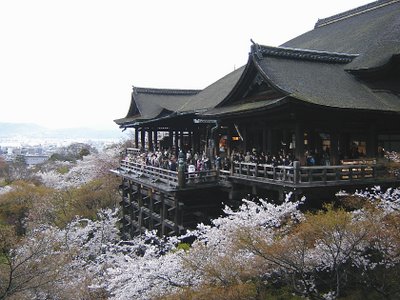
These are all around the very beautiful Kiyomizu temple. Our friend who now lives in Osaka places this temple amongst his "top 3" things to see in Japan. Good call I think.
It was a rainy day, so there is no happy blue sky in these photos. There were still lots of cherry blossoms out, though, and they look good in any light.
First pic is at the entrance:
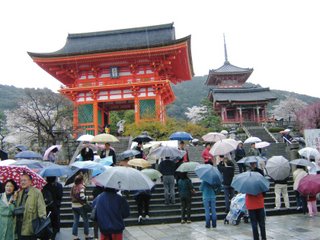
Next is looking at the balcony of the main temple building. It costs a few dollars to get in, but it is the most spectacular location (that's Kyoto in the background):
The outlook from that balcony (looking to the left in the above picture) is like this:
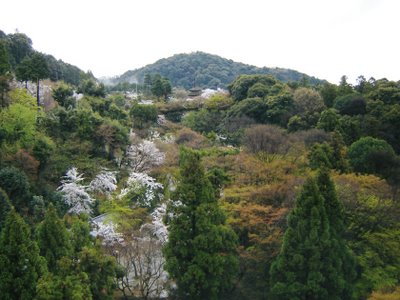
A pathway winds through those trees, but given the weather (and the company of several small children) we did not walk it.
Here's another building in the temple complex:

Wikipedia has a short but interesting little entry about this temple, for those who would like more information.
We only had one day in Kyoto, which was a pity, but it is always good to know which places you would like to re-visit and see properly.
[For some mildly geeky stuff now: all the photos are from a fairly basic 4 megapixel Sony Cybershot camera, which seems to perform quite well, even though I have never finished reading the manual and mainly leave it in "auto" mode. This trip, however, being in cold weather, did result in a high turnover in alkaline batteries - and this is in a camera that is promoted as having long battery life. Living in Brisbane, I had never realised how much the cold weather affects them.
While it seemed to me this trip that the price difference between Australia and Japan for computer stuff was somewhat less than in past visits, one thing that still seems very substantially cheaper there is camera flash memory. A 1GB Memory Stick Pro could be had for about $105, which seems awfully cheap.]
These are all around the very beautiful Kiyomizu temple. Our friend who now lives in Osaka places this temple amongst his "top 3" things to see in Japan. Good call I think.
It was a rainy day, so there is no happy blue sky in these photos. There were still lots of cherry blossoms out, though, and they look good in any light.
First pic is at the entrance:

Next is looking at the balcony of the main temple building. It costs a few dollars to get in, but it is the most spectacular location (that's Kyoto in the background):
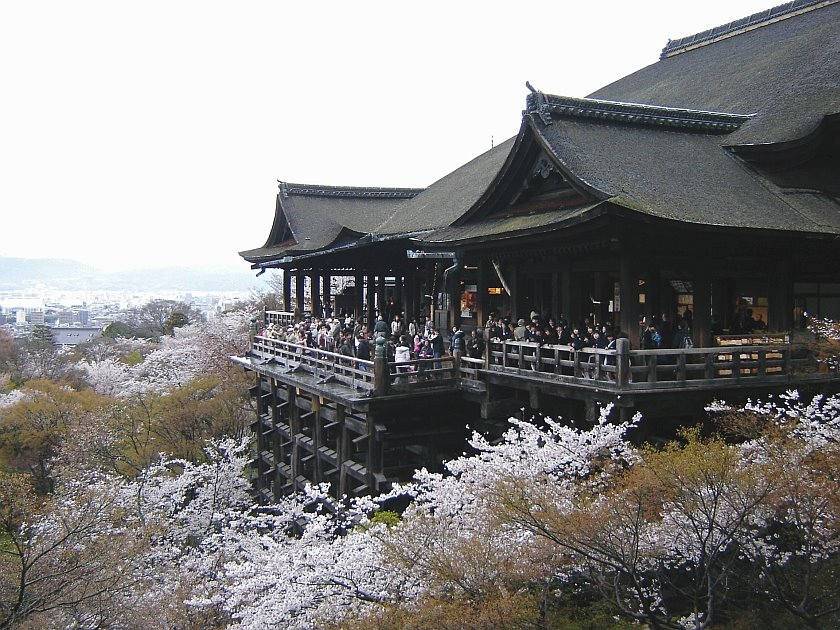
The outlook from that balcony (looking to the left in the above picture) is like this:
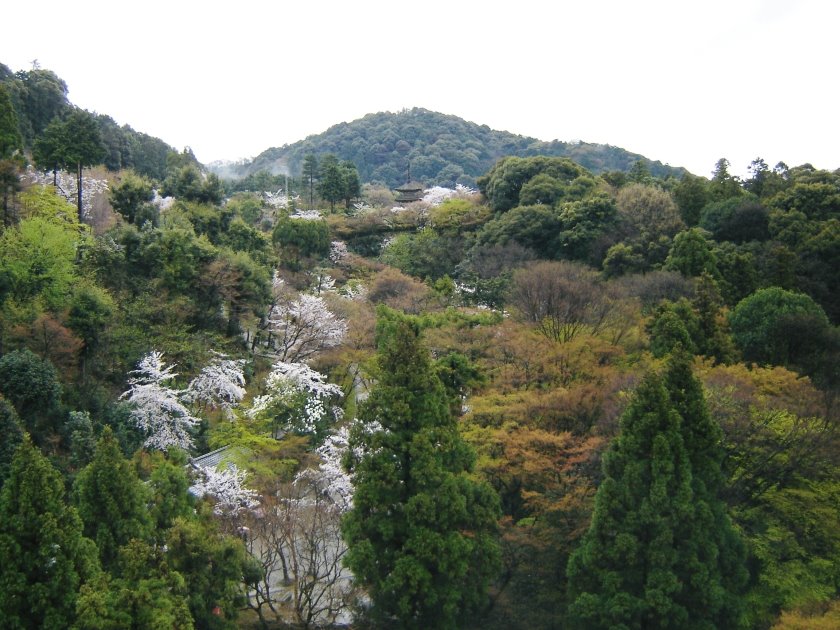
A pathway winds through those trees, but given the weather (and the company of several small children) we did not walk it.
Here's another building in the temple complex:

Wikipedia has a short but interesting little entry about this temple, for those who would like more information.
We only had one day in Kyoto, which was a pity, but it is always good to know which places you would like to re-visit and see properly.
[For some mildly geeky stuff now: all the photos are from a fairly basic 4 megapixel Sony Cybershot camera, which seems to perform quite well, even though I have never finished reading the manual and mainly leave it in "auto" mode. This trip, however, being in cold weather, did result in a high turnover in alkaline batteries - and this is in a camera that is promoted as having long battery life. Living in Brisbane, I had never realised how much the cold weather affects them.
While it seemed to me this trip that the price difference between Australia and Japan for computer stuff was somewhat less than in past visits, one thing that still seems very substantially cheaper there is camera flash memory. A 1GB Memory Stick Pro could be had for about $105, which seems awfully cheap.]
Subscribe to:
Posts (Atom)