Brain scan shows that vegetative patients can think - Britain - Times Online
I have recently criticised the type of research that MRI scans have used for (finding a "God spot" in the brain, for example.)
The story above shows a much more meaningful use - finding out whether a person in a vegatitive state has awareness or not.
Mind you, it may make withdrawal of life support decisions more difficult rather than less, but it's still worth looking into.
Friday, September 08, 2006

Clive leaps into the fray
Death becomes an excuse to savage 'elites' - now that's nasty - Opinion
The ruckus over Steve Irwin's status within the Australian psyche gets kicked along further by Clive Hamilton today.
Let's make it clear: my personal cringe factor about Irwin was pretty high, and I initially assumed (like just about everyone) that his on-screen persona was an act. However, over the years, there were so many people who had worked with him who said that he was really like that in private, that I found there was no reason to disbelieve them.
That he went on about conservation for crocodiles, when in fact they seem to have been conserved to excess in far north Australia for many years now, always struck me as a bit phoney. But the fact that he had a genuine affection for animals and a general concern for conservation of wild life habitat seems beyond doubt. His zoo is well run and seems to have a high level of comfort for the animals. (And unlike older style zoos, pushes the importance of conservation continually.) On the other hand, his attempted justification at taking his baby into a crocodile enclosure was hard to watch, and definitely the low point of his public life.
You get the picture: I don't idealise him by any stretch of the imagination. But the nature of the criticism by Greer, and Clive Hamilton, really is just over the top.
Clive, for example, thinks that Australians feel bad about his death because we feel guilty for encouraging him!:
But, if we are honest, the vitriolic attacks on Irwin's real and imagined critics are rooted in guilt. Whenever Irwin provoked a croc to open its jaws and lunge we were all excited by the prospect that the beast would get him, just as we watch car races anticipating a crash. The filmmakers understand that it is the frisson of danger that makes these shows popular. The close call is the money shot and any real injury would be replayed over and over.
Now Irwin has met the grisly end that excited us, we feel responsible.
In this turmoil of guilt and grief, what a relief it was to find a real target for bitterness in the form of Germaine Greer, whose only mistake was poor timing.
God Lord, how does anyone take Hamilton seriously.
Just maybe, Clive, people feel bad about attacks on him because absolutely everyone who had ever actually known him praised him as a nice guy, with a great enthusiasm for life, good intentions, and he leaves a young family behind.
On the other hand, Germaine (with, for example, her "I seek aboriginal consent whenever I want to return to Australia") presents as the genuine article when it comes to posturing dills.
UPDATE: Matt Price writes well about Irwin today. The Australian also talks about Irwin's land purchases here.
The ruckus over Steve Irwin's status within the Australian psyche gets kicked along further by Clive Hamilton today.
Let's make it clear: my personal cringe factor about Irwin was pretty high, and I initially assumed (like just about everyone) that his on-screen persona was an act. However, over the years, there were so many people who had worked with him who said that he was really like that in private, that I found there was no reason to disbelieve them.
That he went on about conservation for crocodiles, when in fact they seem to have been conserved to excess in far north Australia for many years now, always struck me as a bit phoney. But the fact that he had a genuine affection for animals and a general concern for conservation of wild life habitat seems beyond doubt. His zoo is well run and seems to have a high level of comfort for the animals. (And unlike older style zoos, pushes the importance of conservation continually.) On the other hand, his attempted justification at taking his baby into a crocodile enclosure was hard to watch, and definitely the low point of his public life.
You get the picture: I don't idealise him by any stretch of the imagination. But the nature of the criticism by Greer, and Clive Hamilton, really is just over the top.
Clive, for example, thinks that Australians feel bad about his death because we feel guilty for encouraging him!:
But, if we are honest, the vitriolic attacks on Irwin's real and imagined critics are rooted in guilt. Whenever Irwin provoked a croc to open its jaws and lunge we were all excited by the prospect that the beast would get him, just as we watch car races anticipating a crash. The filmmakers understand that it is the frisson of danger that makes these shows popular. The close call is the money shot and any real injury would be replayed over and over.
Now Irwin has met the grisly end that excited us, we feel responsible.
In this turmoil of guilt and grief, what a relief it was to find a real target for bitterness in the form of Germaine Greer, whose only mistake was poor timing.
God Lord, how does anyone take Hamilton seriously.
Just maybe, Clive, people feel bad about attacks on him because absolutely everyone who had ever actually known him praised him as a nice guy, with a great enthusiasm for life, good intentions, and he leaves a young family behind.
On the other hand, Germaine (with, for example, her "I seek aboriginal consent whenever I want to return to Australia") presents as the genuine article when it comes to posturing dills.
UPDATE: Matt Price writes well about Irwin today. The Australian also talks about Irwin's land purchases here.
Thursday, September 07, 2006
Australian art house puzzle
At the Movies: The Book of Revelation
That Margaret Pomeranz and David Stratton automatically increase any Australian movie's star rating by 1 is a given.
A further warning sign that a movie they review is not for me is when they start calling an art house style movie "challenging" or "brave". David Stratton's comments on the new film "The Book of Revelation" (which I was in no danger of rushing out to see anyway) are like a big warning sign saying "if you not an artiste, you will hate this":
DAVID: When I came out of this film I thought I've never seen a film like this before, a film that tackled these themes, a film that was so provocative, tantalising. And I was left in many ways puzzling, and I'm still in some ways puzzling, over what we were supposed to come away with from the film.
Margaret said:
I would have wished for just a little more grounding in reality in the look of the film, the power of the story comes from our ability to believe totally in Daniel’s journey, not as a dream, although that may be your ultimate interpretation.
What's it about?:
Daniel (Long) is a dancer who is kidnapped by three masked women. They chain him to a warehouse floor and sexually abuse him for roughly two weeks. This is graphically shown in the film and hence it’s R rating here in Australia.
The three women eventually release Daniel but the experience leaves him a changed man.
There would no odds given for my reaction being the same as this viewer's:
Generally, I thought this was convulated drivel.
Run away, people, run away!
That Margaret Pomeranz and David Stratton automatically increase any Australian movie's star rating by 1 is a given.
A further warning sign that a movie they review is not for me is when they start calling an art house style movie "challenging" or "brave". David Stratton's comments on the new film "The Book of Revelation" (which I was in no danger of rushing out to see anyway) are like a big warning sign saying "if you not an artiste, you will hate this":
DAVID: When I came out of this film I thought I've never seen a film like this before, a film that tackled these themes, a film that was so provocative, tantalising. And I was left in many ways puzzling, and I'm still in some ways puzzling, over what we were supposed to come away with from the film.
Margaret said:
I would have wished for just a little more grounding in reality in the look of the film, the power of the story comes from our ability to believe totally in Daniel’s journey, not as a dream, although that may be your ultimate interpretation.
What's it about?:
Daniel (Long) is a dancer who is kidnapped by three masked women. They chain him to a warehouse floor and sexually abuse him for roughly two weeks. This is graphically shown in the film and hence it’s R rating here in Australia.
The three women eventually release Daniel but the experience leaves him a changed man.
There would no odds given for my reaction being the same as this viewer's:
Generally, I thought this was convulated drivel.
Run away, people, run away!
Iron fertilization and global warming
ScienceDaily: Iron Critical To Ocean Productivity, Carbon Uptake
The story above notes:
A new study has found that large segments of the Pacific Ocean lack sufficient iron to trigger healthy phytoplankton growth and the absence of the mineral stresses these microscopic ocean plants, triggering them to produce additional pigments that make ocean productivity appear more robust than it really is.
As a result, past interpretations of satellite chlorophyll data may be inaccurate, the researchers say, and the tropical Pacific Ocean may photosynthesize 1-2 billion tons less atmospheric carbon dioxide than was previously thought. Global ocean carbon uptake is estimated at 50 billion tons, so the reduction in the estimate of the uptake is significant -- about 2 to 4 percent.
It doesn't talk directly about the idea of fertilizing the ocean with iron as a way of decreasing CO2 in the atmosphere, but surely this possible anti global warming method should start attracting more serious attention again soon.
I thought I mentioned this idea before here, but can't find the post now. Anyway, I have found a detailed Wikipedia entry about it which (while apparently written from the "pro" side) does explain some of the possible "cons" too.
Certainly sounds worth serious consideration (more so than shooting sulfur into the high atmosphere.)
UPDATE: Blogger search is obviously not working well at the moment, for some reason. Here's my earlier post where iron fertilization got a mention.
The story above notes:
A new study has found that large segments of the Pacific Ocean lack sufficient iron to trigger healthy phytoplankton growth and the absence of the mineral stresses these microscopic ocean plants, triggering them to produce additional pigments that make ocean productivity appear more robust than it really is.
As a result, past interpretations of satellite chlorophyll data may be inaccurate, the researchers say, and the tropical Pacific Ocean may photosynthesize 1-2 billion tons less atmospheric carbon dioxide than was previously thought. Global ocean carbon uptake is estimated at 50 billion tons, so the reduction in the estimate of the uptake is significant -- about 2 to 4 percent.
It doesn't talk directly about the idea of fertilizing the ocean with iron as a way of decreasing CO2 in the atmosphere, but surely this possible anti global warming method should start attracting more serious attention again soon.
I thought I mentioned this idea before here, but can't find the post now. Anyway, I have found a detailed Wikipedia entry about it which (while apparently written from the "pro" side) does explain some of the possible "cons" too.
Certainly sounds worth serious consideration (more so than shooting sulfur into the high atmosphere.)
UPDATE: Blogger search is obviously not working well at the moment, for some reason. Here's my earlier post where iron fertilization got a mention.
Drinking and flying
The Age Blogs: The Daily Truth / Terror on flight 555 Archives
If you enjoy stories about urgent needs to go to the toilet (and who doesn't?) then you should find this quite funny.
If you enjoy stories about urgent needs to go to the toilet (and who doesn't?) then you should find this quite funny.
Yet another Google innovation
BBC NEWS | Business | Google opens up 200 years of news
Hey, their corporate behaviour may be problematic when it comes to dealing with China (and other regimes?), but for the most part it is quite a remarkable job they are doing for the world.
Hey, their corporate behaviour may be problematic when it comes to dealing with China (and other regimes?), but for the most part it is quite a remarkable job they are doing for the world.
Conservatism and Islam, again
It's a culture guaranteed to cause a clash - Opinion - smh.com.au
Miranda Devine makes pretty much the same point as someone in The Guardian recently. (I posted about it here.)
That is, Muslim reluctance to "blend in" to Australian society may be partly put down to Australian values (in terms of sexual behaviour, especially amongst the young) taking somewhat of a dive in recent years.
Given my revulsion of all things "Big Brother" (and the puzzling idea of "raunch culture" as being some semi-legitimate form of feminism,) I have some sympathy to the argument.
As I said in the previous post, one would think that the political consequence could be that conservative parties get the Muslim vote. But the conservatives don't seem to play the politics of it the right way. (Or they simply figure the Muslim vote is not worth worrying about given the population size here.)
All very interesting.
Miranda Devine makes pretty much the same point as someone in The Guardian recently. (I posted about it here.)
That is, Muslim reluctance to "blend in" to Australian society may be partly put down to Australian values (in terms of sexual behaviour, especially amongst the young) taking somewhat of a dive in recent years.
Given my revulsion of all things "Big Brother" (and the puzzling idea of "raunch culture" as being some semi-legitimate form of feminism,) I have some sympathy to the argument.
As I said in the previous post, one would think that the political consequence could be that conservative parties get the Muslim vote. But the conservatives don't seem to play the politics of it the right way. (Or they simply figure the Muslim vote is not worth worrying about given the population size here.)
All very interesting.
Wednesday, September 06, 2006
The Empire staggers on
The Japan Times Online - Princess Kiko gives birth to a boy
So, finally there is a male grandchild for the Emperor in the Japanese royal family, so the pressure is off Crown Princess Masako to have to have another child. (Her story of stress caused by marrying into a suffocating royal lifestyle is a bit like that of Princess Diana; apart from Masako being academically very smart, successful at a challenging career before marriage, and having a husband who supports her still. OK, almost no resemblance at all really.)
A brief history of the problems caused by having only male heirs to the emperor is set out in this article. Some extracts:
Emperor Meiji (1852-1912) had no male heir with his wife but had 15 children, including five males, with five concubines. Of the five, four died before reaching adulthood, and the one who survived became emperor.
Here's a photo of Meiji. Doesn't look too happy; maybe choosing which concubine to sleep over with gets you down. (Or maybe it's just that it wasn't fashionable in that century to smile for photos.)
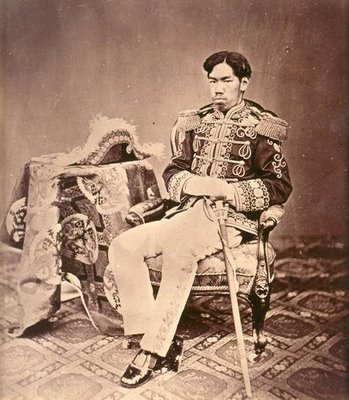
Back to the article:
But Emperor Hirohito (1901-1989), known posthumously as Emperor Showa, refused to have a concubine, which led to the postwar abolition of the system. According to Otabe, Emperor Showa wanted to have a close family atmosphere such as might be found in a Western royal family.
And how's this for a let down in your status:
Soon after Japan's 1945 defeat in World War II, 11 families on the collateral line, which served as a safety net to produce male heirs for the Imperial family, lost their Imperial status and became ordinary citizens.
I wonder what happened to those families. Down to the unemployment office?
So, finally there is a male grandchild for the Emperor in the Japanese royal family, so the pressure is off Crown Princess Masako to have to have another child. (Her story of stress caused by marrying into a suffocating royal lifestyle is a bit like that of Princess Diana; apart from Masako being academically very smart, successful at a challenging career before marriage, and having a husband who supports her still. OK, almost no resemblance at all really.)
A brief history of the problems caused by having only male heirs to the emperor is set out in this article. Some extracts:
Emperor Meiji (1852-1912) had no male heir with his wife but had 15 children, including five males, with five concubines. Of the five, four died before reaching adulthood, and the one who survived became emperor.
Here's a photo of Meiji. Doesn't look too happy; maybe choosing which concubine to sleep over with gets you down. (Or maybe it's just that it wasn't fashionable in that century to smile for photos.)
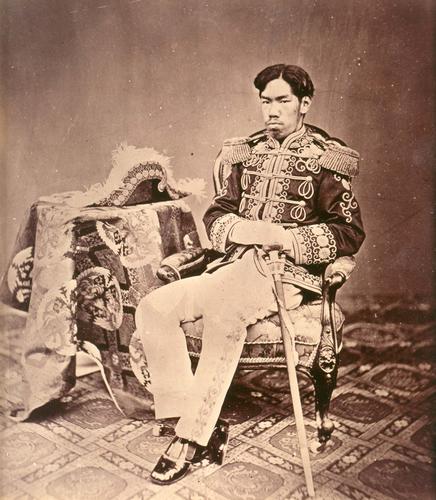
Back to the article:
But Emperor Hirohito (1901-1989), known posthumously as Emperor Showa, refused to have a concubine, which led to the postwar abolition of the system. According to Otabe, Emperor Showa wanted to have a close family atmosphere such as might be found in a Western royal family.
And how's this for a let down in your status:
Soon after Japan's 1945 defeat in World War II, 11 families on the collateral line, which served as a safety net to produce male heirs for the Imperial family, lost their Imperial status and became ordinary citizens.
I wonder what happened to those families. Down to the unemployment office?
Cosmology time
ScienceDaily: Big Bang's Afterglow Fails Intergalactic 'Shadow' Test
Interesting story with unclear implications. Do other scientists think it is a measurement problem? If not, what could explain it?
Interesting story with unclear implications. Do other scientists think it is a measurement problem? If not, what could explain it?
Australian academics need not apply
BBC NEWS | Middle East | Iran's liberal lecturers targeted
From the above:
Iranian President Mahmoud Ahmadinejad has called for liberal and secular university lecturers to be removed.
He told a group of students that they should organise campaigns to demand that the liberal teachers be sacked.
Mr Ahmadinejad said it was difficult to alter secular influences that had been in place in Iran for 150 years, but added that such a change had begun.
The move echoes campaigns of the 1980s, when hundreds of liberal university teachers and students were sacked....
Last year, an ayatollah was appointed to run Tehran University, sparking protests by students.
From the above:
Iranian President Mahmoud Ahmadinejad has called for liberal and secular university lecturers to be removed.
He told a group of students that they should organise campaigns to demand that the liberal teachers be sacked.
Mr Ahmadinejad said it was difficult to alter secular influences that had been in place in Iran for 150 years, but added that such a change had begun.
The move echoes campaigns of the 1980s, when hundreds of liberal university teachers and students were sacked....
Last year, an ayatollah was appointed to run Tehran University, sparking protests by students.
Scaring the scientists
Scientists angered by telephone telepathy study - Britain - Times Online
A fascinating story from the Times about scientists being upset that pro telepathy research was presented at a science forum without adequate scepticism tagging along.
I like this bit in particular:
Sir Walter, a geneticist and cancer researcher, said: "I’m amazed that the BA has allowed it to happen in this way. You have got to be careful not to suppress ideas, even if they are beyond the pale, but it’s quite inappropriate to have a session like that without putting forward a more convincing view."
The "more convincing view" is presumably that telepathy is obviously impossible.
Read the article for details of the research. It's interesting.
A fascinating story from the Times about scientists being upset that pro telepathy research was presented at a science forum without adequate scepticism tagging along.
I like this bit in particular:
Sir Walter, a geneticist and cancer researcher, said: "I’m amazed that the BA has allowed it to happen in this way. You have got to be careful not to suppress ideas, even if they are beyond the pale, but it’s quite inappropriate to have a session like that without putting forward a more convincing view."
The "more convincing view" is presumably that telepathy is obviously impossible.
Read the article for details of the research. It's interesting.
More scepticism on emissions trading
Emissions trading is not the answer - Opinion - theage.com.au
Four Corners last week was all about this too, and there are many small "eco" companies in Australia making money out of trading schemes that critics say are of dubious efficiency.
As with wind power, I suspect that the true effect of such schemes is to give false confidence that something effective is being done.
Four Corners last week was all about this too, and there are many small "eco" companies in Australia making money out of trading schemes that critics say are of dubious efficiency.
As with wind power, I suspect that the true effect of such schemes is to give false confidence that something effective is being done.
Tuesday, September 05, 2006
One question
BBC NEWS | Health | Autism risk linked to older dads
This article indicates that the rate of autism in children rises quite sharply when the father is over 40.
This seems an easily identified trend. Why is it only coming to attention now?
This article indicates that the rate of autism in children rises quite sharply when the father is over 40.
This seems an easily identified trend. Why is it only coming to attention now?
Some detail on the prisoners
BBC NEWS | Middle East | Who are the Mid-East prisoners?
I've been waiting some time for the details in this article. Surprisingly, there really are only a handful of Lebanese prisoners involved.
I've been waiting some time for the details in this article. Surprisingly, there really are only a handful of Lebanese prisoners involved.
On conservation and conservatism
Niall Ferguson: Conservative Doesn't Mean Anti-Conservationist - Los Angeles Times
This column makes some valid points:
The idea that there is something fundamentally unconservative about protecting the environment is, of course, a canard. At the very core of British conservatism since the time of Benjamin Disraeli has been a romantic reverence for the land and a desire to mitigate the damage done by industrialization. It was Marx and Engels who sneered at "the idiocy of rural life." It was Lenin and Stalin whose mania for smoke-belching steelworks turned huge tracts of Russia into toxic wastelands.
It's worth reading it all.
This column makes some valid points:
The idea that there is something fundamentally unconservative about protecting the environment is, of course, a canard. At the very core of British conservatism since the time of Benjamin Disraeli has been a romantic reverence for the land and a desire to mitigate the damage done by industrialization. It was Marx and Engels who sneered at "the idiocy of rural life." It was Lenin and Stalin whose mania for smoke-belching steelworks turned huge tracts of Russia into toxic wastelands.
It's worth reading it all.
Subscribe to:
Posts (Atom)