Monday, May 04, 2015

Good

US 'will not fund research for modifying embryo DNA' - BBC News

As it says at the end:

Dr Collins, who was also a key player in the Human Genome Project, released a statement saying: "The concept of altering the human germline in embryos for clinical purposes has been debated over many years from many different perspectives, and has been viewed almost universally as a line that should not be crossed.

"Advances in technology have given us an elegant new way of carrying out genome editing, but the strong arguments against engaging in this activity remain.

"These include the serious and unquantifiable safety issues, ethical issues presented by altering the germline in a way that affects the next generation without their consent, and a current lack of compelling medical applications."

Dr Marcy Darnovsky, from the Center for Genetics and Society in the US, argued: "There is no persuasive medical reason to manipulate the human germline because inherited genetic diseases can be prevented using embryo screening techniques, among other means.

"Is the only justification for trying to refine germline gene editing the prospect of so-called enhancement?"

Sunday, May 03, 2015

Music video time

So, it seems to have been around for 6 months, but I only recently saw this simple but amusing video clip from George Ezra (and friend):


South East Queensland and rainfall intensity: so this is what global warming looks like?

Rainfall statistics can be analysed any number of ways, and it seems to me that intensity of rainfall is one of the things that has become very important but is being investigated a bit too slowly. 

My strong, strong hunch is, however, that at least South East Queensland (if not other parts of the country) is now clearly undergoing the type of intensification of rainfall that was always expected under global warming and is suffering badly for it.  

Last Friday's rainfall was deadly, remarkable, and unseasonal across most of the South East, but particularly just to the north of Brisbane.   It reminded me of the intensity of rainfall that led to the Lockyer Valley disasters in the 2011 floods - where all forms of normal drainage (and Brisbane's drainage is built to sub-tropical standards) is so overwhelmed  that the flood is disastrously out of the norm in terms of suddenness of onset.    

But I'm not sure whether we are getting a good analysis of this in a timely fashion.

See, while it's interesting that a daily rainfall total might be a record for the time of year, I don't know that this captures the importance of the hourly intensity of rainfall adequately.

There may well be some academic papers on this around the place, but if so, it seems to me it is not attracting adequate publicity via the Bureau of Meteorology.  (Although I think the public knows something is going on.)

Alternatively, I could be wrong and the intensity is not out of the norm in historic terms.   I very much doubt that is the case, however. 

Update:  my point was alluded to in this article in The Conversation (my bold):
The problem is: “How can we estimate the frequency of rare extreme events from observations, or events that we are yet to witness, such as a 1-in-500-year event?” To solve this problem we need to model the data and use it to extrapolate outside our observations.
When we’re talking about flash floods and extreme rainfall, we want to know the highest rainfall in a single day or in a few hours, rather than total rainfall over longer periods such as a month or year. The best long-term rainfall observations are for daily rainfall.


Friday, May 01, 2015

1930's naughtiness update

Last week, on a whim, I was using Trove to find early Australian newspaper references to nudism, and turned up a series of stories from 1929 and into the 30's indicating the interest the topic attracted in Australia and the US.  

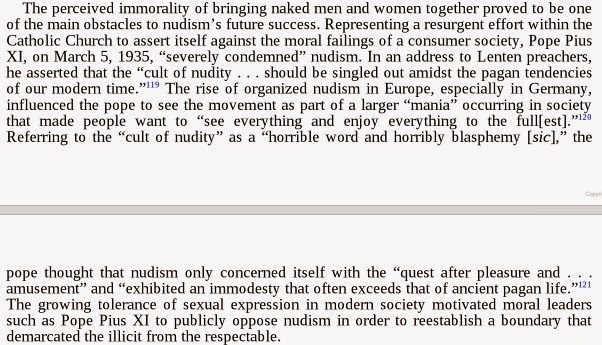
Today I Googled to see if a Pope had ever weighed in on the matter, and indeed, a 1930's Pope (Pius XI) did*:


That lecture seems a little late - the newspaper clippings I had in my previous post show that in 1932 and 1933 (the latter after Hitler had taken power) Germany was already banning the "cult of nudity".

But more interesting was an extract I found from an article about the future Pius XII, the wartime Pope, before he took on the top job:
In 1926, Pacelli was Vatican ambassador, or nuncio, to Germany, and he alerted Rome to the “moral perils” confronting Catholics in the freedoms of Weimar democracy. “Perhaps the thorniest problem for religious life and pastoral care,” he wrote, was Germans’ propensity to use contraceptives and have abortions. He railed against the “perverse propaganda of nudism,” and against the Tango, which was “of very evil origin.” “Any gymnastics wear for girls,” he continued, “that proactively accentuates their shapes or that is inappropriate for the female character must be avoided.”
Germany had just experienced the greatest cataclysm since the seventeenth century, and Berlin was a place where impoverished shopkeepers queued at soup kitchens while disfigured veterans asked for handouts on street corners. Working class families lived six to a room. But what bothered Pacelli were girls’ gym clothes. Pleasure and license posed a danger to eternal salvation, but poverty did not.
I didn't realise the concern with which the Tango was held in the early 20th century.  

In an interview published three years ago, the then Cardinal Bergoglio said of the tango, ‘I like it a lot. It’s something that comes from within me.’ He showed great knowledge of the tango’s history and of its most famous performers, especially mentioning Ada Falcón, an Argentine tango singer and actress of great wealth and celebrity who, 60 years before her death in 2002, suddenly gave up a life of luxury and romantic turbulence to live in seclusion in Buenos Aires.
Times change...

* from "Naked:  A Cultural History of American Nudism", which seems to have just been published this year.

What is it about the eyes?

Through This Chemical Loop, Dogs Win Our Hearts – Phenomena: Not Exactly Rocket Science

Well, given our dog's death last weekend, it seems apt to post about this recent story, which reported both humans and dogs getting an oxytocin boost from even just looking at each other.

This puts me in mind of the "how to fall in love" story from earlier this year - which ends with silent staring into each other's eyes.

I'm finding it rather odd that it is eye gazing in particular which seems to have powerful binding effects.  

Peak superhero?

Hmmm.   Of course, I've been hoping for this for years, and with the amount of money they make, there is really no reason for optimism.   But - with Avengers: Age of Ultron getting a relatively modest 73% on Rottentomatoes, I at least get the feeling that critically, we may have reached, and passed Peak Superhero.

The common theme amongst those critics who are underwhelmed is that the climatic, city wide destruction fights are all looking very same-y these days.   How true. (Well, I think, since I only get to view them in bits in pieces when they show up on free to air TV a few years later.)

Anthony Lane writes one of the wittiest reviews of the movie, with sections like this:
The story begins with a fight in a forest and ends with a fight in a city that floats in midair. In between, there is a fight in a castle, a fight on a freeway, and a fight in the wake of a cocktail party. The loudest fight is a tussle between Iron Man and the Hulk, which is part of a cunning scheme to rip the Avengers apart. Bring it on, I say. It has something to do with dreams, which are triggered by a blast of hypno-magic from the Scarlet Witch (Elizabeth Olsen), a new player in the game; each hero is disabled by harsh visions, tailored to touch upon his or her worst fears. I vaguely hoped that Thor would find himself holding hands with Hello Kitty, but no joy.

The experience of watching “Avengers: Age of Ultron”—which is not just long but, in Iron Man’s words, “Eugene O’Neill long”—runs as follows. First, you try to understand what the hell is going on. Then you slowly realize that you will never understand what is going on. And, last, you wind up with the distinct impression that, if there was anything to understand, it wasn’t worth the sweat.
By the way, showing that he's not just a humourist, Anthony Lane writes well about Gallipoli in another piece inspired by ANZAC Day (and the movie "The Water Diviner".) 

Gerard backed a loser

Dissembling with graphs: Murry Salby edition | Musings on Quantitative Palaeoecology

Further to my suggestion that Gerard Henderson retire, remember that it was his Sydney Institute which first gave a public airing of Murry Salby's late life crisis in which he had decided that CO2 had virtually nothing to do with increasing global warming in the 20th century.

Of course, most in Gerard's audience couldn't really follow what Salby was arguing; those who read climate blogs saw that all other scientists immediately recognised that his argument made no sense at all. He lost his Australian job before it had really started, over some dispute or other about its terms. I see that Salby didn't even make into the IPA's latest bit of effort to promote crap about climate change. 

Anyhow, just in case anyone thought he was a misunderstood genius, have a look at the post above for some stunning examples of deceptive material he now presents at talks that he is apparently still giving. Amazing.

Thursday, April 30, 2015

A fast food and diet observation

It seems years since I've eaten chicken pieces from KFC.  The occasional burger, yes.  But pieces of chicken, no.

But two nights this week, I've eaten cold KFC chicken.  (I got home late, that's all.)

I found it nicer than I remembered.  Much nicer.   Not very greasy, really.  Especially as it was cold.  I sometimes think I prefer cold chicken to hot.

It might also be partly because of being on a 5-2 diet.  It seems to heighten appreciation for the taste of food, even on a non fasting day.


Celebrating brain injury

I entirely concur with the bandanna clad one (Peter FitzSimons, if you didn't know), even though I rarely read anything he writes, in his article about boxing.

That is, once you know the intrinsically damaging nature of boxing as a sport, how can you intellectually consider it as a endeavour worthy of support? 
Chronic traumatic brain injury (CTBI) associated with boxing occurs in approximately 20% of professional boxers.
  The repeated head blows sustained by fighters during their battles link to slower cognitive processing speeds and smaller volumes of certain brain parts.
Not sure that I would ban it if I were Benevolent Ruler of the World.   Perhaps pay for an advertising  campaign designed to shame people out of supporting the sport, though.   Or put money into developing exoskeleton boxing.  (I have my doubts that people are ever going to get sufficient thrill out of watching boxing robots, like in that silly Real Steel movie.  Maybe if they build in blood bags ready to be splattered?)  But what if there's a human in a suit designed to prevent a head taking a full blow?   But why am I worried about satisfying the desire for biffo anyway?   It's all something to do with testosterone and evolutionary biology I suppose, and I feel I need to accept that in some fashion or other.  

OK, here's a compromise:  professional boxing allowed, but it's mandated by law that it has to end with a bonobo style, bonding-despite-the-fight-we-just-had, same-sex love in between the competitors before they leave the ring.

There, the problem of professional boxing solved.   (I'm sure Jason Soon will be impressed.)

Yet more lucid, convincing, Krugman

The austerity delusion | Paul Krugman | Business | The Guardian

Yet another good, long, read from Krugman on austerity, Keynesian and anti-Keynesian forces, and England in particular.    (The way The Guardian presents the article graphically is pretty neat too.)

I especially find this section pretty convincing, especially when you read the never ending defence of corporations and businesses (along the lines "how dare anyone accuse Google or Apple of not paying enough tax!") that comes from the IPA associated economists:

Beyond that lies a point made most strongly in the US by Mike Konczal of
the Roosevelt Institute: business interests dislike Keynesian economics
because it threatens their political bargaining power. Business leaders
love the idea that the health of the economy depends on confidence,
which in turn – or so they argue – requires making them happy. In the US
there were, until the recent takeoff in job growth, many speeches and
opinion pieces arguing that President Obama’s anti-business rhetoric –
which only existed in the right’s imagination, but never mind – was
holding back recovery. The message was clear: don’t criticise big
business, or the economy will suffer.

But this kind of argument loses its force if one acknowledges that job
creation can be achieved through deliberate policy, that deficit
spending, not buttering up business leaders, is the way to revive a
depressed economy. So business interests are strongly inclined to reject
standard macroeconomics and insist that boosting confidence – which is
to say, keeping them happy – is the only way to go.

Monday, April 27, 2015

Saturday, April 25, 2015

A pet's passing

In 2005 in the early days of this blog, I posted this photo of our sweet natured dog, Pochi:


She quite suddenly took ill on Thursday night and died peacefully at home this afternoon, aged close to 16.  The only pet our children have know (we got her before our eldest was born), her sudden departure is being keenly felt tonight...

A bit weird

Liquid mercury found under Mexican pyramid could lead to king's tomb | World news | The Guardian

Time to retire, Gerard

Gerard Henderson's weekly, self-indulgent bore sessions now appear (and not behind a paywall) at The Australian.  This week he gets to re-visit such compelling issues as an ABC Chairman 40 years ago writing a letter to the Sydney Morning Herald in which he defended the airing of a documentary program about pederasty.

Henderson interprets the letter as being a call for sympathetic understanding of pederasty, but it's a bit of culture war cherry picking if ever there was one, given how the letter goes on to refer to uncivilised behaviour.  How outrageous, says Gerard, that the current ABC Chairman refuses to apologise for this.  If it had been a Catholic Bishop who had done this, how different things would be.  (The implication - "everyone has to agree with how I read the letter.")

I think it's clear why Henderson raises this again this week:  it's one of the near routine, and pathetic, attempts at a counterattack you see from the Right wing culture warriors any week in which someone from the Churches has come out badly in the Royal Commission into Institutional Child Abuse.  In this case, a retired Catholic Bishop who apologises for taking 3 years to stop a pedophile priest from having contact with children, and then writing a character reference for him.   Rather more dire, by a magnitude or three, than an academic head of the national broadcaster saying a documentary about pederasty was not intended to offend.  

Gerard is scrapping the very bottom of the faux moral equivalence outrage barrel on this one.  He really ought to retire, it's becoming so embarrassing some of the lines he chooses to pursue.   

He also has a characteristic that Andrew Bolt and a host of other Right wing commentators now routinely display:   they don't just spend time trying to explain why a particular take on a matter is wrong; they devote a huge amount of effort to complaining about how people - the media, celebrities, academics - don't agree with them.

It's boring and tedious, and I mainly put it down to a "chip on the shoulder" that they have developed about not being able to convince scientists, academia and sufficient politicians that climate change is a non-issue.

For ANZAC Day

I see that the Queensland State Library has been putting up some ANZAC Day material for the 100th anniversary, including some good, short videos.  I liked this one:


Update:  there's also a remarkably good set of World War 1 photos (including some from Gallipoli) up at The Atlantic.

The only reservation I have about them is the way black and white photos tend to make the past look more distant that it really is...