Do we Always Practice What we Preach? Real Vampires’ Fears of Coming out of the Coffin to Social Workers and Helping Professionals | Critical Social Work - University of Windsor
I may be sounding increasingly left wing lately, but social workers always have been, and remain, a bit of a worry.
Tuesday, July 14, 2015

Gina re-visited
Really, as her children asked, why did Australian Story bother with a two parter on Gina Rinehart, as it seemed to add nothing to what we didn't already know about her family history? It certainly was used by Gina for an attempt at some better PR, but whose idea was it to do such a lightweight update on her lifestory at this particular time?
Anyway, the show did amuse me for a few reasons:
* I had forgotten about her father's crackpot hope that H bombs could be used to help develop Northern Australia even faster, and it was funny to watch the ever soft voiced Gina talking to family friend Ed Teller about this idea from an aircraft full of the white shoe brigade.
* the show also mentioned her Dad's involvement with the deadly blue asbestos mine at Wittenoom. It didn't mention this:
In short, despite the attempted gloss, the show reminded the careful viewer that nutty Right wingers bent on making money can be freaking dangerous.
Thanks ABC, I guess...
Update: In answer to Tim's question in comments - he definitely thought they were good for creating instant deep water harbours, but really, what didn't Lang think H bombs were good for?:

Anyway, the show did amuse me for a few reasons:
* I had forgotten about her father's crackpot hope that H bombs could be used to help develop Northern Australia even faster, and it was funny to watch the ever soft voiced Gina talking to family friend Ed Teller about this idea from an aircraft full of the white shoe brigade.
* the show also mentioned her Dad's involvement with the deadly blue asbestos mine at Wittenoom. It didn't mention this:
...according to his friend John Singleton, had a party trick of spreading asbestos on his Weet-Bix to prove the point that asbestos wasn't deadly.* it did make a brief mention of Gina opposing the Labor carbon "tax", although it made no mention of her actively funding climate change fake skepticism.
Lang had discovered asbestos in the Pilbara in the 1950s and went to his grave swearing that asbestos wasn't dangerous.
In short, despite the attempted gloss, the show reminded the careful viewer that nutty Right wingers bent on making money can be freaking dangerous.
Thanks ABC, I guess...
Update: In answer to Tim's question in comments - he definitely thought they were good for creating instant deep water harbours, but really, what didn't Lang think H bombs were good for?:
Some interesting answers
Reddit, Why DON'T you smoke weed? : AskReddit
I don't look around Reddit often, but I was Googling for some links about rats on cannabis (being inspired by the previous post about meth rats) when I found a link to this recent Reddit thread.
Given that Reddit is not exactly a forum where you are likely to get too many overly judgemental contributors, it was interesting to see how many readers complain about how cannabis has never agreed with them (usually due to it increasing anxiety, causing paranoia, and/or panic attacks) yet their smoking friends keep on trying to convince them to smoke their way through those problems. Yes, that would be annoying.
This is the reason why I am always leery about the too simple comparison between cannabis and alcohol. Cannabis seems to have a very sudden and strong unpleasant psychoactive effect on some people in a way that (as far as I am aware) is simply not comparable to the effect of a moderate consumption of alcohol. (What's a fair comparison here? I would guess at, say, two standard drinks in one hour as being somewhat akin to one mid strength joint? Not that I know how much cannabis users typically use in one session: just my guesswork here.)
It just seems to me a qualitatively different thing if it can have a paranoia increasing effect even in modest quantities; that sensation is never desired and indicates something serious going on in the brain in a way that I can't imagine is the same for anyone having a modest hit of alcohol. Sure, some people get drunk quicker than others, but even then the sensation of moderate drunkenness per se is rarely distressing. "Two pot screamers" are said to exist; I can't remember ever knowing one.
I know what many will say - the proportion of people who are very sensitive to distressing feelings from cannabis is small, and why punish the majority by criminalisation of something that most adults can handle and desire.
All true, but don't come back to me with the "alcohol causes more harm across society" line. That's an apple and oranges comparison that I've never found compelling. Sure, on a population basis, the overuse of one drug may make it a societal problem; but if you want a fair comparison as between drugs, then the true test would be more like "what is a society with cannabis use as widespread and frequent as alcohol like, compared to one where alcohol is the only abused drug." Both drugs are capable of abuse; having one legal allows for the human desire to have mood altered pleasantly by a drug potentially dangerous and life damaging in overuse; having more than one potentially dangerous drug available for that purpose is indulgent. (Very un-libertarian of me, but then libertarians with any brains are presumably conflicted about how far Russia should go in dealing with a chronic alcohol problem that clearly has economic effects on the entire country. We each draw our lines in different places.)
As for the ultimate effect of the legal cannabis experiment in the US on a society scale - I still say we will have to wait many years to be sure of that.
Certainly, countries known for their high cannabis use don't exactly seem to be the economic powerhouses you would want to emulate. (Here's a story about Uruguay's legalisation experiment, by the way.)
I don't look around Reddit often, but I was Googling for some links about rats on cannabis (being inspired by the previous post about meth rats) when I found a link to this recent Reddit thread.
Given that Reddit is not exactly a forum where you are likely to get too many overly judgemental contributors, it was interesting to see how many readers complain about how cannabis has never agreed with them (usually due to it increasing anxiety, causing paranoia, and/or panic attacks) yet their smoking friends keep on trying to convince them to smoke their way through those problems. Yes, that would be annoying.
This is the reason why I am always leery about the too simple comparison between cannabis and alcohol. Cannabis seems to have a very sudden and strong unpleasant psychoactive effect on some people in a way that (as far as I am aware) is simply not comparable to the effect of a moderate consumption of alcohol. (What's a fair comparison here? I would guess at, say, two standard drinks in one hour as being somewhat akin to one mid strength joint? Not that I know how much cannabis users typically use in one session: just my guesswork here.)
It just seems to me a qualitatively different thing if it can have a paranoia increasing effect even in modest quantities; that sensation is never desired and indicates something serious going on in the brain in a way that I can't imagine is the same for anyone having a modest hit of alcohol. Sure, some people get drunk quicker than others, but even then the sensation of moderate drunkenness per se is rarely distressing. "Two pot screamers" are said to exist; I can't remember ever knowing one.
I know what many will say - the proportion of people who are very sensitive to distressing feelings from cannabis is small, and why punish the majority by criminalisation of something that most adults can handle and desire.
All true, but don't come back to me with the "alcohol causes more harm across society" line. That's an apple and oranges comparison that I've never found compelling. Sure, on a population basis, the overuse of one drug may make it a societal problem; but if you want a fair comparison as between drugs, then the true test would be more like "what is a society with cannabis use as widespread and frequent as alcohol like, compared to one where alcohol is the only abused drug." Both drugs are capable of abuse; having one legal allows for the human desire to have mood altered pleasantly by a drug potentially dangerous and life damaging in overuse; having more than one potentially dangerous drug available for that purpose is indulgent. (Very un-libertarian of me, but then libertarians with any brains are presumably conflicted about how far Russia should go in dealing with a chronic alcohol problem that clearly has economic effects on the entire country. We each draw our lines in different places.)
As for the ultimate effect of the legal cannabis experiment in the US on a society scale - I still say we will have to wait many years to be sure of that.
Certainly, countries known for their high cannabis use don't exactly seem to be the economic powerhouses you would want to emulate. (Here's a story about Uruguay's legalisation experiment, by the way.)
Monday, July 13, 2015
In rat research news...
Researchers test meth-addicted rats in a rodent casino
It's kind of what you would expect, I suppose, but this is what they found:
It's kind of what you would expect, I suppose, but this is what they found:
Using a gambling test, we demonstrated that methamphetamine
(METH)-treated rats chose a high-risk/high-reward option more frequently
and assigned higher value to high returns than control rats, suggestive
of changes in decision-making choice strategy.
Liking the Lollipop
The Samsung TabS I use got its software upgrade to Lollipop (Android 5.0.2) on the weekend.
I'm not a giant nerd about these matters, but I have to say, the new operating system seems to have sped up the way the tablet operates in a very pleasing way.
Not sure that I've learned to love the keyboard yet, but I think I'm starting to like that too.
I also finally got around to paying all of $4 to get PicSay Pro. (I usually use the lite version to make the comic book speaking boxes in photos.) It's a very comprehensive set of photo fiddling tools, and has very a high positive rating on Google Play which is well deserved.
I'm not a giant nerd about these matters, but I have to say, the new operating system seems to have sped up the way the tablet operates in a very pleasing way.
Not sure that I've learned to love the keyboard yet, but I think I'm starting to like that too.
I also finally got around to paying all of $4 to get PicSay Pro. (I usually use the lite version to make the comic book speaking boxes in photos.) It's a very comprehensive set of photo fiddling tools, and has very a high positive rating on Google Play which is well deserved.
The high attrition rate detailed
What Happens to Sperm Once They're Inside a Woman?
I didn't go looking for this post, honest. But it does give an interesting explanation of the high attrition rate of sperm cells at each waypoint, so to speak, on the way to the egg.
I didn't go looking for this post, honest. But it does give an interesting explanation of the high attrition rate of sperm cells at each waypoint, so to speak, on the way to the egg.
Pompeii finally viewed
I mentioned recently that I had recorded but not watched Mary Beard's doco on Pompeii. (I thought it was a short series, but it appears it was a single show.)
I watched it with my son last night, who was surprised to learn about all the sex and rude bits on open display around the town.
Anyway, it was really very good, and I see that it is on Youtube for viewing too. Hope Mary, and the BBC, don't mind.
I watched it with my son last night, who was surprised to learn about all the sex and rude bits on open display around the town.
Anyway, it was really very good, and I see that it is on Youtube for viewing too. Hope Mary, and the BBC, don't mind.
Big wind, indeed
Wind power generates 140% of Denmark's electricity demand | Environment | The Guardian
Infrasound worrier David Leyonhjelm has taken to sarcastically calling the wind power industry "Big Wind".
I take it he saw this story.
True, Denmark has a population of only 5.6 million, and is particularly windy, but still, a modern industrial country getting all of its power that way seems surprising.
In a more general sense, I see that the country is aiming for half of its power from renewables by 2020 (and completely "green" in power by 2050.)
The other interesting wind power story is to do with South Australia, In fact, I see that the State is ambitious in targets too (although it is aiming to achieve this through a combination of solar and wind):
Infrasound worrier David Leyonhjelm has taken to sarcastically calling the wind power industry "Big Wind".
I take it he saw this story.
True, Denmark has a population of only 5.6 million, and is particularly windy, but still, a modern industrial country getting all of its power that way seems surprising.
In a more general sense, I see that the country is aiming for half of its power from renewables by 2020 (and completely "green" in power by 2050.)
The other interesting wind power story is to do with South Australia, In fact, I see that the State is ambitious in targets too (although it is aiming to achieve this through a combination of solar and wind):
Interestingly, the South Australia government has already exceeded its target of generating 33 per cent of the state’s electricity needs from renewables (over a full year), and has now set a 50 per cent target by 2025. In reality, it will likely reach that mark well before that, particularly if the Ceres wind farm and the Hornsdale wind farm are built. It could even be the first mainland state towards 100 per cent renewables over the whole year.Wind power is performing better than expected, it seems.
Yet more "we need babies" talk
Japan should re-examine the idea of marriage to help spur a baby boom | The Japan Times
Yet more talk here about the Japanese population decline and the need to be "creative" in finding ways to encourage reproduction.
I did learn something new about France along the way (I thought it was perhaps a bit more "traditional" than this, given it managed some decent sized protests about gay marriage):
Yet more talk here about the Japanese population decline and the need to be "creative" in finding ways to encourage reproduction.
I did learn something new about France along the way (I thought it was perhaps a bit more "traditional" than this, given it managed some decent sized protests about gay marriage):
For instance, one of the biggest social obstacles is the institution of
marriage, which sounds counterintuitive, since everywhere marriage is
considered a prerequisite for having children. But it doesn’t need to
be. France has one of the highest birthrates in the developed world, and
in 2006 the majority of new mothers there were not married.
In Japan, the birthrate for unmarried women is almost zero, because the
taboo against having children out of wedlock is effective.
Trump and the base
Republican Base and Donald Trump — WHINOS Are Frustrated and Choosing Foolishly | National Review Online
Heh. The apparent popularity of nutty Trump with the Republican "base" is upsetting some other Republicans.
Heh. The apparent popularity of nutty Trump with the Republican "base" is upsetting some other Republicans.
Premature praise
Grindr – The app that has become part of the sexual health solution | Croakey
Interesting report here of a study of the use of sexual health messaging on the Grindr app, which most people think has likely increased the amount of unsafe sex amongst men by making casual "hook ups" easier to organise.
The report seems to say that because a lot of people using the app did go to the site with more information, it was a success.
What it doesn't (and probably can't) deal with is the question of whether more men got tested as a result, or were dissuaded from their intended recreational sex, or were convinced to have the sex but only safe sex. (And, I note, with syphilis in particular, which this campaign seems to have been about, safe sex means no unprotected oral, which one suspects is a particularly "hard sell" in the gay community.)
So, I wouldn't getting too full of praise for it being a "sexual health solution."
Interesting report here of a study of the use of sexual health messaging on the Grindr app, which most people think has likely increased the amount of unsafe sex amongst men by making casual "hook ups" easier to organise.
The report seems to say that because a lot of people using the app did go to the site with more information, it was a success.
What it doesn't (and probably can't) deal with is the question of whether more men got tested as a result, or were dissuaded from their intended recreational sex, or were convinced to have the sex but only safe sex. (And, I note, with syphilis in particular, which this campaign seems to have been about, safe sex means no unprotected oral, which one suspects is a particularly "hard sell" in the gay community.)
So, I wouldn't getting too full of praise for it being a "sexual health solution."
Nothing has changed
Some careless media reporting out there, taking its cue from a poorly drafted press release, about the prospects for a "mini ice age" sooner rather than later, which of course would be grabbed with glee by people who refuse to read widely on global warming. (And by "reading widely" I mean read what science says, apart from a handful of do-nothing/denialists sciecntists.)
Here is the correction on the latest story (read the comments too), but it's pretty much what we have known for years - a new solar minimum will likely have small consequences for global warming, given the amount of CO2 pumped into the atmosphere over the last few hundred years. But yes, it could mean some cold winters in parts of the world.
Here is the correction on the latest story (read the comments too), but it's pretty much what we have known for years - a new solar minimum will likely have small consequences for global warming, given the amount of CO2 pumped into the atmosphere over the last few hundred years. But yes, it could mean some cold winters in parts of the world.
Sunday, July 12, 2015
Sad to report the decline of Pixar
I think it's probably time to call it: Pixar is past its prime and lately producing only passable entertainment that carries little in the way of its early quality.
This is prompted by seeing Inside Out yesterday, inspired as I was by high praise from critics, and despite a trailer which I thought indicated a not very funny or visually exciting film.
Guess what - it was the trailer that was right, not the critics.
I really don't understand their excitement. The movie was more like an academic exercise to build a story around a psychology book. So there were ideas there, just not very interesting ones; characters on screen who were hard to identify with (most the characters are the "inside your head" emotions, anyway - they aren't meant to be nuanced) and a visual style that was unexciting and uninnovative.
It was not a bad film per se, just a very forgettable and not very engaging one. (I actually think Brave was positively bad, so its certainly possible for Pixar to have a complete dud, in my books.)
As for the big picture at Pixar, the last one I quite liked was Toy Story 3, and that was in 2010. I have never bothered with Cars2, given that I thought the first was dull and childish; and Monsters University was underwhelming.
Now, part of the problem is how often they are re-visiting the old stories, and it's a bit distressing to see there are probably 4 sequels in their current production line up. But Brave and Inside Out show they are fizzing on "stand alone" stories too.
Their highlight films for me remain the original Toy Story, Monsters Inc, The Incredibles, and Ratatouille, with A Bug's Life deserving an entry too. Brad Bird is the pick of their directors, but he hasn't made enough yet to really see how consistent he can be.
This is prompted by seeing Inside Out yesterday, inspired as I was by high praise from critics, and despite a trailer which I thought indicated a not very funny or visually exciting film.
Guess what - it was the trailer that was right, not the critics.
I really don't understand their excitement. The movie was more like an academic exercise to build a story around a psychology book. So there were ideas there, just not very interesting ones; characters on screen who were hard to identify with (most the characters are the "inside your head" emotions, anyway - they aren't meant to be nuanced) and a visual style that was unexciting and uninnovative.
It was not a bad film per se, just a very forgettable and not very engaging one. (I actually think Brave was positively bad, so its certainly possible for Pixar to have a complete dud, in my books.)
As for the big picture at Pixar, the last one I quite liked was Toy Story 3, and that was in 2010. I have never bothered with Cars2, given that I thought the first was dull and childish; and Monsters University was underwhelming.
Now, part of the problem is how often they are re-visiting the old stories, and it's a bit distressing to see there are probably 4 sequels in their current production line up. But Brave and Inside Out show they are fizzing on "stand alone" stories too.
Their highlight films for me remain the original Toy Story, Monsters Inc, The Incredibles, and Ratatouille, with A Bug's Life deserving an entry too. Brad Bird is the pick of their directors, but he hasn't made enough yet to really see how consistent he can be.
Rising Inequality and its apologists
There's a good and enlightening review from last month at The Economist about another book on inequality, this one by British economist Anthony Atkinson.
We get to see this chart:
 and these bits of explanatory comment:


Anyhow, The Economist reviewer is critical of many of Atkinson's suggestions as to reigning in inequality, basically saying they are unwelcome throwback to the 1960's and 1970's. And to be fair, the criticisms on some points ring true.
But overall the review obviously considers the book an important contribution to an important issue. What irks me most is the effort those in the ABC** collective put into arguing there is no issue at all.
* words in their mouths are mine, but as far as I can tell, represent their positions with only mild exaggeration, if at all in some cases
(** the Australian, Bolt, Catallaxy)
We get to see this chart:
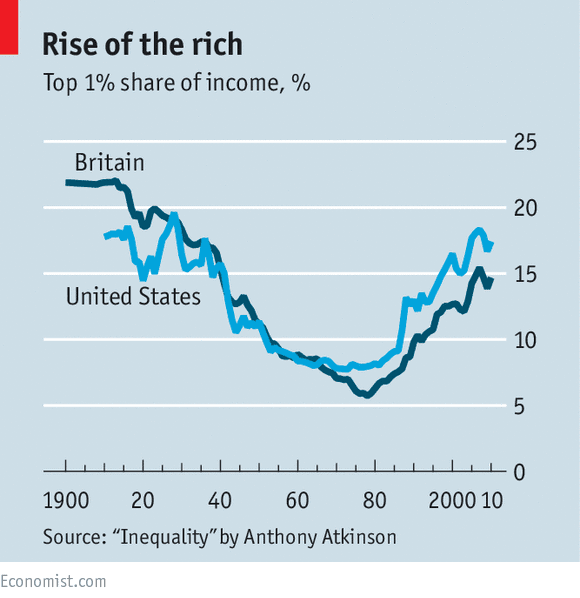
Inequality across rich countries was high before the two world wars of the 20th century. It fell to striking lows after 1945 and then began growing again around 1980 (see chart). Rising income inequality is a feature of most rich countries, especially America and Britain, and parts of the emerging world, including China. Sir Anthony is not interested in outlining any fundamental economic rules. Instead he carefully walks the reader through the ways that different forces have pushed incomes apart historically.This line from the review:
In America, for instance, incomes at the top of the scale began pulling away from the rest quite soon after 1945. Yet household inequality—taking account of taxes and transfers—did not rise until what Mr Atkinson calls the “Inequality Turn” around 1980. Several factors contributed to this, including changes for women and work. After the second world war, when female labour-force participation grew rapidly, high-earning men tended to marry low-earning women; the rising numbers of working women reduced household inequality. From the 1980s on, by contrast, men and women tended to marry those who earned like themselves—rich paired with rich; rising female participation in the workforce exacerbated inequality.
Sir Anthony dwells on one class of contributory factors above all others: the subtle (and not-so-subtle) ways the rich are able to influence government policy in order to protect their wealth.put me in mind of some commentators in Australia. Who could they be*?:


Anyhow, The Economist reviewer is critical of many of Atkinson's suggestions as to reigning in inequality, basically saying they are unwelcome throwback to the 1960's and 1970's. And to be fair, the criticisms on some points ring true.
But overall the review obviously considers the book an important contribution to an important issue. What irks me most is the effort those in the ABC** collective put into arguing there is no issue at all.
* words in their mouths are mine, but as far as I can tell, represent their positions with only mild exaggeration, if at all in some cases
(** the Australian, Bolt, Catallaxy)
Saturday, July 11, 2015
A troubled life
Literary Review - Donald Rayfield on Stalin's Daughter
Well, amongst the many things I didn't know much about until now was the turbulent life of Svetlana Alliluyena, Stalin's daughter. She defected from Russia in 1967. This paragraph from a review of a new biography gives some details of her, shall we say with understatement, troubled life:
Well, amongst the many things I didn't know much about until now was the turbulent life of Svetlana Alliluyena, Stalin's daughter. She defected from Russia in 1967. This paragraph from a review of a new biography gives some details of her, shall we say with understatement, troubled life:
She did not have a particularly good time after her defection, either, but you can read the review to see what went wrong.
Svetlana emerges as a remarkable, largely generous, sometimes heroic
figure. Whatever she inherited from her pathologically cruel and
vindictive father and from her neurotic, suicidal mother she did her
best to overcome (her brother, Vasili, succumbed and destroyed himself
with drink and sex; her half-brother, Yakov, who grew up fostered in
Georgia and did not meet his father until he was a teenager, was
captured by Germany during the Second World War and effectively
committed suicide by provoking his German captors to shoot him).
Svetlana's childhood and youth were as traumatic as any of Euripides's
tragedies: her mother shot herself when she was six; Stalin had nearly
all the maternal aunts, uncles and cousins of his children arrested and,
in many cases, shot. Svetlana's first love was badly beaten and sent to
the Gulag; her first husband was erased from her passport after they
divorced; her second husband was the withdrawn son of one of Stalin's
cronies. She barely saw her father after she ceased to be a living doll
that he could play with: her most searing memory is of Stalin in his
death throes on the floor, soaked in urine, threatening her with a
raised left hand. Yet after his death she negotiated a career for
herself and refused to be a mascot for the party or for anyone else. In
the prestigious Gorky Literary Institute she stood up for the first
dissident writers to fall victim to the Brezhnev regime. She dared to
live openly as Singh's partner.
Subscribe to:
Posts (Atom)