The attitude, well on the rise in aboriginal activism in the capital cities, that the real problem is undoing everyone else's sovereignty that has been in place for more than a century and produced a modern functioning society, just makes me grind my teeth somewhat.
The Taliban will not attend "any conference that shall make decisions
about Afghanistan" until "all foreign forces completely withdraw," a
spokesperson for the group tweeted on Tuesday.
Why it matters:
That's an explicit rejection of an upcoming peace conference in
Istanbul. It also follows President Biden's announcement that the U.S. will withdraw its troops by Sept. 11, but miss a deadline to do so by May 1.
I wonder what exactly the Taliban expects in a post foreign involvement country? They seem against all modern things except guns, bombs and heroin. Why does that attitude survive?
I posted my prediction of this on Friday evening, within a hour or so of hearing about the Duke's death.
And it came true (not a hard one to predict, but still):
Sometimes the predictions
that a narrative around “Meghan and Harry’s Oprah interview
contributing to Prince Philip’s untimely death” were uncanny in how they
bore out.
I can't remember why this came to mind the other day, but of all the people who I haven't heard of for a long time, and wondered whether they had died but I just can't recall the reporting of it with any clarity, prime among them would have to be Burt Bacharach.
The White Tiger, which was released on Netflix a month or so ago and seems to be popular there, is really good - an entertaining take on the problems in Indian society, so well directed and acted. It's one of those very transporting, great sense of place, type films too.
As I said to my daughter after it - the caste system has to go down as one of the all time great really bad cultural ideas of the world.
One other minor note - I think I mentioned before, when discussing the Indian series Sacred Games, and even Typewriter, that it seems Indians are very florid with their swearing in their own language. It's very odd - in all Indian shows, the characters conversationally mix English with their native language, and the really strong swearing only (or mainly?) turns up in translation from the native language. They don't seem to swear in English much, but some of the swearing in Hindi or whatever other language they are using often seems oddly over the top in the context. (And did I mention before, but I asked an Indian client about that last year, and he confirmed - most, or a lot, of Indians swear like troopers.)
John Boehner in a new memoir derides today’s Republican Party as
unrecognizable to traditional conservatives like himself, held hostage
by both former president Donald Trump and by a conservative media echo
chamber that is based on creating “chaos” for its own financial needs.
....it's worth reading this review of a new, somewhat critical, biography of Stephen Hawking.
I would have mentioned before that it had long been obvious that his achievements were over-hyped in the popular press and the public mind. The review contains further confirmation of that.
Yeah, this muon test stuff seems a genuine indication of some sort of "new physics" lurking in the background. Let Fermilab explain:
Update: Oh. I see there is another explanation going around which does not involve new physics, but seemingly leaves the awkward Standard Model secure. I wonder which take on this is going to turn out right.
To save a starving child, aid workers have long used one obvious
treatment: food. But a new study suggests feeding their gut bacteria may
be as important—or even more important—than feeding their stomachs. In a
head-to-head comparison against a leading treatment for malnutrition, a
new supplement designed to promote helpful gut bacteria led to signs of
improved growth and more weight gain, despite having 20% fewer
calories. The study also highlights how important gut bacteria—the
so-called microbiome—can be to human health.....
About 30 million children worldwide are so hungry that their bodies
are wasting away. Their growth slows, their immune systems don’t work
well, and their nervous systems fail to develop properly. To combat
malnutrition, health clinics often administer prepackaged, ready-to-use
supplementary food (RUSF), which is easy to store and turns into goo
after kneading. But malnourished children’s health improvements are
rarely permanent, and many never fully recover, even after they eat
enough. “It’s a problem that previously didn’t have an available
solution,” says Ruslan Medzhitov, an immunologist at Yale University not
involved with the work.
For more than 10 years, Jeffrey Gordon, a microbiologist at
Washington University School of Medicine in St. Louis, has studied the
role the microbiome plays in malnutrition recovery. He and his
colleagues discovered that 15 key bacteria are needed for normal growth
in mice, pigs, and to some degree people, and that children whose
microbiomes fail to “mature” to include these species do not recover
from malnutrition as well as children whose gut bacteria do mature.
“Current therapies do not repair this disrupted microbiome,” Gordon
explains.
So he and Tahmeed Ahmed, a malnutrition expert scientist who heads
the International Centre for Diarrhoeal Disease Research in Dhaka,
Bangladesh, tried with colleagues to find out which of a half dozen
combinations of easy-to-obtain foods most encouraged the growth of these healthy bacteria.
In the new study, they tested their best performing candidate: a
complex mixture of chickpea, banana, soy, and peanut flours and oils
that they call microbiota-directed complementary food No. 2, or MDCF-2.
About 120 malnourished toddlers from a Dhaka slum received either
MDCF-2 or the standard RUSF supplement twice a day for 3 months. Every 2
weeks during treatment, and again 1 month after treatment ended, the
researchers weighed and measured the children, sampled their blood, and
analyzed the bacteria in their feces.
Not only did MDCF-2 boost blood components linked to growth—such as
proteins needed for the proper development of bones, the nervous system,
and the immune system—but it also resulted in a growth rate twice as high, measured by change in a weight-to-length score, as in those receiving RUSF, the researchers report today in The New England Journal of Medicine.
What’s more, 21 types of beneficial bacteria increased in abundance.
Enhanced growth in children continued even after the treatment ended. “A
small amount of this food supplement can actually cure malnutrition in
children,” Ahmed concludes.
What a fascinating area of research, this gut bacteria stuff.
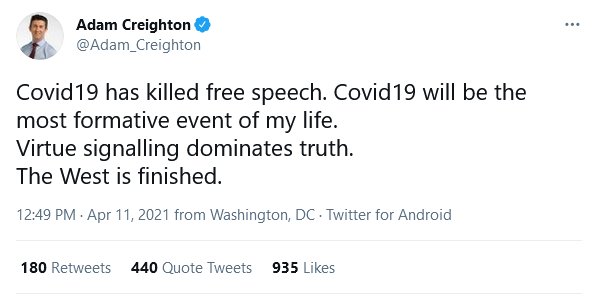
I have been wanting to note for a while that my assessment of Adam Creighton and his ilk (economist Paul Frijters, for one, who Nicholas Gruen has let overrun his blog with "BUT YOU ARE ALL WRONG AND PANICKING UNNECESSARILY" guff about COVID) has moved from something like "dismissive of such clownishness" to "you absolutely disgust me".
I mean - it is just so freaking obvious that COVID spread and optimal responses to it are hugely complicated questions with wildly varying effects across wildly varying cultures and populations such that it is going to be years, if ever, that unpicking the evidence is going to provide anything like definitive answers that are 100% clear. Yet Creighton, Frijters and other economics types (for the most part) decided a position at the very start and are determined to promote it and attack all others (including, of course, public health officials whose lifetime job has been devoted to these issues) as if the answers are obvious and that those against them are the real ones causing unnecessary trouble.
It's a level of arrogant certainty and pig headedness that just makes me sick to read. I guess I could say I tend towards the same feeling now towards climate change denial - certainly towards the likes of politically motivated gadflies like Andrew Bolt and Tim Blair who promote stupidity in the media - but with COVID it's the immediacy of the problem that has intensified my anger and disgust with the economists who think they know best and will not change position or admit there is substantial evidence against them.
Update: just a couple of days after I wrote this, Adam outdid himself:
I don't post much about Catallaxy any more - the intensity of the stupidity, misogyny, racism and crank conservatism is now so off the charts that talking about it is about as useful as noting that 8Chan is a bunch of obnoxious boys not worth even looking at.
Not only that, as I mentioned recently, the site doesn't even work property any more, and Sinclair Davidson doesn't seem too perturbed. I half suspect he thinks it good if the routinely defamatory comments about things like, you know, likely rape victims, are harder to find.
But I do note the irony of a man who has a run a blog devoted to promoting climate change denialism and clean energy scepticism for years is now also against proposals that scientists start serious research into the possible geo-engineering that may only be needed because of the very positions Davidson has shamelessly promoted.
I'm not the biggest fan of the concept of geo-engineering myself, as I would prefer aggressive actions to stop the emissions; but for someone effectively pro-emissions to also be against it is just numbskullery.
Last night, there wasn't much on TV and I found myself watching a repeat of the very interesting BBC documentary David Bowie: Finding Fame, about his struggles in the late 60's which finally paid off in fame in the early 1970's.
He certainly had a rough ride, in terms of false starts and projects that went no where. You have to admire his dedication to finding a way to break through.
However, I will still, for the life of me, never understand the appeal of the garish looks of the Ziggy Stardust performance character to Bowie, the audience of the time, or any audience since. As the show makes clear though, he rose to fame on it, but quickly recognized its limitations, and perhaps in a calculated sense, quit the character at its peak. The aesthetics of 1970's glamour rock will always remain a historical puzzle, I reckon.
There was a producer on the show who I have seen on Youtube explaining how certain later Bowie songs were created. The one about Heroes was particularly interesting, and showed the surprisingly circuitous and multi-contribution way modern pop music is sometimes created: