Physicists suggest selfishness can pay
Frank Tipler thinks that games theory explains why selfishness doesn't pay, and that therefore the future Omega Point that is God naturally doesn't like it.
I didn't realise that so much thought continues to go into games theory, but this article notes how there has been recent controversy over whether previous conclusions about how to best play the prisoner's dilemma still hold up.
This is hard to summarise, but it's interesting to note that Freeman Dyson is one of the guys putting thought into this. I think the conclusion is that it still seems safe to assume, in an evolutionary context, that co-operation is best.
Lucky for Frank, then...
Saturday, September 01, 2012


Friday, August 31, 2012
How did that slip through?
Activation of old carbon by erosion of coastal and subsea permafrost in Arctic Siberia : Nature : Nature Publishing Group
I noticed this article via a mention on The Australian's website this morning. Yes, that's right, The Australian. What's going on? The regular science editor on holiday?
Anyhow, while it is basically an estimate of how much carbon (and CO2) could be coming from defrosting Siberian permafrost, the figures are quite large sounding:
For those who say "why does a thawing Arctic ice cap matter?", there's part of your answer.
I noticed this article via a mention on The Australian's website this morning. Yes, that's right, The Australian. What's going on? The regular science editor on holiday?
Anyhow, while it is basically an estimate of how much carbon (and CO2) could be coming from defrosting Siberian permafrost, the figures are quite large sounding:
Thawing of Arctic permafrost could release significant amounts of carbon into the atmosphere in this century3. Ancient Ice Complex deposits outcropping along the ~7,000-kilometre-long coastline of the East Siberian Arctic Shelf (ESAS)4, 5, and associated shallow subsea permafrost6, 7, are two large pools of permafrost carbon8, yet their vulnerabilities towards thawing and decomposition are largely unknown9, 10, 11. Recent Arctic warming is stronger than has been predicted by several degrees, and is particularly pronounced over the coastal ESAS region12, 13. There is thus a pressing need to improve our understanding of the links between permafrost carbon and climate in this relatively inaccessible region. Here we show that extensive release of carbon from these Ice Complex deposits dominates (57 ± 2 per cent) the sedimentary carbon budget of the ESAS, the world’s largest continental shelf, overwhelming the marine and topsoil terrestrial components. Inverse modelling of the dual-carbon isotope composition of organic carbon accumulating in ESAS surface sediments, using Monte Carlo simulations to account for uncertainties, suggests that 44 ± 10 teragrams of old carbon is activated annually from Ice Complex permafrost, an order of magnitude more than has been suggested by previous studies14. We estimate that about two-thirds (66 ± 16 per cent) of this old carbon escapes to the atmosphere as carbon dioxide, with the remainder being re-buried in shelf sediments.
For those who say "why does a thawing Arctic ice cap matter?", there's part of your answer.
Wednesday, August 29, 2012
Sick
Yes, no doubt about it, I have finally succumbed to (what I assume is) this season's flu.
At least an illness like this makes one better appreciate how good "normal" feels. I used to feel that way about hangovers too, but as they get worse as you get older, it does seem a waste of the next day for something that can be avoided.
Some random observations:
* I like the way you can customize Google news now;
* Who can really admire Apple when they seek to enforce some ridiculous patents.
* I hate websites that scroll sideways. The Global Mail will fail for this reason alone.
Goodnight...
At least an illness like this makes one better appreciate how good "normal" feels. I used to feel that way about hangovers too, but as they get worse as you get older, it does seem a waste of the next day for something that can be avoided.
Some random observations:
* I like the way you can customize Google news now;
* Who can really admire Apple when they seek to enforce some ridiculous patents.
* I hate websites that scroll sideways. The Global Mail will fail for this reason alone.
Goodnight...
Tuesday, August 28, 2012
Potty mouth Luther
Although I knew that he had spent a lot of time sitting on the toilet, I wasn't quite aware of how much he referred to poop and scatological matters generally in his writings and sermons, so I went looking for more information.
And here's what I found: a pretty interesting research paper from 2008 that looks at the question of why Luther engaged in scatological expressions so much. This has, apparently been the subject of much academic attention over the years, and the paper summarises the various schools of thought, before concluding that, in the context of German culture at the time, throwing literary "shit" at his enemies gave him the desirable air of virile masculinity.
It would seem that Germans have always had a scatological bent - I'm sure someone has had a go at explaining that, but I'll go looking for that another day. This part notes the way poop was used in disputes at the time:


Ain't history grand?
(As an aside, this description of Luther's eyes is of interest:

Seems a good lead for a science fiction story based on his being a robot; but I guess all of the sitting on the toilet suggests a design fault.)
Reading about this reminds me that the other great nation with an unusual degree of interest in poo is Japan. I'm sure there must be lots of material on the net about this, but here's a short-ish but useful essay on the topic.
I may well have noted this unusual connection before: why do two nations so far apart have this in common? Like the esoteric stories of Jesus travelling to India (or Japan), was there a prophet of digestive health who travelled from Germany to Japan in the first millennium AD, proselytising the importance of having well formed poo, but who remains mysteriously unrecorded in history?
Just a thought for someone's future research endeavour.
Calling the aliens
Backreaction: How to beat a cosmic speeding ticket
Well, this is very hard to follow in the details for a non physicist, but Sabine Hossenfelder has a go at explaining her new paper looking at (what I take to be) speculative physics that may allow faster than light communication.
I want to note it here just in case she's right.
Well, this is very hard to follow in the details for a non physicist, but Sabine Hossenfelder has a go at explaining her new paper looking at (what I take to be) speculative physics that may allow faster than light communication.
I want to note it here just in case she's right.
Possum returns
The possum under the balcony has been away for quite a while, but she's started turning up again - with youngster in tow. (The photo could be clearer, but you get the idea.)


No big surprise
BBC News - Young cannabis smokers run risk of lower IQ, report claims
The findings come from a study of around 1,000 people in New Zealand.
An international team found those who started using cannabis below the age of 18 - while their brains were still developing - suffered a drop in IQ.
A UK expert said the research might explain why people who use the drug often seem to under-achieve.
For more than 20 years researchers have followed the lives of a group of people from Dunedin in New Zealand.
They assessed them as children - before any of them had started using cannabis - and then re-interviewed them repeatedly, up to the age of 38.
Having taken into account other factors such as alcohol or tobacco dependency or other drug use, as well the number of years spent in education, they found that those who persistently used cannabis - smoking it at least four times a week year after year through their teens, 20s and, in some cases, their 30s - suffered a decline in their IQ.
Natural variability is not always your friend
Given that we now have now officially got an extraordinarily low Arctic ice extent (with a couple of more week's melt to come), the climate change "skeptics" are casting around for reasons as to why it doesn't mean all that much.
One of the more credible attempts at this appears to come from Judith Curry, who points us to a recent paper arguing that the enhanced warming in the Arctic from 1965 to 2000 was mainly due to a natural variability:
Besides which, even if there are no anthropogenic reasons affecting the circulation change, doesn't the whole exercise mean that even modest AGW is a problem when it gets a multi-decade boost from natural variability?
I mean, you see this failed excuse making re solar influences too: sure, a quieter sun could make parts of the Northern Hemisphere cooler for a couple of decades, and that could be partially offset by AGW, but none of that helps when the sun goes back to normal. What could be a mere bit of breathing space for just one area of the world would be no reason to not be working to dramatically reduce CO2 for when a short term cooling effect wears off.
Also - the particular problem with loss of Arctic sea ice - even if it is largely happening at the moment due to natural variability - is the feedback potential that it gives to AGW. This might be a particularly unlucky coincidence that gives the AGW effects on the polar region a boost up to a level that it's not going to drop back from anytime soon.
The "do-nothing" climate skeptics are interested in the short term only. They do not take seriously the long term interests of the residents of the planet.
UPDATE: In any case, here's a 2012 paper which appears to contradict the claim that natural variability has had much role to play in the recent Arctic ice loss.
Given the lack of evidence of substantial polar ice loss in other warm Earth periods, it seems to me to not make much sense that natural variability (uninfluenced by humans) is the substantial cause.
One of the more credible attempts at this appears to come from Judith Curry, who points us to a recent paper arguing that the enhanced warming in the Arctic from 1965 to 2000 was mainly due to a natural variability:
There seems to be a large multidecadal variability in the complex ocean–atmosphere system that can superimpose itself atop the global warming signal. It seems to be identifiable with a few large-scale patterns in the temperature fields; when phases of the pressure modes match up one with another they can enhance the rate of warming, especially on the large, wintertime continents. It is not yet known whether cooling periods can happen as well in this scheme. Nor do we know exactly the origin of the multidecadal long-term variability that has been identified. It could be related to anthropogenic causes, or it could just be part of the natural system’s internal variability.But - as the summary notes before this conclusion:
What causes the two primary decadal empirical pressure patterns to ramp up their amplitudes and line up their phases in such a way as to encourage lots of warm air polewards onto the big continents during the study period and not at other times? Wallace et al. do not address this issue but list several contenders.So: even if you accept that the radiative forcing alone is not doing this (and I would presume that the fact that the IPCC did not predict an Arctic ice melt this fast indicates this may be right) it remains quite possible that anthropogenic changes to circulation patterns are altering what appears to be natural variability to make it worse.
One possibility is that the anthropogenic factors are actually inducing this change in circulation, perhaps even through stratospheric connections as mentioned earlier. They seem to lean toward unforced natural variability at the decadal scales.
Besides which, even if there are no anthropogenic reasons affecting the circulation change, doesn't the whole exercise mean that even modest AGW is a problem when it gets a multi-decade boost from natural variability?
I mean, you see this failed excuse making re solar influences too: sure, a quieter sun could make parts of the Northern Hemisphere cooler for a couple of decades, and that could be partially offset by AGW, but none of that helps when the sun goes back to normal. What could be a mere bit of breathing space for just one area of the world would be no reason to not be working to dramatically reduce CO2 for when a short term cooling effect wears off.
Also - the particular problem with loss of Arctic sea ice - even if it is largely happening at the moment due to natural variability - is the feedback potential that it gives to AGW. This might be a particularly unlucky coincidence that gives the AGW effects on the polar region a boost up to a level that it's not going to drop back from anytime soon.
The "do-nothing" climate skeptics are interested in the short term only. They do not take seriously the long term interests of the residents of the planet.
UPDATE: In any case, here's a 2012 paper which appears to contradict the claim that natural variability has had much role to play in the recent Arctic ice loss.
Given the lack of evidence of substantial polar ice loss in other warm Earth periods, it seems to me to not make much sense that natural variability (uninfluenced by humans) is the substantial cause.
Monday, August 27, 2012
Tax in the US
Paul Ryan tax cuts: American fiscal conservatives who ignore the debt are gambling. - Slate Magazine
This article looks at the current Republican obsession with reducing taxes. I can certainly understand how widening the tax base would make sense, as would reforming the tax system to reduce deductions; but the rush to first of all move in and reduce taxes in a way that the rich simply don't need at this point in time makes me think the party is simply stuck in a stupid ideological mode. As it says:
This article looks at the current Republican obsession with reducing taxes. I can certainly understand how widening the tax base would make sense, as would reforming the tax system to reduce deductions; but the rush to first of all move in and reduce taxes in a way that the rich simply don't need at this point in time makes me think the party is simply stuck in a stupid ideological mode. As it says:
In most countries, to be “fiscally conservative” means to worry a great deal about the budget deficit and debt levels—and to push these issues to the top of the policy agenda. In many eurozone countries today, “fiscal conservatives” are a powerful group, insisting on the need to boost government revenue while bringing spending under control. In Great Britain, too, leading Conservatives have recently proved willing to raise taxes and attempted to limit future spending.
The United States is very different in this respect. Leading politicians who choose to call themselves “fiscal conservatives”— such as Paul Ryan, now the Republican Party’s presumptive vice-presidential —care more about cutting taxes, regardless of the effect on the federal deficit and total outstanding debt. Why do U.S. fiscal conservatives care so little about government debt, relative to their counterparts in other countries?The article goes on to talk about the history of the idea, and ends on this note:
Ryan and other Republicans undoubtedly want to cut the size of the federal government, and they have articulated plans to do this over several decades. But, in the near term, what they promise is primarily tax cuts: Their entire practical program is frontloaded in that direction. The calculation is that this will prove politically popular (probably true) while making it easier to implement spending cuts down the road (less obvious). The vulnerability caused by higher public debt over the next few decades is simply ignored.
For example, Ryan supported George W. Bush’s spending spree. He also supports maintaining defense spending at or near its current level—resisting the cuts that were put in place under the Budget Control Act of 2011.
The assumption here—unstated and highly questionable—is that the U.S. will be able to sell an unlimited amount of government debt at low interest rates for the foreseeable future. There is no other country in the world where fiscal conservatives would want to be associated with such a high-stakes gamble.
The battle of the cutes
Trouble at Kangaroo Island - Nature - Environment - The Independent
I seem to have missed this, if it was in the Australian media:
I seem to have missed this, if it was in the Australian media:
Kangaroo Island, south of Adelaide, is one of Australia's most popular tourism destinations, thanks to its profusion of native wildlife, which includes koalas, kangaroos and the world's smallest penguin species.
But lately there have been dark goings-on in the animal kingdom: the New Zealand fur seals have been devouring the fairy penguins.
Penguin numbers have dropped by half on the island, according to some locals, who want the seals to be sterilised, relocated or even culled. Now they have come up with a new suggestion: shoot them with beanbag rounds – a method more commonly used to control riots – if they approach penguin colonies.
Sunday, August 26, 2012
Personal taste
Not all of these David Mitchell soapbox rants are so good, and as with nearly every single modern comedian except for Jerry Seinfeld, he's starting to swear a bit too much, but I quite liked this one:
Some of the comments following this at The Guardian are pretty funny too. Bacon is always a good subject for humour.
Speaking of swearing comedians, I saw Tony Martin's second book of autobiographical stories (A Nest of Occasionals) going for $5 in some remainder-ish bookshop, and have finished reading it. He really is a talented and funny writer, even though he swears too much. I particularly liked the last story, about a trip back to New Zealand to learn about his grandparents. (Young Tony had a quite unsettled, and unsettling, childhood. In fact, one gets the impression from an earlier chapter - about all of the medical probes he has had over the years - that he may still suffer from the lingering stress of his childhood.)
I see from Martin's fairly extensive Wikipedia entry that he's now divorced. His last TV venture was also not so good. As far as I know his falling out with Mick Molloy has not yet ended in a Jerry Lewis/Dean Martin style televised reconciliation. Maybe he needs a hug.
Some of the comments following this at The Guardian are pretty funny too. Bacon is always a good subject for humour.
Speaking of swearing comedians, I saw Tony Martin's second book of autobiographical stories (A Nest of Occasionals) going for $5 in some remainder-ish bookshop, and have finished reading it. He really is a talented and funny writer, even though he swears too much. I particularly liked the last story, about a trip back to New Zealand to learn about his grandparents. (Young Tony had a quite unsettled, and unsettling, childhood. In fact, one gets the impression from an earlier chapter - about all of the medical probes he has had over the years - that he may still suffer from the lingering stress of his childhood.)
I see from Martin's fairly extensive Wikipedia entry that he's now divorced. His last TV venture was also not so good. As far as I know his falling out with Mick Molloy has not yet ended in a Jerry Lewis/Dean Martin style televised reconciliation. Maybe he needs a hug.
The universe and all that
There was a university press release that got a lot of publicity recently, about "quantum graphity" - rather a bad name by whoever came up with it, I thought.
Anyhow, ars technica has a cynical look at the PR exercise, and as I expected, there is probably less to this than it seems.
Of more interest, I think, is this story about measurements indicating that spacetime is pretty 'smooth':
Anyhow, ars technica has a cynical look at the PR exercise, and as I expected, there is probably less to this than it seems.
Of more interest, I think, is this story about measurements indicating that spacetime is pretty 'smooth':
Some theories of quantum gravity say that the universe is not smooth but foamy—made of fundamental units called Planck lengths that are less than a trillionth of a trillionth the diameter of a hydrogen atom. Planck lengths are so small that there's no way to detect them, except via photons like those that make up gamma-ray bursts. Here's why.
The wavelengths of these photons are some of the shortest distances known to science—so short they should interact with the even smaller Planck length. And if they interact, the photons should be dispersed—scattered—on their trek through Planck length–pixilated spacetime.
In particular, they should disperse in different ways if their wavelengths differ, just as a ping pong ball and a softball might take alternate paths down a gravely hillside.
You wouldn't notice the scattering over short distances, but across billions of light years, the Planck lengths should disperse the light. And three photons from the same gamma-ray burst should not have crashed through the Fermi telescope at the same moment.
But they did, and that calls into question just how foamy spacetime really is. "We have shown that the universe is smooth across the Planck mass," Nemiroff said. "That means that there's no choppiness that's detectible. It's a really cool discovery. We're very excited."
Armstrong remembered
This ABC site has many tributes from all over the place to Neil Armstrong.
Isn't it funny how real life works out compared to fiction? A science fiction story with the first man on the Moon being such an incredibly modest and self effacing character just wouldn't have worked, yet that's the way things panned out.
Isn't it funny how real life works out compared to fiction? A science fiction story with the first man on the Moon being such an incredibly modest and self effacing character just wouldn't have worked, yet that's the way things panned out.
Goodbye, ice
There is likely to be a lot of (well deserved) publicity about the new Arctic sea ice extent minimum that will be reached in the next day or two. In fact, according to some ways of counting the sea ice, we're already there.
People also need to remember that it has been a long time since the Arctic was ice free in summer; according to a 2005 article, it may be 800,000 years ago, although I think I have seen suggestions to the contrary elsewhere. It seems the Eemian period of global warmth about 125,000 still had winter sea ice in the Arctic, even while ocean levels were 3-7 m higher than today. (While Googling, I stumbled across the question posed by the Institute for Creation Research - "Are Polar Ice Sheets Only 4500 Years Old?" What was I worried about?)
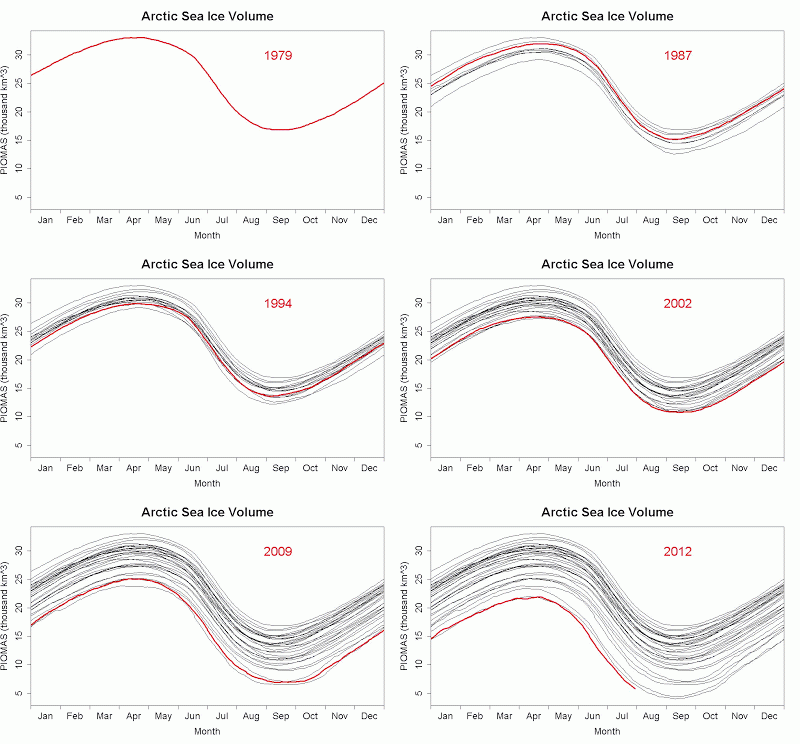
But apart from the extent of Arctic ice, the volume of ice gives the better picture of what has been happening. Tamino came up with this moving graph (click on it) some time ago, but he has reposted it. It is pretty amazing.
People also need to remember that it has been a long time since the Arctic was ice free in summer; according to a 2005 article, it may be 800,000 years ago, although I think I have seen suggestions to the contrary elsewhere. It seems the Eemian period of global warmth about 125,000 still had winter sea ice in the Arctic, even while ocean levels were 3-7 m higher than today. (While Googling, I stumbled across the question posed by the Institute for Creation Research - "Are Polar Ice Sheets Only 4500 Years Old?" What was I worried about?)
But apart from the extent of Arctic ice, the volume of ice gives the better picture of what has been happening. Tamino came up with this moving graph (click on it) some time ago, but he has reposted it. It is pretty amazing.

Saturday, August 25, 2012
20 years is a long time in politics - (subtitle: "Against the Hedley")
Last year, when the issue of Gillard and the AWU scandal came up, I made the observation that, given that virtually all Labor politicians can be counted on as having made some factional enemies during their life in the party, isn't it extremely unlikely that there is a bit of evidence out there that is only now being produced to harm her? If there was something to prove her knowledge of, or involvement in, an obvious fraud, it would have been used against her before now.
A year or so later, we know that:
a. her ex boyfriend Wilson still seems to support her, and has attacked the sleazy internet campaign;
b. the Greek builder says Gillard paid for her renovations and has got nothing against her;
c. she did some legal work that appeared quite minor without opening a file; it turned out subsequently to have a high embarrassment factor for her firm and the partners weren't happy. There appear to have been tensions within the firm over other matters anyway, with several lawyers leaving around the time.
d. as predicted, there is no evidence being produced that she had knowledge of the fraudulent way the association was run by her then boyfriend, or that she benefitted in any substantial way. (I am betting that maybe the Greek or one of the tradies working on her renovation might have been expecting to be paid by Wilson, but if he told Gillard that they owed him a favour, so what?)
As for the media treatment of this, Hedley Thomas is having a tantrum today that the rest of the media weren't showing enough interest in the office politics and embarrassment that Gillard caused Slater & Gordon nearly 20 years ago.
Hedley: it was 20 years ago.
Quite frankly, Mr Thomas as a serial pest with no sense of proportion. He gets lucky at times, noticing (for example) some inconsistencies in the Brisbane flood inquiry evidence, the embarrassment factor of which then seemed to lead to the lawyers for the inquiry going in too hard on the hapless dam engineers who had been exhausted working out what to do during a huge flood event.
And look at the final outcome: the engineers referred to the Crime and Misconduct Commission, only to be found last week to have no case to answer.
This was reported in brief detail by some other reporter in the Australian. As far as I can see, Thomas has made no comment. He was too busy on a beat up of another story beyond its importance.
I mean, just imagine what a misery these engineers' lives have been with this hanging over their heads. To get greater detail of the CMC's finding, you have to go to a Fairfax outlet, or the ABC report, but basically it is all put down to problems with the manual:
Going back to Gillard, I think her being aggressive on the matter this week, even with the boring and pompous Paul Kelly, will help her public image. And as for The Australian's coverage of the matter, I think Barrie Cassidy got it right:
In any event, it is, more than ever, "time to move on". I don't blame Gillard for being furious about the way the right wing shock jocks in particular have dealt with this - particularly Michael Smith, the sympatico support Andrew Bolt offered him, and then the increasingly execrable Alan Jones. And of course Larry Pickering - I mean the utter hide of a bankrupt (widely suspected of fraud) making obviously defamatory statements and then claiming that the lack of legal action against him somehow vindicated him.
There is no doubt at all that this campaign was a "dog whistle" one, where there were lists of "serious questions to be answered" (ignoring the fact that the material had been out there for years and repeatedly denied already) followed by pathetic attempts at arse covering by the occasional (very occasional) statement "not that we're saying Gillard knew what Wilson was doing." Well, boys, that's exactly what you wanted people to believe, and don't pretend otherwise.
My opinion of Andrew Bolt in all of this has sunk further than ever before. He was clearly gleeful that the obscene, bankrupt and utterly careless-of-facts Pickering was getting attention for his claims, and while not specifically referring people to his blog, eventually decided to comment that Pickering was "brave" to be doing this, and only belatedly making some reference to the scumbag nature of the campaign:
A year or so later, we know that:
a. her ex boyfriend Wilson still seems to support her, and has attacked the sleazy internet campaign;
b. the Greek builder says Gillard paid for her renovations and has got nothing against her;
c. she did some legal work that appeared quite minor without opening a file; it turned out subsequently to have a high embarrassment factor for her firm and the partners weren't happy. There appear to have been tensions within the firm over other matters anyway, with several lawyers leaving around the time.
d. as predicted, there is no evidence being produced that she had knowledge of the fraudulent way the association was run by her then boyfriend, or that she benefitted in any substantial way. (I am betting that maybe the Greek or one of the tradies working on her renovation might have been expecting to be paid by Wilson, but if he told Gillard that they owed him a favour, so what?)
As for the media treatment of this, Hedley Thomas is having a tantrum today that the rest of the media weren't showing enough interest in the office politics and embarrassment that Gillard caused Slater & Gordon nearly 20 years ago.
Hedley: it was 20 years ago.
Quite frankly, Mr Thomas as a serial pest with no sense of proportion. He gets lucky at times, noticing (for example) some inconsistencies in the Brisbane flood inquiry evidence, the embarrassment factor of which then seemed to lead to the lawyers for the inquiry going in too hard on the hapless dam engineers who had been exhausted working out what to do during a huge flood event.
And look at the final outcome: the engineers referred to the Crime and Misconduct Commission, only to be found last week to have no case to answer.
This was reported in brief detail by some other reporter in the Australian. As far as I can see, Thomas has made no comment. He was too busy on a beat up of another story beyond its importance.
I mean, just imagine what a misery these engineers' lives have been with this hanging over their heads. To get greater detail of the CMC's finding, you have to go to a Fairfax outlet, or the ABC report, but basically it is all put down to problems with the manual:
Mr Jerrard has found the dam was operated in breach of the operating manual but said this was due to shortcomings in the manual design.As I have argued in detail before, Hedley Thomas and the Australian's campaign to encourage flood victims to believe there was someone to blame for an unavoidable natural disaster, all based on the opinion of one of two engineers of dubious ability and knowledge of the true situation at Wivenhoe, remains a disgraceful example of journalism doing harm to public understanding.
"There is no evidence that I have seen which suggests the conduct of Mr Tibaldi, Mr Ayre and Mr Malone relating to the preparation of documents surrounding the January 2011 flood event, and oral testimony given to the flood inquiry, evidences offences against the Criminal Code or official misconduct under the Crime and Misconduct Act 2001," he said in advice released today.
Mr Jerrard said any inconsistencies in the engineers' explanations of how they managed the flood could be explained by the contradictions in the operation manual.
Going back to Gillard, I think her being aggressive on the matter this week, even with the boring and pompous Paul Kelly, will help her public image. And as for The Australian's coverage of the matter, I think Barrie Cassidy got it right:
Speers was also right to say, "These may not be serious matters."There are a couple of things still confusing about this. As I noted before, the Gillard sympathising Brisbane journalist Dennis Atkins referred to her living with Wilson, but I thought this was the particular claim that I thought cost Glenn Milne his job. Gillard seemed to be claiming that Milne's 2007 article falsely claimed she set up an account and this was the subject of a retraction, but I'm not sure if that is quite right either.
And that goes to the heart of the coverage in The Australian. Of course the newspaper did well to gain fresh information. But the newspaper grossly exaggerated the value of that information and the worth of the story.
Nobody is suggesting the newspaper should not have pursued the issue. It's a question of prominence.
According to The Age, The Australian has published more than 40 articles and opinion pieces about the allegations since 1995, three quarters of them in the last month.
Some of that coverage included front page banner headlines and full page transcripts. This was not the Loans Affair or Tampa. This was a story about the Prime Minister showing a lack of judgment 17 years ago. As the Australian and others repeatedly said, nobody was accusing Julia Gillard of wrongdoing, nobody apart from those Gillard has dismissed as misogynists and nut jobs.
In any event, it is, more than ever, "time to move on". I don't blame Gillard for being furious about the way the right wing shock jocks in particular have dealt with this - particularly Michael Smith, the sympatico support Andrew Bolt offered him, and then the increasingly execrable Alan Jones. And of course Larry Pickering - I mean the utter hide of a bankrupt (widely suspected of fraud) making obviously defamatory statements and then claiming that the lack of legal action against him somehow vindicated him.
There is no doubt at all that this campaign was a "dog whistle" one, where there were lists of "serious questions to be answered" (ignoring the fact that the material had been out there for years and repeatedly denied already) followed by pathetic attempts at arse covering by the occasional (very occasional) statement "not that we're saying Gillard knew what Wilson was doing." Well, boys, that's exactly what you wanted people to believe, and don't pretend otherwise.
My opinion of Andrew Bolt in all of this has sunk further than ever before. He was clearly gleeful that the obscene, bankrupt and utterly careless-of-facts Pickering was getting attention for his claims, and while not specifically referring people to his blog, eventually decided to comment that Pickering was "brave" to be doing this, and only belatedly making some reference to the scumbag nature of the campaign:
It was terrific how she made out the controversy started with the utterly scurrilous blog of Larry Pickering..As far as I am concerned, anyone associated with Labor should freeze him out completely by never appearing on his smug faced Sunday show. He deserves their contempt.
Thursday, August 23, 2012
Movie mystery solved
Ratatouille with olives: a traditional Provençal summer vegetable stew.
Fans of the movie Ratatouille may have wondered about the version of the title dish that Remy the rat made at the dramatic climax of the film. Well, I certainly did, anyway, as I had never heard of it being made with thin slices of vegetables. But the above article from Slate explains:
Fans of the movie Ratatouille may have wondered about the version of the title dish that Remy the rat made at the dramatic climax of the film. Well, I certainly did, anyway, as I had never heard of it being made with thin slices of vegetables. But the above article from Slate explains:
Unfortunately, the adorable rat was doing ratatouille wrong. The version of ratatouille featured in Ratatouille, also known as confit biyaldi, is a visual delight: razor-thin slices of tomato, zucchini, and eggplant arranged artfully over a bell-pepper purée and baked for hours. But ratatouille is not supposed to be a visual delight; it’s supposed to make short work of as many late-summer vegetables as possible simultaneously. Ratatouille was invented by Provençal peasants, and Provençal peasants possessed neither the time nor the inclination to slice vegetables with such precision or to bake them as gently and slowly as possible. What they had the time and inclination for was stew.The article then goes on to explain, roughly, how to made the real version of ratatouille. I've never been that big a fan of the dish, but I'm half tempted to give it a go again.
Worth a look
Arctic Death Spiral: How It Favors Extreme, Prolonged Weather Events ‘Such As Drought, Flooding, Cold Spells And Heat Waves’ | ThinkProgress
Sure, Romm can be shrill sometimes, but in a post like this he has lots of links to scientists explaining the increasingly convincing proposal that less Arctic ice is leading to more heat in the Arctic ocean which is leading to jet stream changes which bring weird and extreme weather South.
Sure, Romm can be shrill sometimes, but in a post like this he has lots of links to scientists explaining the increasingly convincing proposal that less Arctic ice is leading to more heat in the Arctic ocean which is leading to jet stream changes which bring weird and extreme weather South.
Younger fatherhood encouraged
BBC News - Older dads linked to rise in mental illness
According to Dr Kari Stefansson, of Decode Genetics, who led the research, the results show it is the age of men, rather than women, that is likely to have an effect on the health of the child.
"Society has been very focussed on the age of the mother. But apart from [Down's Syndrome] it seems that disorders such as schizophrenia and autism are influenced by the age of the father and not the mother"....
"The average age of fathers has been steeply rising [in industrialised countries] since 1970. Over the same period there has been an increase in autism and it is very likely that part of that rise is accounted for by the increasing age of the father," he said....
Older fathers and therefore genetic mutations have been linked with neurological conditions because the brain depends on more genes for its development and regulation.
So mutations in genes are more likely to show up as problems in the brain than in any other organ. But it is unclear whether the age of fathers has an effect on any other organ or system. The research has not yet been done.
The reason that men rather than women drive the mutation rate is that women are born with all their eggs whereas men produce new sperm throughout their adult life. It is during sperm production that genetic errors creep in, especially as men get older.
Wednesday, August 22, 2012
Under the sea
Life on board a British nuclear submarine | UK news | The Guardian
I can happily read about astronauts travelling in small spaceships without getting twinges of claustrophobia, but submarines are a different matter. I think I can imagine too well how I would be aware of the crushing pressure of dark water all around me. How James Cameron could bear to drop, alone, kilometres to the bottom of the ocean while looking out into the darkness I'll never know. (By the way, is there some special about that coming out? I assume it would on National Geographic, which means I won't see it, but that's no great loss because that network seems to have a strange ability to make any documentary on any subject boring.)
Anyhow, this account by a Guardian journalist of a week in a British nuclear submarine is quite interesting. Here's the bit that made me feel claustrophobic:
I can happily read about astronauts travelling in small spaceships without getting twinges of claustrophobia, but submarines are a different matter. I think I can imagine too well how I would be aware of the crushing pressure of dark water all around me. How James Cameron could bear to drop, alone, kilometres to the bottom of the ocean while looking out into the darkness I'll never know. (By the way, is there some special about that coming out? I assume it would on National Geographic, which means I won't see it, but that's no great loss because that network seems to have a strange ability to make any documentary on any subject boring.)
Anyhow, this account by a Guardian journalist of a week in a British nuclear submarine is quite interesting. Here's the bit that made me feel claustrophobic:
You can hardly move in the bunk – sitting up is impossible – and if you turn over you are likely to tip out and end up on the floor. You have to share your rack with a gas mask and various other bits of safety equipment, plus a lot of your own gear. There are small lockers, but I am never offered one, so sleep with bag, clothes and shoes in the bed. Each bunk has an air vent, which does offer some respite from the heat but also blows a blast of cold air into your right ear. "If the air stops blowing, it means something bad has happened," one of the men tells me reassuringly. One morning I am woken by a sudden thud and fear the worst. Later, I discover it was just air being released – a routine operation.
Several men mention "coffin dreams" – nightmares in which the sleeper shouts out that the control room is flooding or he is being pursued by a torpedo. I sympathise: though I have no nightmares – I don't sleep deeply enough for that – the racks do feel like coffins. A better option is to sleep in the "bomb shop", where the missiles and torpedoes are kept. It is the quietest, most spacious room on the boat and hugging an 18ft cruise missile keeps you cool.
A few men go "wibble" after years under water; they just can't stand it any more – the lack of proper sleep, the absence of privacy, the endlessly repeated conversations, the cycle of meals (it's Wednesday so it must be curry), the unspoken dangers. How do you know when someone has gone wibble? "The noisy ones go quiet, and the quiet ones suddenly become noisy," one man tells me. Chief Johnson recalls one experienced submariner who went wibble and started keeping a book of shipmates he thought had wronged him. "You're on my list as well," he told Johnson before being taken off the boat. He only agreed to leave as long as he could be designated captain of the rescue vessel.
Bugs R Us
The human microbiome: Me, myself, us | The Economist
Click the link for a quite long, quite interesting, article about how humans are incredibly reliant on the bacteria that we're full of. For a start:
Click the link for a quite long, quite interesting, article about how humans are incredibly reliant on the bacteria that we're full of. For a start:
A healthy adult human harbours some 100 trillion bacteria in his gut alone. That is ten times as many bacterial cells as he has cells descended from the sperm and egg of his parents. These bugs, moreover, are diverse. Egg and sperm provide about 23,000 different genes. The microbiome, as the body’s commensal bacteria are collectively known, is reckoned to have around 3m. Admittedly, many of those millions are variations on common themes, but equally many are not, and even the number of those that are adds something to the body’s genetic mix.The article then gives many examples of ways in which the bacteria may affect our health. The one I found most surprising:
The link with diabetes was noticed in morbidly obese people who had opted for a procedure known as Roux-en-Y, which short-circuits the small intestine and thus reduces the amount of food the body can absorb. Such people are almost always diabetic. As a treatment for obesity, Roux-en-Y is effective. As a treatment for diabetes, it is extraordinary. In 80% of cases the condition vanishes within days.
Experiments conducted on mice by Dr Nicholson and his colleagues show that Roux-en-Y causes the composition of the gut microbiome to change. Dr Nicholson thinks this explains the sudden disappearance of diabetes.
The diabetes in question is known as type-2. It is caused by the insensitivity of body cells to insulin, a hormone that regulates the level of blood sugar. Insulin sensitivity is part of a complex and imperfectly understood web of molecular signals. Dr Nicholson suspects, though he cannot yet prove, that some crucial part of this web is regulated by the microbiome in a way similar to the role played by formic acid in the case of high blood pressure. The intestinal bypass, by disrupting the microbiome, resets the signal, and the diabetes vanishes.
Subscribe to:
Comments (Atom)