Climatologist Who Predicted California Drought 10 Years Ago Says It May Soon Be 'Even More Dire' | ThinkProgress
It's not so often that some modelling work seems to have made such an accurate predication, but in this case, the 2004 work seems to have been very close to the mark.
Tamino has a post on the same issue (it's via him that I found the Romm article), taking to task NOAA's Martin Hoerling, who has written that there is no evidence of global warming being behind the Californian drought.
I have noted for years that NOAA has been prominent in issuing quick denials of connections between AGW and extreme weather. I'm not sure if Hoerling is the one who has always been behind this policy; I would have to search back a bit. In any event, as I have argued before, dismissing connections too quickly is not a very sound approach in something as complex as climate and weather.
Tuesday, March 11, 2014

Monday, March 10, 2014
As I expected
Solidoodle 4: Testing the home 3-D printer.
I have always felt rather cynical about the claims for the revolutionary nature of 3D printers, and this Slate writer's experience with trying out a domestic model seems to justify my doubts.
I have always felt rather cynical about the claims for the revolutionary nature of 3D printers, and this Slate writer's experience with trying out a domestic model seems to justify my doubts.
The open secret
Abbott’s paid parental leave will do little to bring women to the workforce | Business | theguardian.com
Greg Jericho column is pretty good on the topic.
What I find most amusing about this is how everyone - and I mean everyone - knows that Abbott has no support at all from anyone, even within his party, for the policy. Yet he has decided to stake his reputation on it.
What a loser, with poor judgement.
Greg Jericho column is pretty good on the topic.
What I find most amusing about this is how everyone - and I mean everyone - knows that Abbott has no support at all from anyone, even within his party, for the policy. Yet he has decided to stake his reputation on it.
What a loser, with poor judgement.
Organising health care
What makes a community healthy? - latimes.com
A somewhat interesting article here arguing that differences in how health care services are organised in the US are very important. I see in the map on the site, nearly all of Texas is shown as performing poorly, but also large parts of California. Odd.
A somewhat interesting article here arguing that differences in how health care services are organised in the US are very important. I see in the map on the site, nearly all of Texas is shown as performing poorly, but also large parts of California. Odd.
Sunday, March 09, 2014
To Canberra and Back - Part 6
After a week in Canberra, it was time to start heading north, and I wanted to show the family the Jenolan Caves. I had first visited them on a day trip when I was about 9, and the place left a strong impression. I would have been in my 20's when I went there again, and this time stayed overnight, enjoying a trout dinner in the old art deco dining room. It's a great spot at which I could happily spend days.
The route from Canberra takes you past Lake George (currently empty, I think, but some big wind turbines are to be seen on the other side.) The most interesting part of the drive is the rather lonely road from Goulburn north. As you can see from the map, it really only has one, small town on the way, Taralga:

We stopped there for lunch and had some quite delicious store made pies (chicken and leek for me and my son; I forget what the "girls" had.) Here's the shop (on the right as you head north):


That's a bed and breakfast on the left. There is an old pub nearby with accommodation, and another one further up the road. The general store is pretty small, and the cafes probably only do lunch, but there are meals at the pubs. The Wikipedia entry says it has a population of 312, which is perhaps smaller than I expected, and they do well to have what they do in the town, then.
The somewhat remote feeling about the place, and unexpected collection of old but relatively well kept buildings, were quite appealing to me. It would seem my favourable impressions were well founded:
But on northward, through more pretty empty country, til we got to the famous Jenolan Caves. I like everything about the place, except (I suppose) how busy it can be during holidays. I like the setting:


the blue water (caused by dissolved limestone) in the pond outside:

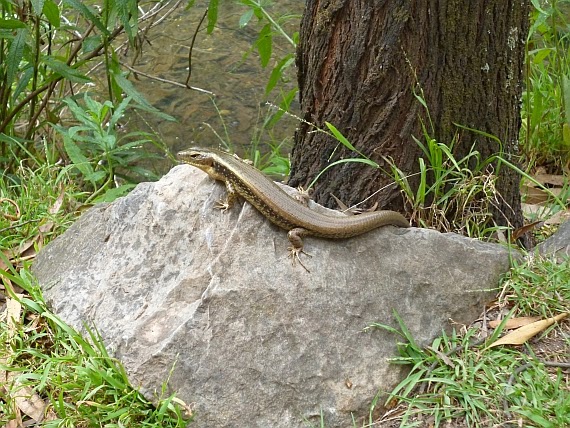
even the skinks are a pleasing, golden, colour:
And of course the caves themselves. We only had time for one, and it was the Lucas Cave, the one I first went into when I was a child:

(No, you don't use the ladder, but the maintenance people who do use to change lightbulbs are pretty brave.) It's hard to do justice to the caves with your basic digital camera, but you get the idea:

They say there are still parts of this extensive network of caves still being newly explored, which is quite amazing given how long these have been a tourist attraction (since the 1860's.)
Unfortunately, the day visit was a bit tarnished by a night spent in some bush cabins beside some extremely rowdy young folk from some overseas place - I suspected Iranians. The setting was nice - full of kangaroos and a wide open field, but these young pests were chasing each other around spraying soft drink on each other before it was dark, then the music came on and it was party time til we (actually, my wife) shouted at them at 12.30 am. It would have been better if they were religious Muslims.
Then the trip continued the next day....
The route from Canberra takes you past Lake George (currently empty, I think, but some big wind turbines are to be seen on the other side.) The most interesting part of the drive is the rather lonely road from Goulburn north. As you can see from the map, it really only has one, small town on the way, Taralga:
We stopped there for lunch and had some quite delicious store made pies (chicken and leek for me and my son; I forget what the "girls" had.) Here's the shop (on the right as you head north):
The buildings on the other side of the road (and this is pretty much the centre of town) look like this:
The somewhat remote feeling about the place, and unexpected collection of old but relatively well kept buildings, were quite appealing to me. It would seem my favourable impressions were well founded:
Taralga differs from many towns in that a large proportion of its existing buildings date from the 1860s to 90s (although now subject to later uses) and because most of them are of stone construction - built from the vast number of stones and rocks which litter the volcanic soils for miles around.I am not sure what one would do if you stayed there, but it was the sort of place I felt I should hang around for a couple of days. It sometimes gets snow in winter, apparently, which would make it look particularly pretty.
These two combined to produce an architectural style which is unique to Taralga - not quite Georgian, not quite Victorian - with a tendency to larger windows and quite substantial construction even for modest dwellings. It also means that the town retains a special heritage of particular interest to the traveller.
But on northward, through more pretty empty country, til we got to the famous Jenolan Caves. I like everything about the place, except (I suppose) how busy it can be during holidays. I like the setting:
the old accommodation
the blue water (caused by dissolved limestone) in the pond outside:
even the skinks are a pleasing, golden, colour:
And of course the caves themselves. We only had time for one, and it was the Lucas Cave, the one I first went into when I was a child:
(No, you don't use the ladder, but the maintenance people who do use to change lightbulbs are pretty brave.) It's hard to do justice to the caves with your basic digital camera, but you get the idea:
They say there are still parts of this extensive network of caves still being newly explored, which is quite amazing given how long these have been a tourist attraction (since the 1860's.)
Unfortunately, the day visit was a bit tarnished by a night spent in some bush cabins beside some extremely rowdy young folk from some overseas place - I suspected Iranians. The setting was nice - full of kangaroos and a wide open field, but these young pests were chasing each other around spraying soft drink on each other before it was dark, then the music came on and it was party time til we (actually, my wife) shouted at them at 12.30 am. It would have been better if they were religious Muslims.
Then the trip continued the next day....
Tiny, tiny black holes, again
I haven't spent much time browsing through arXiv lately, which is a pity, because here are a couple of papers of interest spotted today:
* here's one suggesting that the early universe could have led to the creation of lots of tiny black hole "atoms", which have the unusual feature of having electrons within them, and no charge, and therefore to be very weakly interacting with anything else. They are therefore suggested as a candidate for dark matter. (I'm pretty sure black hole remnants have been suggested as a dark matter candidate before, just not this type of micro black hole.) Interesting.
* here's another paper, much harder to follow, but it is about the blocking of Hawking radiation if a black is inside of a neutron star. This is of interest because I thought that the safety of the potential micro black holes created in the LHC was based on studies looking at the long term existence of neutron stars. I am not sure whether those studies considered the potential for the blocking of Hawking Radiation inside of a neutron star which might not exist inside of a planet. Someone smarter than me would have to look into this.
* here's one suggesting that the early universe could have led to the creation of lots of tiny black hole "atoms", which have the unusual feature of having electrons within them, and no charge, and therefore to be very weakly interacting with anything else. They are therefore suggested as a candidate for dark matter. (I'm pretty sure black hole remnants have been suggested as a dark matter candidate before, just not this type of micro black hole.) Interesting.
* here's another paper, much harder to follow, but it is about the blocking of Hawking radiation if a black is inside of a neutron star. This is of interest because I thought that the safety of the potential micro black holes created in the LHC was based on studies looking at the long term existence of neutron stars. I am not sure whether those studies considered the potential for the blocking of Hawking Radiation inside of a neutron star which might not exist inside of a planet. Someone smarter than me would have to look into this.
Another way for the Omega Point?
Physics - Cosmological Constant Redefined
I need an article that explains this better for me, but as my preferences lie towards a universe that will collapse rather than just end in a run away expansion, I am encouraged that there is a way that it might still happen:
I need an article that explains this better for me, but as my preferences lie towards a universe that will collapse rather than just end in a run away expansion, I am encouraged that there is a way that it might still happen:
The cosmological constant refers to a uniform energy density that presumably could explain the accelerated expansion of the Universe. However, a straightforward calculation of this constant gives an impossibly large value. A new approach to this problem, detailed in Physical Review Letters, involves a slight reformulation of general relativity, in which the cosmological constant ends up being a historical average of the matter energy density in the Universe. Besides predicting a small cosmological constant, the theory foresees an eventual collapse of our Universe in a big crunch.I wonder if Frank Tipler feels encouraged too for his Omega Point idea? I haven't read anything about him for a while. He still seems to be on the Faculty at Tulane University.
Because the cosmological constant is, by definition, constant throughout time and space, it’s natural to associate it with the energy of the vacuum. Unfortunately, if one calculates the vacuum energy density from quantum zero-point fluctuations (i.e., when particles pop in and out of existence), the result is a factor of 10120 higher than the value deduced from astronomical observations.
Theorists have tried to “tune” the cosmological constant by assuming that the quantum vacuum energy is cancelled out by some additional energy (for example, coming from a Higgs-like particle). But these solutions have proven to be unstable. Nemanja Kaloper of the University of California, Davis, and Antonio Padilla of the University of Nottingham, UK, have devised a new strategy, in which they rewrite Einstein’s general relativity equations. The new equations effectively cancel out the input from quantum fluctuations, by treating the cosmological constant as an average of the matter contribution over all of space and time. This produces a relatively small cosmological constant, but it also predicts that our current accelerated expansion will somehow stop in the future and reverse direction. – Michael Schirber
Saturday, March 08, 2014
Beautiful science
Found via Millard Fillmore's Bathtub, here's a spectacular bit of film making by a young guy who works on salmon research at the University of Washington. It certainly shows you don't need a huge budget to get great nature footage these days. Watch it in High Definition, full screen.
Salmon Research at Iliamna Lake, Alaska 2013 from Jason Ching on Vimeo.
Salmon Research at Iliamna Lake, Alaska 2013 from Jason Ching on Vimeo.
What a repulsive bunch
So, Republican Mitch McConnell tries to up his popularity with the conservative, gun loving, climate change denying CPAC crowd by walking on with an (antique) gun held aloft. What a revolting image for a nation with regular gun massacres. As this video shows, it didn't actually work when it came to his speech.
Also, have a look at this good commentary on the speech by vile NRA head Wayne LaPierre.
Also, have a look at this good commentary on the speech by vile NRA head Wayne LaPierre.
Norton's very funny episode
I don't watch Graham Norton's chat show all that often: it's sometimes pretty good, sometimes just so-so.
But last night, while looking for something to watch, I settled on a Norton episode which turned out to be pretty recent. Featuring Matt Damon, Bill Murray, and the English actor from Downton Abbey (they were all in that Monuments Men movie, which seems to have been a bit of a critical and box office fizzer), it was genuinely very funny and felt very spontaneous.
I see that my opinion is shared by others.
It is, at least for the moment, able to be watched in full here:
But last night, while looking for something to watch, I settled on a Norton episode which turned out to be pretty recent. Featuring Matt Damon, Bill Murray, and the English actor from Downton Abbey (they were all in that Monuments Men movie, which seems to have been a bit of a critical and box office fizzer), it was genuinely very funny and felt very spontaneous.
I see that my opinion is shared by others.
It is, at least for the moment, able to be watched in full here:
Dubious tax claims
I did note during the week, via Jason Soon's twitter feed, Adam Creighton's claim that the "rich" are obviously paying enough tax because it is only the top 25% of households that pay "net" tax.
I thought this smelt like more right wing, small government economist spinalysis* which is all about dissuading politicians from ever talking about raising high end tax rates ever again; in fact, its motivation is to suggest the rich should be taxed less. (See IPA, CIS, right wing American economists. Adam Creighton used to do CIS articles.)
John Quiggin has a short, sharp response.
* (I thought analysis which is really all about ideological spin deserved its own word)
I thought this smelt like more right wing, small government economist spinalysis* which is all about dissuading politicians from ever talking about raising high end tax rates ever again; in fact, its motivation is to suggest the rich should be taxed less. (See IPA, CIS, right wing American economists. Adam Creighton used to do CIS articles.)
John Quiggin has a short, sharp response.
* (I thought analysis which is really all about ideological spin deserved its own word)
Wages non disaster
As Koukoulas says: hardly the wages blowout of an inflexible market.
I would guess that the reduced number of restaurants doing Sunday trade means most people assume that penalty rates in hospitality should come down a bit. That's probably about the only change to current wages arrangements for which there is any public sympathy.
I would guess that the reduced number of restaurants doing Sunday trade means most people assume that penalty rates in hospitality should come down a bit. That's probably about the only change to current wages arrangements for which there is any public sympathy.
Today's Rage choice
Well, there are a lot of uninteresting songs and clips still being put out, but I still didn't this mind one, by a new-ish Liverpool band. It seems a while since I've noticed a band made up of young guys who don't look overly angst-y, and you can certainly imagine them going over big in the young female market, which deserves a break from the female domination of pop at the moment:
Friday, March 07, 2014
Roger lying down with dogs, again
I give Roger Scruton credit for being the rarest of things: a clearly right wing intellectual who takes a precautionary approach to climate change, and advocates taxation as a means to address it. (According to this review of one of his books - by Peter Singer no less - Scruton advocates a carbon consumption tax, even though it appears rather impractical to put an accurate figure for such on imported goods.)
So what's Roger doing coming out here and being the headline act, so to speak, of yet another IPA "Western Civilisation Symposium" in May this year? Unless these symposiums are a bit of a money spinner for the far from poor IPA, it's hard to see why they are running another one. You can tell from the comments at Catallaxy that the attendees are all more than likely already members of the IPA who are simply attending - and paying - to get the warm inner glow of hearing what they already believe, and to have drinks with people who think Labor and Unions are appalling people, darling, (and causing the downfall of the once great glorious West).
It keeps them off the street for a weekend, I suppose, and from making inane comments at Catallaxy.
But, does Roger know of the IPA's starring role within Australian politics at promoting not only skepticism over political responses to climate change, but disbelief in climate change per se?
If he is genuine in his concern about a political need to take action about it (as he obviously is if he is promoting a tax as the answer), why would his lend his support to this organisation?
Unfortunately, there is a precedent for this behaviour. Scruton was caught out as a handsomely paid shill for tobacco companies just over a decade ago. What an embarrassment that turned out to be, and one would have thought that he might be more careful about his associations in future. But then, the Institute of Paid Advocacy and him obviously have something in common.
Now, I assume the symposium will not touch climate change, but even so - if there is any prospect that this event is a money spinner for the IPA, or even if he is just helping raise its public profile, he's helping support an organisation that deserves his disrespect and complete disdain if he is genuine about climate change.
I see that Scruton is also doing a Quadrant event. Similar comments apply.
So what's Roger doing coming out here and being the headline act, so to speak, of yet another IPA "Western Civilisation Symposium" in May this year? Unless these symposiums are a bit of a money spinner for the far from poor IPA, it's hard to see why they are running another one. You can tell from the comments at Catallaxy that the attendees are all more than likely already members of the IPA who are simply attending - and paying - to get the warm inner glow of hearing what they already believe, and to have drinks with people who think Labor and Unions are appalling people, darling, (and causing the downfall of the once great glorious West).
It keeps them off the street for a weekend, I suppose, and from making inane comments at Catallaxy.
But, does Roger know of the IPA's starring role within Australian politics at promoting not only skepticism over political responses to climate change, but disbelief in climate change per se?
If he is genuine in his concern about a political need to take action about it (as he obviously is if he is promoting a tax as the answer), why would his lend his support to this organisation?
Unfortunately, there is a precedent for this behaviour. Scruton was caught out as a handsomely paid shill for tobacco companies just over a decade ago. What an embarrassment that turned out to be, and one would have thought that he might be more careful about his associations in future. But then, the Institute of Paid Advocacy and him obviously have something in common.
Now, I assume the symposium will not touch climate change, but even so - if there is any prospect that this event is a money spinner for the IPA, or even if he is just helping raise its public profile, he's helping support an organisation that deserves his disrespect and complete disdain if he is genuine about climate change.
I see that Scruton is also doing a Quadrant event. Similar comments apply.
Subscribe to:
Posts (Atom)