An explicit sex video allegedly involving a NSW player has been leaked as part of a plot to sabotage the Blues on the eve of the State of Origin series.If there's 90 minutes of such material around, their use in lieu of the match broadcast might even drawn in big Victorian viewing numbers for a change.
Monday, June 03, 2019
Unusual tactics
The Sydney Morning Herald claims:

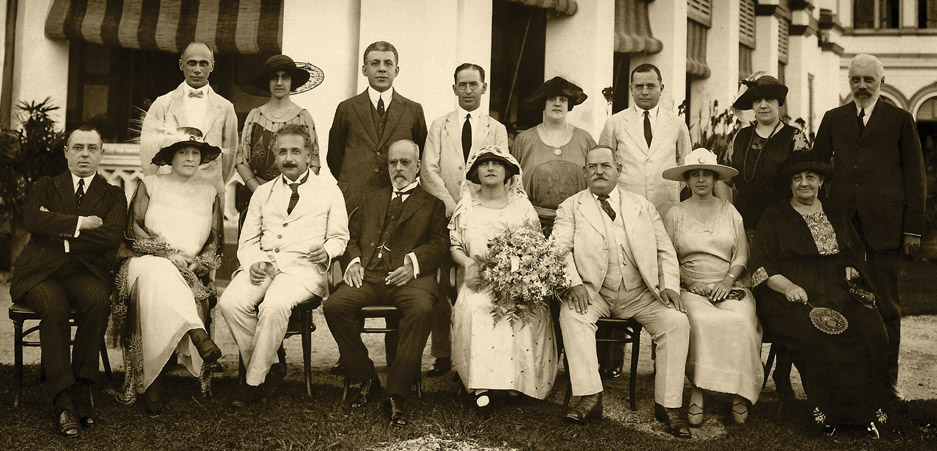
Einstein in the tropics
Yesterday I learned, via a documentary on Channel News Asia about Singaporean history, that Einstein had briefly stopped off there in 1922, on his way to Japan. He met with prominent Singaporean Jews (there were about 623 there at the time - more than I would have expected) to ask for donations for the creation of a Hebrew University. He was already famous at this time, but got his Nobel prize a week after the visit.
Here's a photo of his reception with his wealthy hosts:
 Looking at the photo, the thing that immediately strikes me is how overdressed everyone seems to be for the tropical heat and humidity of Singapore, pre-airconditioning. Europeans in the tropics in those days were made of sturdy stuff...
Here's a photo of his reception with his wealthy hosts:
Pig guilt
I saw on the ABC last week that some Chinese pig farms have taken to burying hundreds/thousands of pigs alive as a culling method to try to prevent the spread of African swine flu.
Googling the topic, I see that video has also circulated late last year apparently showing pigs in a pit (live, the video says, although they don't move much) being set alight.
As a person lately feeling twinges of guilt over eating mammals, this is not helping.
Googling the topic, I see that video has also circulated late last year apparently showing pigs in a pit (live, the video says, although they don't move much) being set alight.
As a person lately feeling twinges of guilt over eating mammals, this is not helping.
He's very strange
As with Trump, Duterte (the globe's other nutty, democratically elected but authoritarian inclined national leader) says so many oddball or offensive things that they are barely registering with the public anymore.
Hence, I have not noticed much attention given to this:
Hence, I have not noticed much attention given to this:
I guess that, like Trump, bragging about his sexual history with women is very important to him. He just throws in additional details of a sex life we really don't need to know about.THE PRESIDENT of the Philippines told a crowd in Japan he used to be gay but was cured by 'beautiful women' – before inviting four women on stage to kiss him.President Rodrigo Duterte, 74, began his speech on Thursday by telling the crowd his critic Senator Antonio Trillanes IV was 'similar' to him because they were both gay.But, he said, he had actually been 'cured' by beautiful women and 'became a man again' when he married his first wife Elizabeth Zimmerman, according to CNN Philippines.
100 ongoing jobs?
Apparently, a Senator last week said Adani would have 100 ongoing jobs (after the construction phase, which will provide all of 1,500 jobs.)
Read about the extremely rubbery Adani figures at this post.
Read about the extremely rubbery Adani figures at this post.
Electromagnetic pulse and the Right
Slate notes that the possibility of an EMP attack on America (by a nuclear weapon or two being let of high above the country) has become a long standing obsession of the Right in particular, and asks why.
I hadn't realised the apparent partisanship of this concern before, but they make a good case.
In any event, as the article does admit, preparatory action to harden electrical networks against it are a good idea, given that it may help with unexpected things like another Carrington event from the Sun.
I hadn't realised the apparent partisanship of this concern before, but they make a good case.
In any event, as the article does admit, preparatory action to harden electrical networks against it are a good idea, given that it may help with unexpected things like another Carrington event from the Sun.
Tornadoes, hurricanes and climate change
The USA seems to be having a lot of problematic weather lately - floods and tornadoes mainly.
Roy Spencer has been going for years about how people are wrong to think that climate change is making tornadoes worse - he talks about the wind shear component that should decrease as the atmosphere warms. And I see that he has another go this year at pooh-poohing the idea that this year's high number is due to climate change (at Fox News, of course.)
But mainstream climate scientists think the story is more complicated, and suspect that climate change is having some effect on tornadoes - although they admit this is a very difficult thing to study given their nature.
Here's a balanced article about it: Is climate change fuelling tornadoes? Some climate scientists are quoted, and the conclusions are:
Roy Spencer has been going for years about how people are wrong to think that climate change is making tornadoes worse - he talks about the wind shear component that should decrease as the atmosphere warms. And I see that he has another go this year at pooh-poohing the idea that this year's high number is due to climate change (at Fox News, of course.)
But mainstream climate scientists think the story is more complicated, and suspect that climate change is having some effect on tornadoes - although they admit this is a very difficult thing to study given their nature.
Here's a balanced article about it: Is climate change fuelling tornadoes? Some climate scientists are quoted, and the conclusions are:
Many of them pointed out that it can be tough to detect tornado trends because comprehensive records only go back a few decades and there's a lot of variability in tornado activity year to year. But they said some shifts are starting to show: while tornado intensity doesn't appear to have changed, there are more days with multiple tornadoes now, and there may be a shift in which regions are especially prone to tornadoes.Even if future storms in a higher temperature don't spawn more tornadoes, there will likely be more damaging severe storms anyway:
More broadly, Brooks said, researchers are looking at severe storm development, because even without tornadoes, giant thunderstorms can produce damaging hail and destructive winds. There's a robust signal that global warming will make the atmosphere more likely to spawn such storms.And the wandering jet stream is not off the hook, too:
Prolonged tornado outbreaks also could potentially be linked with global warming through a jet stream pattern that is becoming more frequent and that keeps extreme weather patterns locked in place, Potsdam Institute for Climate Impact Research scientist Stefan Rahmstorf suggested on Twitter.Speaking of wind shear, I also see a recent paper on research indicating climate change may lead to more rapidly intensifying hurricanes (as well as wetter ones.)
Friday, May 31, 2019
The irrational Delingpole
Professional Right wing denier of climate change Delingpole says that a dubious sounding treatment (regular massage of the limbic system) for a dubious diagnosis ("chronic" Lyme disease) has been making him act nutty:
If I’ve been incredibly rude to you or snappy or tearful lately, if I’ve taken offence where none was intended, or I’ve wildly overreacted to something you said on social media, I do apologise. It wasn’t the real me you experienced in those moments: it was the mad brain that sometimes seizes control of me.But then, he talks about he's been borderline insane many times over many years:
The reason I have these episodes — as I keep having to explain to my bemused victims, after the event — is that I’m currently undergoing intensive medical treatment which gives me these weird and powerful mood swings.
Now that I’m on the healing path I’ve finally been able to take stock of my life and understand what a huge toll my Lyme years have exerted on me physically and mentally. There was a period — still too raw and horrible to talk about in detail — when I wonder whether I shouldn’t have been sectioned. Only recently, when I learnt that Lyme can cause psychosis and I looked up the symptoms, did I realise that this was what I probably had. I was in a dark and terrible place; I certainly wasn’t fit to make important decisions. God, if only I’d known what was happening to me, that it wasn’t my fault and that I needed help.And gullible conservatives have found this guy's view on climate change convincing....
Hydrogen planes, not battery?
There's a start up planning on making a small, boxy commuter "flying car" powered by hydrogen fuel cells. The mock up doesn't look all that inspiring (looks like a slightly bigger version of a passenger drone):

but what's said in the article about the energy density of fuel cells is interesting:
Anyway, one way or another, it seems our future cities will look a bit Blade Runner-ish.

but what's said in the article about the energy density of fuel cells is interesting:
I would still think a pressured hydrogen tank would be the safest thing in a crash. But nor is normal aviation fuel, of course.The argument for fuel cells boils down to energy density: One pound of compressed hydrogen contains over 200 times more energy than one pound of battery, says Alaka’i founder Brian Morrison. That means the Skai can meet the speed, range, and payload requirements that Alaka’i thinks will make it competitive, while saving a lot of weight—a top line consideration for anything that flies. Though the company won’t reveal specifics surrounding the power system, it suggests that it and its fuel cell provider (also not disclosed) have made “breakthroughs” with the technology that enable this performance.Hydrogen fuel cells are proving themselves able to significantly boost run times for vehicle systems, with certain small unmanned aircraft jumping from 30- to 45-minute run times with batteries to more than two to four hours with fuel cells, says Thomas Valdez, a chemical engineer with Teledyne Energy Systems. And they offer a safety benefit by eliminating the risk of thermal runaway. Even a punctured tank is no big deal: “Pressurized hydrogen would very quickly dissipate in the air, so it won’t pool or catch fire the way conventional fuels do,” Valdez says.
Anyway, one way or another, it seems our future cities will look a bit Blade Runner-ish.

How to keep poor people from fleeing poverty - make them poorer
I haven't bothered yet looking at the twitter reaction to Trump's plan to put tariffs on Mexico that will rapidly rise to 25% unless Mexico stops illegal immigration.
But surely someone had already said it - isn't a bit perverse to seek to keep poor people in Mexico by helping ensure their country gets poorer via punitive trade tariffs?
But surely someone had already said it - isn't a bit perverse to seek to keep poor people in Mexico by helping ensure their country gets poorer via punitive trade tariffs?
A blockchain fail
I trust the wonderful world of blockchain conferencing and waffle-ful papers is still being enjoyed by Sinclair Davidson and Chris Berg? At least it gets them out of Australia and their other pet project of trying to drum up support within the Liberals for ending funding of the ABC, so I don't mind them wasting their time overseas, really.
Anyway, I post about it again because it seems that if the German banks have much say in it, blockchain technology doesn't have a bright looking future:
Anyway, I post about it again because it seems that if the German banks have much say in it, blockchain technology doesn't have a bright looking future:
A trial project using blockchain to transfer and settle securities and cash proved more costly and less speedy than the traditional way, Germany’s central bank president said.
The experiment, launched by the Bundesbank together with Deutsche Boerse in 2016, concluded late last year that the prototype “in principle fulfilled all basic regulatory features for financial transactions.” Yet while advocates of distributed ledger technology say it has the potential to be cheaper and faster than current settlement mechanisms, Jens Weidmann said the Bundesbank project did not bear those out.
Still no cold fusion
So Google has been looking into cold fusion again since 2015, but come up with no good news.
Nature notes, surprisingly, that it is not definitely the end of the line for the possibility of cold fusion:
Nature notes, surprisingly, that it is not definitely the end of the line for the possibility of cold fusion:
Is that the final nail in the cold-fusion coffin? Not quite. The group was unable to attain the material conditions speculated to be most conducive to cold fusion. Indeed, it seems extremely difficult to do so using current experimental set-ups — although the team hasn’t excluded such a possibility. So the fusion trail, although cooling, is not yet cold, leaving a few straws for optimists to clutch on to.It's pretty remarkable that it is proving so hard to write this field off entirely.
Trump's "friend" misbehaving, again
Well, can Trump find a way to forgive his "friend" for some more friendship challenging behaviour?
North Korea has executed its special envoy to the United States as well as foreign ministry officials who carried out working-level negotiations for the second summit with Donald Trump in February, holding them responsible for its collapse, South Korean reports say.
Thursday, May 30, 2019
In which renewable energy saves the world (without that much storage)
If this latest idea is right, it suggests that renewables are more capable of saving the world than I had realised.
An article at The Conversation argues that their modelling indicates that, rather than worry about building a lot of storage for renewables, just build with a big enough over-capacity instead, and don't use the excess when it's produced. Sounds questionable, but then again, who knew that adding a metre to an equator-covering rope would raise it 13 cm around the whole world? Not me, so I'm not relying on intuition ever again, or at least, until it suits me.
I would have thought the overcapacity would have to be spread out a fair bit, but they don't even seem to be arguing that. For example:
Anyway, let's go back to some of my earlier ideas about how to get along with more solar. Because if you are going to build to overcapacity, you are going to be wanting to install a lot of extra solar compared to what we have now, and in some places, do you really want to cover up good land with panels? So:
* Remember my previous posts about floating solar on water? Specifically, there seems to be no good reason not to cover large parts of water storage dams (such as Brisbane's Wivenhoe and Somerset dams) with solar panels on plastic floats. I doubt that they represent any real pollution risk to drinking water, and plastic floats are surely pretty cheap. Less evaporation from the dams too.
Why is no one in Australia listening to what is a patently good idea??
Remember - I also argued for Snowy 2 to use floating solar panels to pump storage water. (Although maybe wind there is a better bet?)
* I also have posted before about compulsory State government building codes requiring a minimum amount of solar power and storage - why wouldn't that be a good idea in most of Australia?
In fact, I see that the Greens have adopted such a policy.
And it has now been adopted in California.
This could only help with the "build to overcapacity" idea too, surely?
* If you have to build large solar farms in the country side, I've also posted before (in 2015) about raising them above the ground and spreading them out enough to still be able to use the land underneath for farming or grazing.
* Not sure that I have ever posted about it before, but if you are going to spread out large solar power farms (say, in the middle of Australia where the land is not productive), then you need a good electricity network that is going to reduce losses over transmission distance. High Voltage Direct Current cables have long been mooted as good for that, but their advance seems to be happening pretty slowly.
Gosh, look at the photo at that link for some real oversized gear. I'll throw it in here because it reminds me of the ridiculous oversized equipment on Forbidden Planet:

And in conclusion:
With this latest idea, combined with what I've been suggesting over the last few years, it seems I've pretty much solved the world's renewable energy problems, if only people would listen to me!
Thank you.
PS: I see that a Bill Gates clip from last year of him making a cranky sounding statement that people were kidding themselves if renewables and storage could power the world is doing the rounds. I suspect he just has settled on nuclear as being essential and won't be budged. And didn't he mention steel making?
Well, why doesn't he look harder into proposals to make steel either with no coal at all (see Sweden), or even the CSIRO's proposal to make it with biochar as a way to cut down the CO2 by a large amount.
I can envisage some places where renewables are difficult to use on large enough scale (that Russian city in the Arctic circle during winter, for one!). But just because Bill Gates has what sounds like a sensible hunch, it doesn't always pan out. Has his "condom of the future" competition had any dramatic effects, for example? Not that I know of...
An article at The Conversation argues that their modelling indicates that, rather than worry about building a lot of storage for renewables, just build with a big enough over-capacity instead, and don't use the excess when it's produced. Sounds questionable, but then again, who knew that adding a metre to an equator-covering rope would raise it 13 cm around the whole world? Not me, so I'm not relying on intuition ever again, or at least, until it suits me.
I would have thought the overcapacity would have to be spread out a fair bit, but they don't even seem to be arguing that. For example:
A legitimate question to ask is what would be the area required for a full deployment of oversized solar PV. For Minnesota, in the most extreme 100% PV generation scenario assuming oversizing by a factor of two – or doubling the solar needed to meet current demand – this area would amount to 435 square miles, assuming solar panels with state-of-the-art efficiency of 20%. This area represents less than 1% of the state’s cultivated crops and half of the high- and medium-density urbanized space.Again - sounds a touch too good to be true, but, you know, that rope thing is starting to make me believe anything.
Anyway, let's go back to some of my earlier ideas about how to get along with more solar. Because if you are going to build to overcapacity, you are going to be wanting to install a lot of extra solar compared to what we have now, and in some places, do you really want to cover up good land with panels? So:
* Remember my previous posts about floating solar on water? Specifically, there seems to be no good reason not to cover large parts of water storage dams (such as Brisbane's Wivenhoe and Somerset dams) with solar panels on plastic floats. I doubt that they represent any real pollution risk to drinking water, and plastic floats are surely pretty cheap. Less evaporation from the dams too.
Why is no one in Australia listening to what is a patently good idea??
Remember - I also argued for Snowy 2 to use floating solar panels to pump storage water. (Although maybe wind there is a better bet?)
* I also have posted before about compulsory State government building codes requiring a minimum amount of solar power and storage - why wouldn't that be a good idea in most of Australia?
In fact, I see that the Greens have adopted such a policy.
And it has now been adopted in California.
This could only help with the "build to overcapacity" idea too, surely?
* If you have to build large solar farms in the country side, I've also posted before (in 2015) about raising them above the ground and spreading them out enough to still be able to use the land underneath for farming or grazing.
* Not sure that I have ever posted about it before, but if you are going to spread out large solar power farms (say, in the middle of Australia where the land is not productive), then you need a good electricity network that is going to reduce losses over transmission distance. High Voltage Direct Current cables have long been mooted as good for that, but their advance seems to be happening pretty slowly.
Gosh, look at the photo at that link for some real oversized gear. I'll throw it in here because it reminds me of the ridiculous oversized equipment on Forbidden Planet:

And in conclusion:
With this latest idea, combined with what I've been suggesting over the last few years, it seems I've pretty much solved the world's renewable energy problems, if only people would listen to me!
Thank you.
PS: I see that a Bill Gates clip from last year of him making a cranky sounding statement that people were kidding themselves if renewables and storage could power the world is doing the rounds. I suspect he just has settled on nuclear as being essential and won't be budged. And didn't he mention steel making?
Well, why doesn't he look harder into proposals to make steel either with no coal at all (see Sweden), or even the CSIRO's proposal to make it with biochar as a way to cut down the CO2 by a large amount.
I can envisage some places where renewables are difficult to use on large enough scale (that Russian city in the Arctic circle during winter, for one!). But just because Bill Gates has what sounds like a sensible hunch, it doesn't always pan out. Has his "condom of the future" competition had any dramatic effects, for example? Not that I know of...
Subscribe to:
Posts (Atom)