The outcome of the elections is not good news for the country’s Christians. Although Christians comprise only 2.3 per cent of India’s population, they are known for running excellent schools and well-maintained hospitals. Anti-Christian sentiment is not a new phenomenon. Nevertheless, the situation has grown worse since the current ruling party’s rise to power in 2014.Yes, it is worse than I realised....
In general, there are three primary means of exclusion under which religious minorities suffer in India today: social hostility, laws curbing religious freedom, and caste discrimination.
In a report published in 2018, the US based Pew research centre gave India the highest score for “social hostility” towards religious minorities, including Christians. This intolerance appears to be growing. The faith-based legal organization ADF India and the United Christian Forum run a helpline for victims of persecution. In the first quarter of 2019, there were more than 80 reported cases of mob violence against Christians. This means one violent attack almost every day, targeting priests, pastors, families, and whole church communities.
The aggression against minorities has been fuelled by the propaganda of the so-called Hindutva movement in the run-up to the elections. This movement seeks to purge India of everything non-Hindu and ultimately to build a Hindu nation with the BJP as its political arm. Needless to say, Christianity fits poorly into this nationalist concept.
Meanwhile, the Indian state of Uttarakhand introduced a new law last year ironically called the “Religious Freedom Act”. The BJP-led state is the 10th in India to introduce a so-called anti-conversion law. It is designed to prevent people from converting to religions other than Hinduism. One has to register with the authorities long in advance before being granted permission to accept another faith.
In the more radical versions of such laws, priests who want to baptise an adult and accept him into the Catholic Church also need to register.
Tuesday, June 04, 2019
Christians against Modi
The Catholic Herald has quite a strongly worded piece saying that Christians in India are dismayed that Modi won the Indian election (and so convincingly). The problem - his Hindutva support base:

The duck who was actually a imperialist capitalist running dog
Well, quite an entertaining explanation at The New Yorker about a book written in Chile (pre-Pinochet) that pointed out the capitalist faults of one Donald Duck. The first paragraph:
In Santiago, Chile, in the early nineteen-seventies, the writer Ariel Dorfman served as a cultural adviser to the Chilean President, Salvador Allende. There was revolutionary fervor in the air, and Dorfman, as he wrote in his 1998 memoir, “Heading South, Looking North,” “felt the giddiness of those few great moments in your existence when you know that everything is possible.” He produced everything from poems and policy reports to children’s comics and radio jingles, “letting Spanish flow out of me as if I were a river.” His most enduring work from these years is a volume titled “How to Read Donald Duck: Imperialist Ideology in the Disney Comic,” co-authored with the Belgian sociologist Armand Mattelart. Among North American audiences, Disney was most famous for its films and theme parks, but, abroad, Disney comics had a robust readership, and legions of freelance artists tailored them—or rewrote them—to international tastes. In Chile, Donald Duck was by far the most popular Disney character. But Dorfman and Mattelart argued that Donald was a conservative mouthpiece, dampening the revolutionary spirit, fostering complacency, and softening the sins of colonialism. What kind of a role model was he, this eunuch duck, who sought only fame and fortune, who ignored the plight of the working class, who accepted endless suffering as his lot? “Reading Disney,” they wrote, “is like having one’s own exploited condition rammed with honey down one’s throat.”Post-Pinochet, the book became targeted for burning:
“How to Read Donald Duck,” published in 1971, was an instant best-seller in Chile. But, in 1973, Augusto Pinochet seized power from Allende, in a violent military coup; under Pinochet’s rule, the book was banned, as an emblem of a fallen way of thought. Donald and Mickey Mouse became champions of the counter-revolution. One official pasted their faces on the walls of his office, where, under his predecessor, socialist slogans had once hung. Dorfman watched on TV as soldiers cast his book into a bonfire; the Navy confiscated some ten thousand copies and dumped them into the bay of Valparaíso. A motorist tried to plow him down in the street, shouting “Viva el Pato Donald!” Families of protesters swarmed his home, deploring his attack on their innocence while, less than innocently, they hurled rocks through the windows. In the fifties, Dorfman’s family had fled to Chile to escape an America gripped by McCarthyism; now he would return to the U.S. an exile from Chile. He wouldn’t go back for nearly two decades.How odd.
Krugman on tariff history
An interesting column by Krugman comparing Trump's reckless use of tariffs as punishment to what went on in America post World War 1:
It is, I believe, pretty widely known that America turned its back on the world after World War I: refusing to join the League of Nations, slamming the doors shut on most immigration (fortunately a few years after my grandparents got here).
What’s less known, I suspect, is that America also took a sharply protectionist turn long before the infamous 1930 Smoot Hawley Act. In early 1921, Congress enacted the Emergency Tariff Act, soon followed by the Fordney-McCumber Tariff of 1922. These actions more than doubled average tariffs on dutiable imports. Like Trump, the advocates of these tariffs claimed that they would bring prosperity to all Americans.They didn’t. There was indeed a manufacturing boom, driven not by tariffs but by new products like affordable cars and new technologies like the assembly line. Farmers, however, spent the 1920s suffering from low prices for their products and high prices for farm equipment, leading to a surge in foreclosures.Part of the problem was that U.S. tariffs were met with retaliation; even before the Depression struck, the world was engaged in a gradually escalating trade war. Making things even worse, U.S. tariffs put our World War I allies in an impossible position: We expected them to repay their huge war debts, but our tariffs made it impossible for them to earn the dollars they needed to make those payments.And the trade war/debt nexus created a climate of international distrust and bitterness that contributed to the economic and political crises of the 1930s. This experience had a profound effect on U.S. policy after World War II, which was based on the view that free trade and peace went hand in hand.So am I saying that Trump is repeating the policy errors America made a century ago? No. This time it’s much worse.After all, while Warren Harding wasn’t a very good president, he didn’t routinely abrogate international agreements in a fit of pique. While America in the 1920s failed to help build international institutions, it didn’t do a Trump and actively try to undermine them. And while U.S. leaders between the wars may have turned a blind eye to the rise of racist dictatorships, they generally didn’t praise those dictatorships and compare them favorably to democratic regimes.There are, however, enough parallels between U.S. tariff policy in the 1920s and Trumpism today for us to have a pretty good picture of what happens when politicians think that tariffs are “beautiful.” And it’s ugly.
Heat news
* Heatwave in India, waiting for the monsoon to arrive:

* Heat, not drought, will cause crop losses in America in future:
* Heat, not drought, will cause crop losses in America in future:
Climate change-induced heat stress will play a larger role than drought stress in reducing the yields of several major U.S. crops later this century, according to Cornell University researchers who weighed in on a high-stakes debate between crop experts and scientists.* Record breaking heat in parts of American this last Memorial Day weekend:
The South was sweating through Memorial Day with temperatures hotter than an average summer day.
The region has been under a heat dome since Friday. That's when high pressure aloft acts like a lid trapping the heat below, setting the stage for potentially life-threatening conditions.Some locations, such as Columbia, South Carolina and Augusta, Georgia, broke triple-digit temperature records Monday.
Conscience and evolution
A book review at Nature starts:
What is our conscience, and where does it come from? In her highly readable Conscience, the philosopher Patricia Churchland argues that “we would have no moral stance on anything unless we were social”.It seems she is very even handed in her criticisms of moral philosophers, hating both Kant:
That we have a conscience at all relates to how evolution has shaped our neurobiology for social living. Thus, we judge what is right or wrong using feelings that urge us in a general direction and judgement that shapes these urges into actions. Such judgement typically reflects “some standard of a group to which the individual feels attached”. This idea of conscience as a neurobiological capacity for internalizing social norms contrasts with strictly philosophical accounts of how and why we tell right from wrong.
She eviscerates moral philosophers who believe that moral rules can be utterly divorced from biology and find a foundation based on reasoning alone. She points out that the assumption that morality is not properly philosophically grounded unless it is universal is itself merely a rebuttable stipulation. She notes that decades of attempts to define universal rules have not succeeded. And finally, she shows that most moral dilemmas are just that: dilemmas in which it is impossible to satisfy all the constraints, and which put ostensibly universal principles into conflict with each other.but she's no fan of utilitarianism too:
Neither does she have much use for utilitarians, with their simple calculus of adding up the greatest good for the greatest number. She rightly points out that living in a utilitarian society would be unsatisfying for most people, because we are not partial to all members of our society equally. We prefer our own groups, our own friends, our own families. For most people, as she argues, “love for one’s family members is a colossal neurobiological and psychological fact that mere ideology cannot wish away”. She concludes that utilitarianism is irresolvably at odds with how our brains function, given that we evolved to care more deeply about people we know than about those whom we do not.Could be a good read...
Monday, June 03, 2019
My harsh but fair assessment of the Federal election results

I see that the final seat tally is 77 Coalition, 68 Labor and 6 others (1 of which is Green).
That's a net gain to the Coalition of ONE seat since the last election.
What a trouncing, hey?
Unusual tactics
The Sydney Morning Herald claims:
An explicit sex video allegedly involving a NSW player has been leaked as part of a plot to sabotage the Blues on the eve of the State of Origin series.If there's 90 minutes of such material around, their use in lieu of the match broadcast might even drawn in big Victorian viewing numbers for a change.
Einstein in the tropics
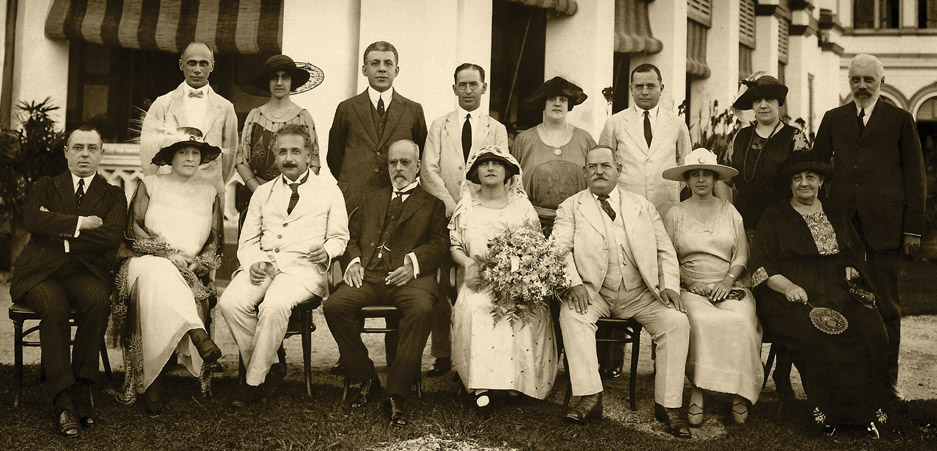
Yesterday I learned, via a documentary on Channel News Asia about Singaporean history, that Einstein had briefly stopped off there in 1922, on his way to Japan. He met with prominent Singaporean Jews (there were about 623 there at the time - more than I would have expected) to ask for donations for the creation of a Hebrew University. He was already famous at this time, but got his Nobel prize a week after the visit.
Here's a photo of his reception with his wealthy hosts:
 Looking at the photo, the thing that immediately strikes me is how overdressed everyone seems to be for the tropical heat and humidity of Singapore, pre-airconditioning. Europeans in the tropics in those days were made of sturdy stuff...
Here's a photo of his reception with his wealthy hosts:
Pig guilt
I saw on the ABC last week that some Chinese pig farms have taken to burying hundreds/thousands of pigs alive as a culling method to try to prevent the spread of African swine flu.
Googling the topic, I see that video has also circulated late last year apparently showing pigs in a pit (live, the video says, although they don't move much) being set alight.
As a person lately feeling twinges of guilt over eating mammals, this is not helping.
Googling the topic, I see that video has also circulated late last year apparently showing pigs in a pit (live, the video says, although they don't move much) being set alight.
As a person lately feeling twinges of guilt over eating mammals, this is not helping.
He's very strange
As with Trump, Duterte (the globe's other nutty, democratically elected but authoritarian inclined national leader) says so many oddball or offensive things that they are barely registering with the public anymore.
Hence, I have not noticed much attention given to this:
Hence, I have not noticed much attention given to this:
I guess that, like Trump, bragging about his sexual history with women is very important to him. He just throws in additional details of a sex life we really don't need to know about.THE PRESIDENT of the Philippines told a crowd in Japan he used to be gay but was cured by 'beautiful women' – before inviting four women on stage to kiss him.President Rodrigo Duterte, 74, began his speech on Thursday by telling the crowd his critic Senator Antonio Trillanes IV was 'similar' to him because they were both gay.But, he said, he had actually been 'cured' by beautiful women and 'became a man again' when he married his first wife Elizabeth Zimmerman, according to CNN Philippines.
100 ongoing jobs?
Apparently, a Senator last week said Adani would have 100 ongoing jobs (after the construction phase, which will provide all of 1,500 jobs.)
Read about the extremely rubbery Adani figures at this post.
Read about the extremely rubbery Adani figures at this post.
Electromagnetic pulse and the Right
Slate notes that the possibility of an EMP attack on America (by a nuclear weapon or two being let of high above the country) has become a long standing obsession of the Right in particular, and asks why.
I hadn't realised the apparent partisanship of this concern before, but they make a good case.
In any event, as the article does admit, preparatory action to harden electrical networks against it are a good idea, given that it may help with unexpected things like another Carrington event from the Sun.
I hadn't realised the apparent partisanship of this concern before, but they make a good case.
In any event, as the article does admit, preparatory action to harden electrical networks against it are a good idea, given that it may help with unexpected things like another Carrington event from the Sun.
Tornadoes, hurricanes and climate change
The USA seems to be having a lot of problematic weather lately - floods and tornadoes mainly.
Roy Spencer has been going for years about how people are wrong to think that climate change is making tornadoes worse - he talks about the wind shear component that should decrease as the atmosphere warms. And I see that he has another go this year at pooh-poohing the idea that this year's high number is due to climate change (at Fox News, of course.)
But mainstream climate scientists think the story is more complicated, and suspect that climate change is having some effect on tornadoes - although they admit this is a very difficult thing to study given their nature.
Here's a balanced article about it: Is climate change fuelling tornadoes? Some climate scientists are quoted, and the conclusions are:
Roy Spencer has been going for years about how people are wrong to think that climate change is making tornadoes worse - he talks about the wind shear component that should decrease as the atmosphere warms. And I see that he has another go this year at pooh-poohing the idea that this year's high number is due to climate change (at Fox News, of course.)
But mainstream climate scientists think the story is more complicated, and suspect that climate change is having some effect on tornadoes - although they admit this is a very difficult thing to study given their nature.
Here's a balanced article about it: Is climate change fuelling tornadoes? Some climate scientists are quoted, and the conclusions are:
Many of them pointed out that it can be tough to detect tornado trends because comprehensive records only go back a few decades and there's a lot of variability in tornado activity year to year. But they said some shifts are starting to show: while tornado intensity doesn't appear to have changed, there are more days with multiple tornadoes now, and there may be a shift in which regions are especially prone to tornadoes.Even if future storms in a higher temperature don't spawn more tornadoes, there will likely be more damaging severe storms anyway:
More broadly, Brooks said, researchers are looking at severe storm development, because even without tornadoes, giant thunderstorms can produce damaging hail and destructive winds. There's a robust signal that global warming will make the atmosphere more likely to spawn such storms.And the wandering jet stream is not off the hook, too:
Prolonged tornado outbreaks also could potentially be linked with global warming through a jet stream pattern that is becoming more frequent and that keeps extreme weather patterns locked in place, Potsdam Institute for Climate Impact Research scientist Stefan Rahmstorf suggested on Twitter.Speaking of wind shear, I also see a recent paper on research indicating climate change may lead to more rapidly intensifying hurricanes (as well as wetter ones.)
Friday, May 31, 2019
The irrational Delingpole
Professional Right wing denier of climate change Delingpole says that a dubious sounding treatment (regular massage of the limbic system) for a dubious diagnosis ("chronic" Lyme disease) has been making him act nutty:
If I’ve been incredibly rude to you or snappy or tearful lately, if I’ve taken offence where none was intended, or I’ve wildly overreacted to something you said on social media, I do apologise. It wasn’t the real me you experienced in those moments: it was the mad brain that sometimes seizes control of me.But then, he talks about he's been borderline insane many times over many years:
The reason I have these episodes — as I keep having to explain to my bemused victims, after the event — is that I’m currently undergoing intensive medical treatment which gives me these weird and powerful mood swings.
Now that I’m on the healing path I’ve finally been able to take stock of my life and understand what a huge toll my Lyme years have exerted on me physically and mentally. There was a period — still too raw and horrible to talk about in detail — when I wonder whether I shouldn’t have been sectioned. Only recently, when I learnt that Lyme can cause psychosis and I looked up the symptoms, did I realise that this was what I probably had. I was in a dark and terrible place; I certainly wasn’t fit to make important decisions. God, if only I’d known what was happening to me, that it wasn’t my fault and that I needed help.And gullible conservatives have found this guy's view on climate change convincing....
Hydrogen planes, not battery?
There's a start up planning on making a small, boxy commuter "flying car" powered by hydrogen fuel cells. The mock up doesn't look all that inspiring (looks like a slightly bigger version of a passenger drone):

but what's said in the article about the energy density of fuel cells is interesting:
Anyway, one way or another, it seems our future cities will look a bit Blade Runner-ish.

but what's said in the article about the energy density of fuel cells is interesting:
I would still think a pressured hydrogen tank would be the safest thing in a crash. But nor is normal aviation fuel, of course.The argument for fuel cells boils down to energy density: One pound of compressed hydrogen contains over 200 times more energy than one pound of battery, says Alaka’i founder Brian Morrison. That means the Skai can meet the speed, range, and payload requirements that Alaka’i thinks will make it competitive, while saving a lot of weight—a top line consideration for anything that flies. Though the company won’t reveal specifics surrounding the power system, it suggests that it and its fuel cell provider (also not disclosed) have made “breakthroughs” with the technology that enable this performance.Hydrogen fuel cells are proving themselves able to significantly boost run times for vehicle systems, with certain small unmanned aircraft jumping from 30- to 45-minute run times with batteries to more than two to four hours with fuel cells, says Thomas Valdez, a chemical engineer with Teledyne Energy Systems. And they offer a safety benefit by eliminating the risk of thermal runaway. Even a punctured tank is no big deal: “Pressurized hydrogen would very quickly dissipate in the air, so it won’t pool or catch fire the way conventional fuels do,” Valdez says.
Anyway, one way or another, it seems our future cities will look a bit Blade Runner-ish.
Subscribe to:
Posts (Atom)