I'm currently slowly reading "Life and Leisure in Ancient Rome" by J Balsdon. It's actually a 1969 book, now sold in cheap paperback edition in discount book shops.
My knowledge of day to day life in those times is very limited. Watching "I Claudius," "Gladiator" and the recent Dr Who episode set in Pompeii is about it, really. I suppose I could get a better idea by ploughing through Colleen McCullough's Roman novels, but I am not convinced she is a good enough writer. [Update: I forgot, but I did quite like the British Museum's section on Rome too, where I became aware of the popularity of the phallic symbol as a sort of "good luck" charm, and household gods. I remain curious about how particular household gods were created in the first place. Somewhere in England, I think at Hadrian's Wall, I also learnt about how they used sponges on sticks instead of toilet paper.]
So far, the book is actually very enjoyable, and every few pages there is something odd and novel that I feel like sharing. Here are some examples:
* August 24, October 5 and November 8 were believed to be the days that the entrance to the underworld was open. There were another three days when the ghosts of the dead were out and about. While I know many cultures share the idea of a "ghost" day, what is the point of having another set of days in which the entrance to the underworld is open? In any event, they were unlucky days on which nothing important could be done. I like to imagine the exchanges in some toga-clad planning committee trying to set a good day for the equivalent of a school fete: "no, no, you can't do it on that Saturday, remember the gates of the underworld are open that day."
"Ah, oh yeah, yeah, sorry forgot about that one."
* On March 15, the festival of Anna Perenna was a holiday in which people went to a river bank north of the city and "lay about promiscuously in the open or in tents, drank heavily (one glass for every further year of life that was desired) and, in the evening, reeled back to the city in tipsy procession." All sounds like some festivals in present day England. I assume the alcohol content of the drinks was less than today (they drank wine with water, I think) otherwise those desiring a long life would have been at high risk of ending it early by alcohol poisoning.
* The low birth rate within Roman families is noted, although the reasons why are apparently not entirely clear. The widespread use of lead may well have had something to do with it. Certainly, contraception was often desired, but not effective, and abortion as well as "exposing infants" (leaving outside them to die - or, if lucky, be rescued by strangers) was common. God knows what the rate of death by botched abortion might have been - the author does not describe the methods. Abortion was made illegal in the second century, but it appears there was never a law against abandoning infants.
Interestingly, the reason for abandonment was often simply economic. The much maligned Emporer Constantine introduced immediate economic relief for the poor who were at risk of doing this. He also allowed them to sell their children (often to slave nurseries), but with the proviso that if things improved, they could buy them back. A big improvement on being left on a rock for the night, at least, but whether that makes up for his having his son and wife killed is debatable. (He's a saint in the Eastern Orthodox Church, but as far as I know, Roman Catholics don't spend a lot of time celebrating him. Evelyn Waugh wrote a novel about his mother Helena, and told a friend how Constantine figured in it as - if I recall correctly - "a bit of a sh*t.")
It's interesting to think that State welfare to encourage the raising of children started 2,000 years ago.
Anyhow, it's a good read, and well worth a look.
Monday, July 13, 2009


The past stinks
From a TLS review of a new book on the Palace of Versailles:
Water was in great demand and caused enormous problems. The fountains used up half a million litres in three hours. In the eighteenth century they were rarely switched on, and in summer the basins emitted pestilential odours. A great reservoir at the end of the North Wing provided water for washing and for the kitchens and stables, usually in an insanitary way. A brisk washing of hands and faces was often sufficient for most courtiers, and perfumes seldom counteracted the remaining body odours. A bath was a sex aid rather than an act of personal hygiene. Before the water closet became a royal privilege, the chaise percée was the norm. There were 274 of them in Louis XIV’s time. The king and leading courtiers habitually gave audience while seated on theirs. The ambitious Parmesan diplomat Alberoni paid a compliment to the homosexual duc de Vendôme as the latter rose from his chaise percée by exclaiming ecstatically “O culo d’angelo”, as the duke wiped his backside. The gist of Newton’s findings is that Versailles stank, as courtiers and their servants urinated in corners and on staircases. Drains were inadequate, refuse and dead animals were simply thrown out in the public way, and vidangeurs had the unenviable task of cleaning out stinking cesspools.What a great word: "pestilential".
Tesla remembered
Happy birthday, Nikola Tesla: thanks for the electricity
Good to see Nikola Tesla remembered in The Guardian. It's well worth reading up on him, if you never have before.
He certainly was a character well suited to science fiction speculations, yet I don't recall him appearing in any famous movie.
Good to see Nikola Tesla remembered in The Guardian. It's well worth reading up on him, if you never have before.
He certainly was a character well suited to science fiction speculations, yet I don't recall him appearing in any famous movie.
Precision
Apollo special: Mirrors on the moon - New Scientist
A good article about the measurements done by laser on the Earth-Moon distance.
Did you know that they can measure the distance to within a few millimetres? And at this scale, you have to take into account the solar radiation pressure that can push the moon about 4 mm?
No, nor did I. It's hard to imagine how precisely some scientific measurements can now be made.
A good article about the measurements done by laser on the Earth-Moon distance.
Did you know that they can measure the distance to within a few millimetres? And at this scale, you have to take into account the solar radiation pressure that can push the moon about 4 mm?
No, nor did I. It's hard to imagine how precisely some scientific measurements can now be made.
Funny the way things turn out...
It's been an odd feature of the last 20 years of politics here how Labor's view of itself as the "natural" party for better Australian foreign policy has gone all askew. On the face of it, one would think that they have a point: it sees itself as less subservient to the US, emphasizes independence of foreign policy development and the importance of regional engagement, and academic foreign policy experts all appear broadly to be aligned with such sentiments.
Yet, I don't think anyone seriously denies that Keating was about as far off the mark as he possibly could have been when he said Asia would not take a Howard government "seriously".
Now, we have the counter-intuitive situation of aPrime Minister with apparent superb credentials to impress the Chinese getting slapped around the face by said country.
Go on Kevin, we're waiting to be impressed with your resolution of this problem.
Yet, I don't think anyone seriously denies that Keating was about as far off the mark as he possibly could have been when he said Asia would not take a Howard government "seriously".
Now, we have the counter-intuitive situation of aPrime Minister with apparent superb credentials to impress the Chinese getting slapped around the face by said country.
Go on Kevin, we're waiting to be impressed with your resolution of this problem.
Long life in a pill?
If red wine's good, are resveratrol pills even better? - Los Angeles Times
Interesting article on how resveratrol (a potentially health promoting compound in red wine) is being sold to the public well before anyone knows if it works on humans, or at what dosage.
Impatience of this type is often unwise.
Interesting article on how resveratrol (a potentially health promoting compound in red wine) is being sold to the public well before anyone knows if it works on humans, or at what dosage.
Impatience of this type is often unwise.
Sunday, July 12, 2009
A weekend in July
Some highlights:
* Saturday night ox tail stew. This is a dish for which a pressure cooker is indispensable. A better winter meal (served on mashed potatoes, with some green beans and couple of glasses of red) is hard to imagine.
* A visit to the Queensland Maritime Museum. It's been maybe 20 years since I had been there, and I was really impressed. Years ago, it was a bit of an amateur enthusiasts' jumble, but now the new-ish main exhibit hall is set out with high quality exhibits full of interesting detail. (Queensland Museum, go have a look.) The centrepiece of the museum remains, however, the HMAS Diamantina, a former Navy ship that saw some service in WWII, now sitting in a permanent dry dock originally built in the 1880's. The ship has been fitted out well (better than the last time I saw it), and all levels are open for people to wander around. Here's a photo (not the clearest, but still):

One of the exhibits in the main hall is an extract from an 1864 migrant ship on-board newspaper, written to entertain the passengers. Oddly, the then idea of entertainment included a serialisation of a real life shipwreck story. (This appearing after the introductory bit about how rough the weather has been lately, preventing the passengers from entertaining themselves "on the poop" as before.) There is also a birth on board recorded, indicating that migrants were made of sturdy stuff in those days. You can have a read of some of it if you click the image:
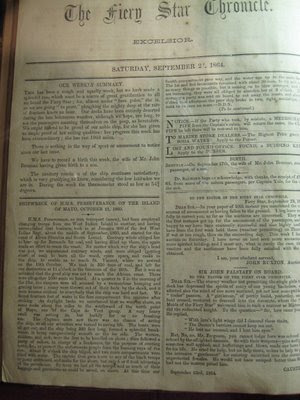
I think the story was that this was re-printed in Brisbane when the ship arrived: it did not appear in neat newsprint like this on board the ship.
There is a small admission price to this museum, but it is well worth it for half a day.
* Some extremely tender "wagyu" style rump steak on Sunday night. More red wine, this time the $1.99 a bottle cab sav from Dan Murphy's!. (Quite drinkable, but unremarkable. The steak was excellent, though.)
* Saturday night ox tail stew. This is a dish for which a pressure cooker is indispensable. A better winter meal (served on mashed potatoes, with some green beans and couple of glasses of red) is hard to imagine.
* A visit to the Queensland Maritime Museum. It's been maybe 20 years since I had been there, and I was really impressed. Years ago, it was a bit of an amateur enthusiasts' jumble, but now the new-ish main exhibit hall is set out with high quality exhibits full of interesting detail. (Queensland Museum, go have a look.) The centrepiece of the museum remains, however, the HMAS Diamantina, a former Navy ship that saw some service in WWII, now sitting in a permanent dry dock originally built in the 1880's. The ship has been fitted out well (better than the last time I saw it), and all levels are open for people to wander around. Here's a photo (not the clearest, but still):

One of the exhibits in the main hall is an extract from an 1864 migrant ship on-board newspaper, written to entertain the passengers. Oddly, the then idea of entertainment included a serialisation of a real life shipwreck story. (This appearing after the introductory bit about how rough the weather has been lately, preventing the passengers from entertaining themselves "on the poop" as before.) There is also a birth on board recorded, indicating that migrants were made of sturdy stuff in those days. You can have a read of some of it if you click the image:

I think the story was that this was re-printed in Brisbane when the ship arrived: it did not appear in neat newsprint like this on board the ship.
There is a small admission price to this museum, but it is well worth it for half a day.
* Some extremely tender "wagyu" style rump steak on Sunday night. More red wine, this time the $1.99 a bottle cab sav from Dan Murphy's!. (Quite drinkable, but unremarkable. The steak was excellent, though.)
Saturday, July 11, 2009
Embarrassing? Let me count the ways...
ADF man robbed of laptop by ladyboy | The Australian
THE Australian Defence Force is investigating a potential breach of national security after a naval officer in Bangkok was robbed of his Defence Department computer by a ladyboy he had brought back to his hotel room late at night.Defence last night played down the security implications of the theft, saying the data in the laptop was of a low classification and it was password-protected.
The officer -- named in a Thai police report as Lieutenant Commander ....................., a qualified helicopter pilot who received the Order of Australia Medal in January -- was in Bangkok on official business and had gone out for the night to the city's Nana Plaza, an entertainment zone in the city full of go-go bars and where ladyboys also solicit in the streets.
Friday, July 10, 2009
An observation...
Has there ever been an uglier internet ad than the one for "The Gabriel Method". No, I'm not going to link to it, but you know, the weight loss whatever-it-is with the photo of the porker guy before (with shirt) and after (sans shirt)?
I've always found it deeply unappealing, yet it seems to be popping up more than ever. (I think it used to haunt conservative blogs in particular, but its reach now seems more widespread.)
Can someone design a Firefox tool that hides it from my sight?
I've always found it deeply unappealing, yet it seems to be popping up more than ever. (I think it used to haunt conservative blogs in particular, but its reach now seems more widespread.)
Can someone design a Firefox tool that hides it from my sight?
Thursday, July 09, 2009
'ello?
Seems remarkably quiet, comment-wise, around here lately. I do my best to cover the best topics: sex, religion, politics, giant robots, but for nought...
UPDATE: blog re-designed somewhat. I'm quite pleased with the result. (But still some fiddling to be done to make it perfect.) Any novel Gadget/Widget suggestions are welcome.
UPDATE 2: that's odd. I just noticed that the upgrade to the "layouts" template made my links revert to a previous version, before I fixed them up a few weeks ago. I've got to go sort them out again (as well as insert headings.) Oh well...
UPDATE: blog re-designed somewhat. I'm quite pleased with the result. (But still some fiddling to be done to make it perfect.) Any novel Gadget/Widget suggestions are welcome.
UPDATE 2: that's odd. I just noticed that the upgrade to the "layouts" template made my links revert to a previous version, before I fixed them up a few weeks ago. I've got to go sort them out again (as well as insert headings.) Oh well...
Good news, kind of...
Low-end house prices 'to fall 10pc' | Property | News.com.au
The odd thing is, I guess for the first time buyer, government grants to encourage you to buy a house shouldn't really make much difference. I mean, while the grants are available, they artificially inflate the price, as everyone knows the government is funding a percentage of your buying power.
When the grants finish, the price should drop and the net cost to the first time buyer who has waited should be about the same.
The drop in price should also encourage investment buyers, which may have the effect of reducing rent (slightly) for those who can't buy.
The only losers are those who buy with a grant and who then need to sell soon after the grants cease. (Oh, and the rest of us who have had their taxes spent on a grant which may not really have helped first home buyers at all.)
The odd thing is, I guess for the first time buyer, government grants to encourage you to buy a house shouldn't really make much difference. I mean, while the grants are available, they artificially inflate the price, as everyone knows the government is funding a percentage of your buying power.
When the grants finish, the price should drop and the net cost to the first time buyer who has waited should be about the same.
The drop in price should also encourage investment buyers, which may have the effect of reducing rent (slightly) for those who can't buy.
The only losers are those who buy with a grant and who then need to sell soon after the grants cease. (Oh, and the rest of us who have had their taxes spent on a grant which may not really have helped first home buyers at all.)
Of note in Slate
There are two fairly amusing articles of note in Slate.
The first: about the Segway and its image problem. Apparently, guided city tours on them are now "ubiquitous", and "help fulfill one of the iron laws of tourism: Thou shalt do things one would never do at home (eat tripe, smoke a water pipe, listen to French pop)." I am curious to try them at least once.
The second: William Saletan has a go at finding a loophole in the Catholic Church's official negative position on masturbation. Was there ever a teaching that was less followed in the history of the church? A much more realistic Christian approach to the topic - at least in the context of teenagers - can be found at this site, which appears to be written by an Australian youth worker associated with the Assemblies of God. However, the number of photos of boys plastered through the site (even though it is just their faces) works against it: it gives the feeling that the author has just a little too much interest in boys, even though his advice is pretty reasonable (if you're Christian, at least.)
The first: about the Segway and its image problem. Apparently, guided city tours on them are now "ubiquitous", and "help fulfill one of the iron laws of tourism: Thou shalt do things one would never do at home (eat tripe, smoke a water pipe, listen to French pop)." I am curious to try them at least once.
The second: William Saletan has a go at finding a loophole in the Catholic Church's official negative position on masturbation. Was there ever a teaching that was less followed in the history of the church? A much more realistic Christian approach to the topic - at least in the context of teenagers - can be found at this site, which appears to be written by an Australian youth worker associated with the Assemblies of God. However, the number of photos of boys plastered through the site (even though it is just their faces) works against it: it gives the feeling that the author has just a little too much interest in boys, even though his advice is pretty reasonable (if you're Christian, at least.)
Do as the giant robot commands!
Gundam promotes Tokyo 2016’s Olympic bid
(Go to the link to see a photo of said giant robot in Tokyo)
(Go to the link to see a photo of said giant robot in Tokyo)
Iraqi veteran fabulist
The story of the Marine who wasn't - Los Angeles Times
As it happens, I am pretty certain I currently have a client who is a big-time fabulist.
My suspicions are likely to be confirmed soon if promised large amounts of money (not for my benefit) do not arrive.
As it happens, I am pretty certain I currently have a client who is a big-time fabulist.
My suspicions are likely to be confirmed soon if promised large amounts of money (not for my benefit) do not arrive.
Miyazaki news of the day
Hayao Miyazaki, Anime’s Master, to Visit San Diego Comic-Con - NYTimes.com
(The article talks about him generally, and his lack of commercial success in the US.)
(The article talks about him generally, and his lack of commercial success in the US.)
Big dill hits Big Apple?
It's usually Tim Blair's job to track all things "Hicks", but here we go.
The New Yorker ran an article noting that it finally appears confirmed (in a new book by his ex-wife) that Osama Bin Laden made a short trip with her to the United States in 1979. According to the wife, it seemed most Americans were nice enough towards them.
In the comments that follow, there is one by someone calling him (or her?) self "davidhicks1" who is from "downunder". I'll just put it here in full:
Whoever the writer is, he (or she) should not plan on visiting the States any time soon.
The New Yorker ran an article noting that it finally appears confirmed (in a new book by his ex-wife) that Osama Bin Laden made a short trip with her to the United States in 1979. According to the wife, it seemed most Americans were nice enough towards them.
In the comments that follow, there is one by someone calling him (or her?) self "davidhicks1" who is from "downunder". I'll just put it here in full:
"I came to believe that Americans were gentle and nice." Well of course 'most' Americans are thus. The only 'problematic' ones are those that have been supporting the Racist State of Israel these many decades past. There is a feeling around -and some hope in the world these days- that these unfortunate policies may be about to be minimised( Stay on course President Obama!),and maybe even reversed. How many Americans could list the THREE 'demands' of Osama bin Laden post 9/11. I'll give you a clue from 'downunder.' One had the word PALESTINE in it!To my ear, this does indeed sound like something the real David Hicks would say, but who knows. Certainly, it seems odd that the writer finds "most" Americans are nice, but then finds the (very large) proportion who support Israel "problematic". Are they overlapping sets, with some Americans being both nice and "problematic"?
Whoever the writer is, he (or she) should not plan on visiting the States any time soon.
Julia, Julia
Annabel Crabb today has a pretty witty column about how right wingers have become infatuated with Julia Gillard, in much the same Margaret Thatcher was seen to have sex appeal by her male opponents of a certain age.
Well, it may have something to do with the mysterious allure of her fleshy ears, since I can report again that barely a day goes past without a few people landing at this blog via a Google search of "Julia Gillard earlobes" or some variation thereof. (For those fans, Julia's sometimes coyly hiding lobes were on very open display last night in a 7.30 Report interview. Knock yourselves out.)
As for me, I think I have mentioned here before that my response to her softened when she showed a surprising graciousness on election night by declining Kerry O'Brien's offer to put the boot into John Howard for not making way for Peter Costello. (When asked whether this had been Howard's big mistake, she replied that, while such simple analysis would be easy to make, in reality all the Labor polling indicated that the Coalition would have done worse under Costello.)
Of course, her policies will still lead to rack and ruin in industrial relations, but she does seem a more genuine person than K Rudd by a few country miles.
Well, it may have something to do with the mysterious allure of her fleshy ears, since I can report again that barely a day goes past without a few people landing at this blog via a Google search of "Julia Gillard earlobes" or some variation thereof. (For those fans, Julia's sometimes coyly hiding lobes were on very open display last night in a 7.30 Report interview. Knock yourselves out.)
As for me, I think I have mentioned here before that my response to her softened when she showed a surprising graciousness on election night by declining Kerry O'Brien's offer to put the boot into John Howard for not making way for Peter Costello. (When asked whether this had been Howard's big mistake, she replied that, while such simple analysis would be easy to make, in reality all the Labor polling indicated that the Coalition would have done worse under Costello.)
Of course, her policies will still lead to rack and ruin in industrial relations, but she does seem a more genuine person than K Rudd by a few country miles.
Subscribe to:
Comments (Atom)