 Hey, it only took 10 minutes or so.
Tuesday, February 07, 2006

Monday, February 06, 2006
Some Muslims get it
IslamOnline - Views Section
In the interests of fairness, it should be noted that many Islamic commentators understand the harm that the violent demonstrations about cartoons are causing the reputation of their religion. See the link above for one.
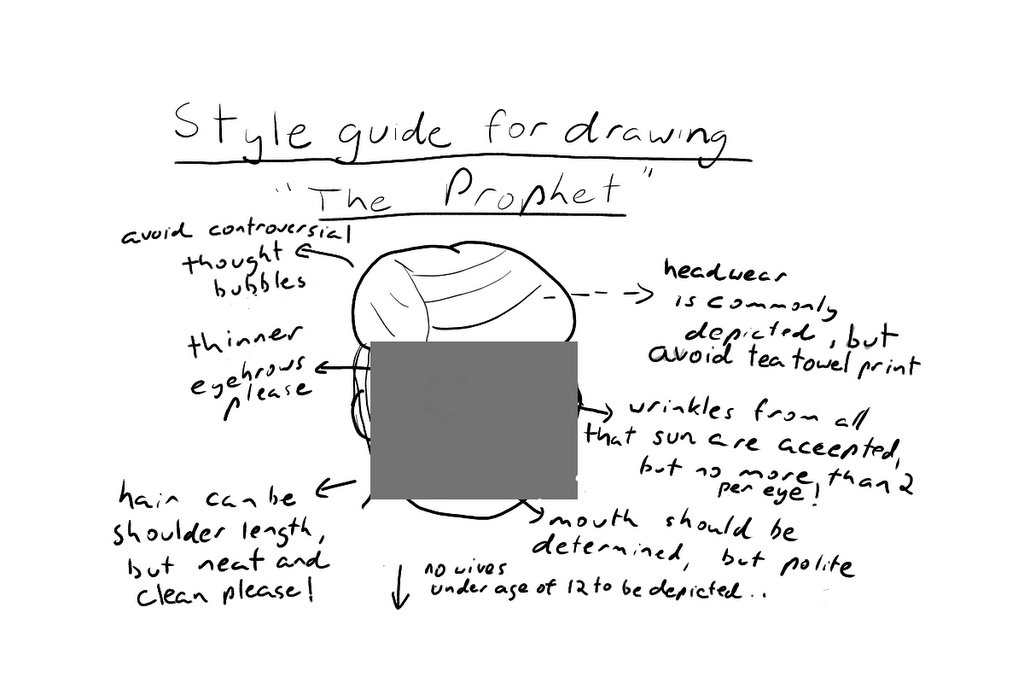
Now that my previous post established that more cartoons might encourage democracy in the Arab world, I should point people towards the following "style guide" to drawing Mohammed:
"The hairstyle of the Prophet (peace and blessings of Allaah be upon him) is mentioned in a number of ahaadeeth, such as the following:
1 – His hair was neither curly nor straight....
It was narrated that Anas ibn Maalik said, describing the Prophet (peace and blessings of Allaah be upon him), he was of average height, neither very tall nor very short. He had a ruddy complexion, neither very white nor very dark, and his hair was neither curly nor straight. The revelation came to him when he was forty years old.
2 – His hair came down to his earlobes...
3 – His hair sometimes came down to his shoulders ...
4 – The Prophet (peace and blessings of Allaah be upon him) used to dye his hair sometimes...
5 – He used to part his hair....
6 – The Prophet (peace and blessings of Allaah be upon him) did his Farewell Pilgrimage when his hair was stuck together.
(This means) making some parts of the hair stick to others using gum or something similar, so that the hair is held together and avoids getting dirty and does not need to be washed....
7 – The Prophet (peace and blessings of Allaah be upon him) sometimes used to braid his hair, especially when travelling, to keep it from getting dusty. "
Actually, the web site I got that from is full of interesting facts about the Messenger (as he is called). For example, if you ever wondered what the name of his camel was, well, that's a bit controversial:
"Of camels he had al-Qaswaa’, and it was said that she was the camel on which he made his Hijrah; and al-‘Adbaa’ and al-Jad’aa’. Were al-‘Adbaa’ and al-Jad’aa’ one and the same, or two different camels? There is some difference of opinion concerning this."
And I am sure you are wondering, how did he ride his camel:
"The Prophet (peace and blessings of Allaah be upon him) rode horses, camels, mules and donkeys. He rode horses both saddled and bareback, and he used to make them gallop them on occasion. He used to ride alone, which was most of the time, but sometimes he would put someone behind him on the camel, or he would put one person behind him and one in front, so there would be three men on one camel. So he would sometimes let some men ride on his camel with him, and on some occasions he let his wives ride with him."
Surely you have to laugh at such a ridiculously detailed answer to a question that seems incredibly irrelevant to anything to do with religion.
Maybe someone is thinking I shouldn't poke fun at Islam this way; after all Christian monks used to argue about how many angels could dance on the head of a pin. But the point is that Christians don't worry about that any more, and we can recognise that medieval Christianity had many obsessions we now consider quite bizarre and therefore wryly amusing (the trade in relics, for example.) Anyway, I would hope that some Muslims agree that this sort of interest in the tiniest detail of their Prophet's life is sort of funny, and rather beside the main point of their religion.
In the interests of fairness, it should be noted that many Islamic commentators understand the harm that the violent demonstrations about cartoons are causing the reputation of their religion. See the link above for one.
Now that my previous post established that more cartoons might encourage democracy in the Arab world, I should point people towards the following "style guide" to drawing Mohammed:
"The hairstyle of the Prophet (peace and blessings of Allaah be upon him) is mentioned in a number of ahaadeeth, such as the following:
1 – His hair was neither curly nor straight....
It was narrated that Anas ibn Maalik said, describing the Prophet (peace and blessings of Allaah be upon him), he was of average height, neither very tall nor very short. He had a ruddy complexion, neither very white nor very dark, and his hair was neither curly nor straight. The revelation came to him when he was forty years old.
2 – His hair came down to his earlobes...
3 – His hair sometimes came down to his shoulders ...
4 – The Prophet (peace and blessings of Allaah be upon him) used to dye his hair sometimes...
5 – He used to part his hair....
6 – The Prophet (peace and blessings of Allaah be upon him) did his Farewell Pilgrimage when his hair was stuck together.
(This means) making some parts of the hair stick to others using gum or something similar, so that the hair is held together and avoids getting dirty and does not need to be washed....
7 – The Prophet (peace and blessings of Allaah be upon him) sometimes used to braid his hair, especially when travelling, to keep it from getting dusty. "
Actually, the web site I got that from is full of interesting facts about the Messenger (as he is called). For example, if you ever wondered what the name of his camel was, well, that's a bit controversial:
"Of camels he had al-Qaswaa’, and it was said that she was the camel on which he made his Hijrah; and al-‘Adbaa’ and al-Jad’aa’. Were al-‘Adbaa’ and al-Jad’aa’ one and the same, or two different camels? There is some difference of opinion concerning this."
And I am sure you are wondering, how did he ride his camel:
"The Prophet (peace and blessings of Allaah be upon him) rode horses, camels, mules and donkeys. He rode horses both saddled and bareback, and he used to make them gallop them on occasion. He used to ride alone, which was most of the time, but sometimes he would put someone behind him on the camel, or he would put one person behind him and one in front, so there would be three men on one camel. So he would sometimes let some men ride on his camel with him, and on some occasions he let his wives ride with him."
Surely you have to laugh at such a ridiculously detailed answer to a question that seems incredibly irrelevant to anything to do with religion.
Maybe someone is thinking I shouldn't poke fun at Islam this way; after all Christian monks used to argue about how many angels could dance on the head of a pin. But the point is that Christians don't worry about that any more, and we can recognise that medieval Christianity had many obsessions we now consider quite bizarre and therefore wryly amusing (the trade in relics, for example.) Anyway, I would hope that some Muslims agree that this sort of interest in the tiniest detail of their Prophet's life is sort of funny, and rather beside the main point of their religion.
Cartoon comments from Arab News
There Are 101 Ways to Skin a Cat
The link above suggests ways in which offended Muslim nations should retaliate against Europe:
"I recommend that we utilize a gradual and escalating approach to boycotting Western goods and services. Starting with luxury items and easily replaceable products as a first step that can be quickly and, relatively painlessly implemented.
We may then move on to more complicated items that require finding alternative sources and working with them to produce goods that match our specifications.
Finally we move on to products that we will need to build our own factories to produce.
This serves several purposes: One, it allows our businessmen to find alternatives to Western products in an organized way. Remember, it is not an easy task to rearrange trading patterns that have been in place for decades, if not centuries.
Second, it allows our economies to realign and adjust to the changed trading environment with a minimum of difficulty.
Third, it allows our non-Western trading partners to adjust their production to fulfill our needs."
Hmm. Sounds like the writer is encouraging the Arab countries to learn how to make stuff themselves instead of just buying it with oil money. Presumably, this will lead to a bigger middle class, which most people think is a preliminary step to having more liberal and democratic countries.
If that is the result - the West should publish more cartoons as soon as possible...
The link above suggests ways in which offended Muslim nations should retaliate against Europe:
"I recommend that we utilize a gradual and escalating approach to boycotting Western goods and services. Starting with luxury items and easily replaceable products as a first step that can be quickly and, relatively painlessly implemented.
We may then move on to more complicated items that require finding alternative sources and working with them to produce goods that match our specifications.
Finally we move on to products that we will need to build our own factories to produce.
This serves several purposes: One, it allows our businessmen to find alternatives to Western products in an organized way. Remember, it is not an easy task to rearrange trading patterns that have been in place for decades, if not centuries.
Second, it allows our economies to realign and adjust to the changed trading environment with a minimum of difficulty.
Third, it allows our non-Western trading partners to adjust their production to fulfill our needs."
Hmm. Sounds like the writer is encouraging the Arab countries to learn how to make stuff themselves instead of just buying it with oil money. Presumably, this will lead to a bigger middle class, which most people think is a preliminary step to having more liberal and democratic countries.
If that is the result - the West should publish more cartoons as soon as possible...
Tim Blair stands up
Tim Blair
It took a little time, but Tim has now posted the cartoons in question. Yay.
I am now waiting for some right wing death bloggers to come up with some more. (I wonder if Blogger is entirely happy with that prospect.) I don't want to see anything out and out nasty (not like you see in Arab papers against the Jews.) But it is kind of funny to think you could presumably draw a stick man, title it "Prophet Mohammed" and still be in trouble.
Update: Zoe Brain fires a broadside that is well worth looking at too.
Update 2: just to be clear about what I meant above: I think it would be interesting to have bloggers have a go at drawing original cartoons that depict Mohammed in a humourous context, but within the bounds of reasonable taste that those in the West or Far East would expect if the figure was, say, Jesus Christ, Bhudda or a Hindu god. I may have a go later tonight myself.
I don't think people should go out of their way to be offensive, but as several people have noted, the Danish cartoons were really very mild, even if the meaning of one or two was somewhat obscure. The one which seems to have caused most offence (the bomb in the turban) is correctly seen as an indictment of where certain strains of Islam are taking us; not an insult to Mohammed himself.
Incidentally, why didn't the makers of "South Park" get targetted when their "Super Best Friends" episode went to air in 2001? (I am not a fan of that show, but I did quite like that episode.) I believe that is Mohammed 3rd from the left in the screen shot here.
It took a little time, but Tim has now posted the cartoons in question. Yay.
I am now waiting for some right wing death bloggers to come up with some more. (I wonder if Blogger is entirely happy with that prospect.) I don't want to see anything out and out nasty (not like you see in Arab papers against the Jews.) But it is kind of funny to think you could presumably draw a stick man, title it "Prophet Mohammed" and still be in trouble.
Update: Zoe Brain fires a broadside that is well worth looking at too.
Update 2: just to be clear about what I meant above: I think it would be interesting to have bloggers have a go at drawing original cartoons that depict Mohammed in a humourous context, but within the bounds of reasonable taste that those in the West or Far East would expect if the figure was, say, Jesus Christ, Bhudda or a Hindu god. I may have a go later tonight myself.
I don't think people should go out of their way to be offensive, but as several people have noted, the Danish cartoons were really very mild, even if the meaning of one or two was somewhat obscure. The one which seems to have caused most offence (the bomb in the turban) is correctly seen as an indictment of where certain strains of Islam are taking us; not an insult to Mohammed himself.
Incidentally, why didn't the makers of "South Park" get targetted when their "Super Best Friends" episode went to air in 2001? (I am not a fan of that show, but I did quite like that episode.) I believe that is Mohammed 3rd from the left in the screen shot here.
Comedians are dumb
Practising the dangerous art of sedition - Opinion - theage.com.au
I note that a bunch of comics who either can't or don't bother reading had another go at complaining about the revised sedition laws.
The article about this in the Age (linked above) is again clearly misleading:
"This afternoon a group of artists will descend on the Arts Centre, in St Kilda Road, and try their hardest to get arrested. Comic Rod Quantock will collect money for an unnamed terrorist organisation, cabaret artist Eddie Perfect will sing his ditty John Howard's Bitches and satirist Max Gillies will assume a stiff marionette smirk and do his utmost to make Prime Minister John Howard look like a twat.
If this isn't urging disaffection with the Government, what is? Such antics are hardly intended to arouse warm, fuzzy feelings for our elected leaders. Under new sedition laws, seditious intent is defined as urging disaffection against the Constitution, the Government of the Commonwealth, or either house of Parliament. Yet, chances are, when Sedition!, the concert, is performed at the Arts Centre this afternoon, nothing will happen."
As I have pointed out several times before, this idea that a person doing something with "seditious intent" (as defined above) is an offence under the legislation is simply wrong.
But can comics read for themselves? Can journalists from The Age? Seems not.
I note that a bunch of comics who either can't or don't bother reading had another go at complaining about the revised sedition laws.
The article about this in the Age (linked above) is again clearly misleading:
"This afternoon a group of artists will descend on the Arts Centre, in St Kilda Road, and try their hardest to get arrested. Comic Rod Quantock will collect money for an unnamed terrorist organisation, cabaret artist Eddie Perfect will sing his ditty John Howard's Bitches and satirist Max Gillies will assume a stiff marionette smirk and do his utmost to make Prime Minister John Howard look like a twat.
If this isn't urging disaffection with the Government, what is? Such antics are hardly intended to arouse warm, fuzzy feelings for our elected leaders. Under new sedition laws, seditious intent is defined as urging disaffection against the Constitution, the Government of the Commonwealth, or either house of Parliament. Yet, chances are, when Sedition!, the concert, is performed at the Arts Centre this afternoon, nothing will happen."
As I have pointed out several times before, this idea that a person doing something with "seditious intent" (as defined above) is an offence under the legislation is simply wrong.
But can comics read for themselves? Can journalists from The Age? Seems not.
No apologies required
Drawn into a religious conflict - Los Angeles Times
The article above in the LA Times is quite a good one on the cartoons and Islam story.
After some historical background (which I presume is more or less accurate, but I am just taking it on trust), the writer (Tim Rutten) has this to say:
"The West's current struggle with a murderous global Sunni Muslim insurgency and the threat of a nuclear-armed theocracy in Iran makes it clear that it's no longer possible to overlook the culture of intolerance, hatred and xenophobia that permeates the Islamic world. The hard work of rooting those things out will have to be done by honest Muslim leaders and intellectuals willing to retrace their tradition's steps and do the intellectual heavy lifting that participation in the modern world requires. They won't be helped, however, if Western governments continue to pander to Islamic sensitivity while looking away from violent Islamic intolerance. They won't be helped by European diplomats and officials who continue to ignore the officially sanctioned hate regularly directed at Jews by the Mideast's government-controlled media, while commiserating with Muslims offended by a few cartoons in the West's free news media.
The decent respect for the opinions of others that life in modern, pluralistic societies requires is not a form of relativism. It will not do, as Isaiah Berlin once put it, to say, "I believe in kindness and you believe in concentration camps" and let's leave it at that."
The only problem I see is: just how much time does the West have to wait for Islam to be revised by its "honest Muslim leaders and intellectuals?" Not a lot, it would seem.
As you may expect, Christopher Hitchens also thinks the US is sounding too sympathetic to Islam. See his article in Slate here.
In the Wall Street Journal there is also criticism of the West (by and large) caving in too easily on this issue:
"The issue, though, is much larger than the question of how to balance press freedom with religious sensibilities; it goes to the heart of the conflict with radical Islam. The Islamists demand no less than absolute supremacy for their religion--and not only in the Muslim world but wherever Muslims may happen to reside. That's why they see no hypocrisy in their demand for "respect" for Islam while the simple display of a cross or a Star of David in Saudi Arabia is illegal. Infidels simply don't have the same rights."
I am waiting to see what Australian commentators have to say about this. I expect something wishy washy from Fairfax press, and presumably something more in line with the above pieces in News Limited.
The article above in the LA Times is quite a good one on the cartoons and Islam story.
After some historical background (which I presume is more or less accurate, but I am just taking it on trust), the writer (Tim Rutten) has this to say:
"The West's current struggle with a murderous global Sunni Muslim insurgency and the threat of a nuclear-armed theocracy in Iran makes it clear that it's no longer possible to overlook the culture of intolerance, hatred and xenophobia that permeates the Islamic world. The hard work of rooting those things out will have to be done by honest Muslim leaders and intellectuals willing to retrace their tradition's steps and do the intellectual heavy lifting that participation in the modern world requires. They won't be helped, however, if Western governments continue to pander to Islamic sensitivity while looking away from violent Islamic intolerance. They won't be helped by European diplomats and officials who continue to ignore the officially sanctioned hate regularly directed at Jews by the Mideast's government-controlled media, while commiserating with Muslims offended by a few cartoons in the West's free news media.
The decent respect for the opinions of others that life in modern, pluralistic societies requires is not a form of relativism. It will not do, as Isaiah Berlin once put it, to say, "I believe in kindness and you believe in concentration camps" and let's leave it at that."
The only problem I see is: just how much time does the West have to wait for Islam to be revised by its "honest Muslim leaders and intellectuals?" Not a lot, it would seem.
As you may expect, Christopher Hitchens also thinks the US is sounding too sympathetic to Islam. See his article in Slate here.
In the Wall Street Journal there is also criticism of the West (by and large) caving in too easily on this issue:
"The issue, though, is much larger than the question of how to balance press freedom with religious sensibilities; it goes to the heart of the conflict with radical Islam. The Islamists demand no less than absolute supremacy for their religion--and not only in the Muslim world but wherever Muslims may happen to reside. That's why they see no hypocrisy in their demand for "respect" for Islam while the simple display of a cross or a Star of David in Saudi Arabia is illegal. Infidels simply don't have the same rights."
I am waiting to see what Australian commentators have to say about this. I expect something wishy washy from Fairfax press, and presumably something more in line with the above pieces in News Limited.
Friday, February 03, 2006
On Alan Turing
The New Yorker: The Critics: Books
If, like me, you a bit about Alan Turing's work but not much about his personal life, the book review above is very interesting. Eccentric genius would seem an appropriate description. (Also gay, which seems not all that common amongst science types.)
The author of the review, Jim Holt, is (I presume) the same Jim Holt who wrote some excellent science stories in Slate magazine. For example, check his exploration of How Will the Universe End. He's a great popular science writer.
If, like me, you a bit about Alan Turing's work but not much about his personal life, the book review above is very interesting. Eccentric genius would seem an appropriate description. (Also gay, which seems not all that common amongst science types.)
The author of the review, Jim Holt, is (I presume) the same Jim Holt who wrote some excellent science stories in Slate magazine. For example, check his exploration of How Will the Universe End. He's a great popular science writer.
The Economist backgrounds the varieties of Islam
Political Islam | Forty shades of green | Economist.com
A lengthy article that is useful in understanding mad Islamists. Give them Madagascar, I say.
A lengthy article that is useful in understanding mad Islamists. Give them Madagascar, I say.
Now, the civility wars
The Australian: Peter Saunders: Don't blame Howard for decline of civility [February 03, 2006]
Much common sense is spoken by Peter Saunders in the above article.
I am well and truly sick of the spurious argument that "economic rationalism" means increased incivility. Apart from Left leaning commentators, does the average person in the street really believe this theory? Maybe some with liberal tendencies would say they do, but probably simply because it has been repeated so often they might assume its truth. I would like to know who first came up with the idea; certainly it has been done to death over the years by those such as Hugh Mackay and Eva Cox. But really, it is the triumph of sloganeering over common sense.
Anyone over 40 knows that there has been a gradual erosion in certain matters of civility since the 1960's that is impossible to plausibly tie to "economic rationalism". For example, the careless use of language regardless of the possible offence caused to the public (I am thinking of those who wear outright crude T Shirts while walking down a shopping mall, or teenagers who swear loudly while waiting for the bus, regardless of the little old ladies sitting next to them.)
"Road rage" is also a completely novel phenomena that I think rarely has anything to do with the quality of the car that annoys the offender.
On the other hand, certain types of incivility have diminished since the 1960's. I suspect that there are not a hell of a lot of catholic kids getting beaten up by State school kids these days.
But overall, yes I agree that incivility has been on the rise, but the reasons set out by Saunders in his article are correct. His ending is particularly telling:
"In the past, when the norms governing public behaviour were clearer than they are today, public figures such as teachers and police officers felt confident about expressing and enforcing them. They knew the rest of the community (including those higher up) would back them up. Today, this confidence is ebbing away. Last October, Sydney magistrate Pat O'Shane dismissed a case brought against a youth who had drunkenly sworn obscenities at police in a public street, and she ordered the police to pay the offender's costs of $2600. She told her court: "I'm not sure there is such a thing as community standards any more."
Statements like this from people in authority can cause huge damage. There are still community standards, but they take a hammering when prominent people such as magistrates refuse to acknowledge them.
If we want to safeguard civility, our teachers, politicians, broadcasters, magistrates and judges must understand how important it is for them not only to recognise that community standards of behaviour still exist, but also to defend them wholeheartedly and tenaciously. If we cannot rely on this, then we are indeed in trouble."
Yes indeed, a lot of the problem is the underlying relativism of much of the Left's moral reasoning, which erodes certainty as to the limits of acceptable behaviour. Yet they have the hide to try to deflect blame onto the bogeyman of economic rationalism.
Much common sense is spoken by Peter Saunders in the above article.
I am well and truly sick of the spurious argument that "economic rationalism" means increased incivility. Apart from Left leaning commentators, does the average person in the street really believe this theory? Maybe some with liberal tendencies would say they do, but probably simply because it has been repeated so often they might assume its truth. I would like to know who first came up with the idea; certainly it has been done to death over the years by those such as Hugh Mackay and Eva Cox. But really, it is the triumph of sloganeering over common sense.
Anyone over 40 knows that there has been a gradual erosion in certain matters of civility since the 1960's that is impossible to plausibly tie to "economic rationalism". For example, the careless use of language regardless of the possible offence caused to the public (I am thinking of those who wear outright crude T Shirts while walking down a shopping mall, or teenagers who swear loudly while waiting for the bus, regardless of the little old ladies sitting next to them.)
"Road rage" is also a completely novel phenomena that I think rarely has anything to do with the quality of the car that annoys the offender.
On the other hand, certain types of incivility have diminished since the 1960's. I suspect that there are not a hell of a lot of catholic kids getting beaten up by State school kids these days.
But overall, yes I agree that incivility has been on the rise, but the reasons set out by Saunders in his article are correct. His ending is particularly telling:
"In the past, when the norms governing public behaviour were clearer than they are today, public figures such as teachers and police officers felt confident about expressing and enforcing them. They knew the rest of the community (including those higher up) would back them up. Today, this confidence is ebbing away. Last October, Sydney magistrate Pat O'Shane dismissed a case brought against a youth who had drunkenly sworn obscenities at police in a public street, and she ordered the police to pay the offender's costs of $2600. She told her court: "I'm not sure there is such a thing as community standards any more."
Statements like this from people in authority can cause huge damage. There are still community standards, but they take a hammering when prominent people such as magistrates refuse to acknowledge them.
If we want to safeguard civility, our teachers, politicians, broadcasters, magistrates and judges must understand how important it is for them not only to recognise that community standards of behaviour still exist, but also to defend them wholeheartedly and tenaciously. If we cannot rely on this, then we are indeed in trouble."
Yes indeed, a lot of the problem is the underlying relativism of much of the Left's moral reasoning, which erodes certainty as to the limits of acceptable behaviour. Yet they have the hide to try to deflect blame onto the bogeyman of economic rationalism.
Thursday, February 02, 2006
Janet Albrechtsen on Howard's history
The Australian: Textbook case of making our past a blame game [February 01, 2006]
Janet's column in yesterday's Australia is an excellent piece. (Assuming she is fairly reporting what is in her child's history text.)
Teachers are a worry.
Janet's column in yesterday's Australia is an excellent piece. (Assuming she is fairly reporting what is in her child's history text.)
Teachers are a worry.
Desktop fusion is real
ScienceDaily: Using Sound Waves To Induce Nuclear Fusion With No External Neutron Source
One hopes that this may lead to something useful in terms of energy production in future.
One hopes that this may lead to something useful in terms of energy production in future.
Yes, it was as stupid as it sounds
Toxic fish advice kept secret - National - smh.com.au
This is an update to the post I did questioning the common sense (or lack thereof) in banning fishing in one area of a harbour, as if they can't swim.
And yes, scientists did realise it was stupid not to do more, but nothing happened for years. Great.
This is an update to the post I did questioning the common sense (or lack thereof) in banning fishing in one area of a harbour, as if they can't swim.
And yes, scientists did realise it was stupid not to do more, but nothing happened for years. Great.
More on contraception & abortion
Is Abortion Bad? - Waiting for the condom crusade. By William Saletan and Katha Pollitt
The link above is to a Slate published exchange of letters between William Saletan (whose New York Times article I strongly recommended a few posts ago) and a critic of his approach.
He quotes more interesting poll results from the USA which indicate that the pro choice lobby really won't convince the public of much if it insists on abortion being just unfortunate, rather than an inherently bad thing. And, as common sense would indicate is appropriate, the later the abortion, the worse the public thinks of it.
The link above is to a Slate published exchange of letters between William Saletan (whose New York Times article I strongly recommended a few posts ago) and a critic of his approach.
He quotes more interesting poll results from the USA which indicate that the pro choice lobby really won't convince the public of much if it insists on abortion being just unfortunate, rather than an inherently bad thing. And, as common sense would indicate is appropriate, the later the abortion, the worse the public thinks of it.
Wednesday, February 01, 2006
Meanwhile, up with the sheep...
It's kind of fun to annoy people by talking about a movie I haven't seen and probably won't. Anyway, Brokeback Mountain was the subject of a decidedly gushing comment piece by John Heard in the Australian a couple of days ago. It is, presumably, not a bad movie, but this (emphasis mine) is a bit over the top, isn't it?:
"This curious tale of unabashed same-sex attraction written for the rigidly heterosexual cowboy genre wasn't just a hit in the obvious places, although the queues in Chelsea, New York City, went around the block on opening night.
Rather, it has been watched and re-watched by thousands in the south and especially in Texas, the most masculine, devout, George W.Bush-rearing state in the union.
The personal testimonies on the film's website, left by surprised, delighted or otherwise deeply moved, deeply ordinary Texans and other cowpokes and ranch folk are wrenching. The thought of "good ole boys" sitting down with popcorn and handkerchiefs to watch what is, ostensibly, a chick-flick in man-drag is stunning."
So how big a hit (commercially) is it? From Rotten Tomatoes, I see that it has earned $51 million in the US after 8 weeks in release, and took $6 million last weekend (presumably, there is a bounce in ticket sales from all the recent awards.) By comparison, something like "Fun with Dick and Jane", a poorly reviewed Jim Carrey comedy, has made $106 million.
My point is: until a movie reaches about $100 million in the US, it doesn't exactly have "big hit" written all over it. (King Kong took over $200 million and is considered a bit of a flop, but then it did cost about that to make. I presume there are few special effects up on Brokeback.) (Gosh it is hard to avoid trying to be funny about that movie.)
Speaking of movie hits, have a look at that Rotten Tomatoes link to see how much money the prominent Oscar nominated films have made this year. Not only has Hollywood seemingly decided to try to annoy all Red States, it has also apparently set poor-to-middling box office performance as a criteria for attention.
"This curious tale of unabashed same-sex attraction written for the rigidly heterosexual cowboy genre wasn't just a hit in the obvious places, although the queues in Chelsea, New York City, went around the block on opening night.
Rather, it has been watched and re-watched by thousands in the south and especially in Texas, the most masculine, devout, George W.Bush-rearing state in the union.
The personal testimonies on the film's website, left by surprised, delighted or otherwise deeply moved, deeply ordinary Texans and other cowpokes and ranch folk are wrenching. The thought of "good ole boys" sitting down with popcorn and handkerchiefs to watch what is, ostensibly, a chick-flick in man-drag is stunning."
So how big a hit (commercially) is it? From Rotten Tomatoes, I see that it has earned $51 million in the US after 8 weeks in release, and took $6 million last weekend (presumably, there is a bounce in ticket sales from all the recent awards.) By comparison, something like "Fun with Dick and Jane", a poorly reviewed Jim Carrey comedy, has made $106 million.
My point is: until a movie reaches about $100 million in the US, it doesn't exactly have "big hit" written all over it. (King Kong took over $200 million and is considered a bit of a flop, but then it did cost about that to make. I presume there are few special effects up on Brokeback.) (Gosh it is hard to avoid trying to be funny about that movie.)
Speaking of movie hits, have a look at that Rotten Tomatoes link to see how much money the prominent Oscar nominated films have made this year. Not only has Hollywood seemingly decided to try to annoy all Red States, it has also apparently set poor-to-middling box office performance as a criteria for attention.
Some more Middle East thoughts
* On Hamas in the Middle East: Salon.com (of course) is trying to blame George W for the success of Hamas and wants to ridicule him over the failure of "democracy" to deliver acceptable outcomes. The argument that you can't expect democracy to have good results unless it is based "on a rule of law, on stable institutions, on basic economic security for the population, and on checks and balances that forestall a tyranny of the majority" initially sounds plausible, but on closer reflection it is all a bit "chicken and egg" isn't it? I mean, undemocratic governments don't have much incentive to set up well for up a system that is likely to kick them out, do they? And in the case of Iraq in particular, there was not exactly a hell of a lot of time to be spent on establishing the liberal society first before giving democracy a try, was there?
Maybe it comes down, then, to some liberals just believing that the Middle East should be left to flounder in its own mess. Maybe next century they will be ready for democracy..
But one further point that Juan Cole makes in his article (which, incidentally, has a particularly snide header, even for Salon: "How do you like your democracy now, Mr Bush?") perhaps shows the flaw in his pessimism. He writes (emphasis mine):
" To be sure, many Israelis believe that Hamas is only using the truce to rearm, that it will never change its opposition to the very existence of Israel, and that any negotiations with the Islamist group will only weaken the Jewish state. And Hamas' failure to speak clearly about its intentions does nothing to allay such fears. But no one has ever put Hamas to the test. Neither Bush nor Israel have ever made good-faith efforts to resolve the underlying issues, preferring to issue moralistic denunciations that ignore the reality on the ground."
As an article I linked to in a previous post noted, it is the fact that Hamas now has to take responsibility and not hide behind its "government" that actually gives some cautious ground for optimism.
Maybe it comes down, then, to some liberals just believing that the Middle East should be left to flounder in its own mess. Maybe next century they will be ready for democracy..
But one further point that Juan Cole makes in his article (which, incidentally, has a particularly snide header, even for Salon: "How do you like your democracy now, Mr Bush?") perhaps shows the flaw in his pessimism. He writes (emphasis mine):
" To be sure, many Israelis believe that Hamas is only using the truce to rearm, that it will never change its opposition to the very existence of Israel, and that any negotiations with the Islamist group will only weaken the Jewish state. And Hamas' failure to speak clearly about its intentions does nothing to allay such fears. But no one has ever put Hamas to the test. Neither Bush nor Israel have ever made good-faith efforts to resolve the underlying issues, preferring to issue moralistic denunciations that ignore the reality on the ground."
As an article I linked to in a previous post noted, it is the fact that Hamas now has to take responsibility and not hide behind its "government" that actually gives some cautious ground for optimism.
Subscribe to:
Posts (Atom)