Mystery Comet Explodes into Brightness
Clearly, the current space shuttle mission is actually a welcoming party, but they'll probably be disintegrating before they can say "Klaatu barada nikto".
Clutching at straws, you say. Tell that to your new comet-dwelling alien overlords!
Saturday, October 27, 2007


Howard's record by Hartcher
Typical. The Sydney Morning Herald's Peter Hartcher has an article that leads the News Review section of the paper this morning, but it seems not to be on the web. Called "Smashing the Myths", it deals with several favourite anti-Howard memes and lists the evidence for or against them. I can summarise the myths that Hartcher debunks as follows:
1. John Howard has made more Australia more selfish (except for the fact that they both donate much more money now and volunteer more time)
2. Howard can't work with Asia (except that in fact Australia has been more engaged with Asia than ever). Hartcher notes that even Keating dropped this line last month, when he said "any clown" could manage relations with Asian powers. (I had missed that.)
3.Howard has ruined the immigration programme (in fact has more immigrants than ever, and with less public resistance to it than when Keating was in.)
4. The economy is strong mainly because of the mining boom (as Gerard Henderson noted earlier this week, economists don't agree).
5. The 2004 Free Trade Agreement with the US sold out the national interest and would cause economic damage. (There is no reporting of the harm it has caused because it has caused none.)
So far so good, in the sense that Hartcher cites a lot of evidence to support his "myth busting" under each of the headings. When he gets onto the Howard negatives, though, the evidence becomes questionable.
The negative list is:
1. Howard took Australia to war in Iraq on a false premise. Well, at least he is not saying "Howard lied" about this. Hartcher cites the US Senate Select Committee on the pre-war intelligence. Hartcher might be a bit more even handed by adding that even the likes of Kevin Rudd believed the "false premise" too.
2. Howard and the Howard government have told lies. Here Hartcher really goes off the rails for a minute, as the evidence he cites is public opinion polls indicate most people believe it! Yeah, right, that's the way to 'get to the truth' of this proposition, Peter. Why do we need journalists at all if the polls will tell us what happened.
3. The Howard government has increased regulatory burden on businesses. Well, guess I can't dispute that, but it is part and parcel of introducing a new tax (GST) that, as far as I can tell, is deemed a great success.
4. The government has treated some immigrants and refugees punitively and manipulatively. In fact, I accept some criticism of the government about this, but at least it is remarkable how boats with would-be refugee claimants are no longer drowning in the Timor Sea.
5. The Howard government wasted a decade denying man-made global warming was real. Hartcher actually makes a point I was not aware of: Howard initially gave high praise to the Kyoto treaty. I didn't recall that, and shows that all politicians can make mistakes!
Overall, it was a good article.
1. John Howard has made more Australia more selfish (except for the fact that they both donate much more money now and volunteer more time)
2. Howard can't work with Asia (except that in fact Australia has been more engaged with Asia than ever). Hartcher notes that even Keating dropped this line last month, when he said "any clown" could manage relations with Asian powers. (I had missed that.)
3.Howard has ruined the immigration programme (in fact has more immigrants than ever, and with less public resistance to it than when Keating was in.)
4. The economy is strong mainly because of the mining boom (as Gerard Henderson noted earlier this week, economists don't agree).
5. The 2004 Free Trade Agreement with the US sold out the national interest and would cause economic damage. (There is no reporting of the harm it has caused because it has caused none.)
So far so good, in the sense that Hartcher cites a lot of evidence to support his "myth busting" under each of the headings. When he gets onto the Howard negatives, though, the evidence becomes questionable.
The negative list is:
1. Howard took Australia to war in Iraq on a false premise. Well, at least he is not saying "Howard lied" about this. Hartcher cites the US Senate Select Committee on the pre-war intelligence. Hartcher might be a bit more even handed by adding that even the likes of Kevin Rudd believed the "false premise" too.
2. Howard and the Howard government have told lies. Here Hartcher really goes off the rails for a minute, as the evidence he cites is public opinion polls indicate most people believe it! Yeah, right, that's the way to 'get to the truth' of this proposition, Peter. Why do we need journalists at all if the polls will tell us what happened.
3. The Howard government has increased regulatory burden on businesses. Well, guess I can't dispute that, but it is part and parcel of introducing a new tax (GST) that, as far as I can tell, is deemed a great success.
4. The government has treated some immigrants and refugees punitively and manipulatively. In fact, I accept some criticism of the government about this, but at least it is remarkable how boats with would-be refugee claimants are no longer drowning in the Timor Sea.
5. The Howard government wasted a decade denying man-made global warming was real. Hartcher actually makes a point I was not aware of: Howard initially gave high praise to the Kyoto treaty. I didn't recall that, and shows that all politicians can make mistakes!
Overall, it was a good article.
Friday, October 26, 2007
Tattoos you may regret
Maybe I will get around to commenting on the Dumbledore was gay schtick soon, but in the meantime the story has meant fame for a 36 year old (non gay) Dad with a huge Dumbledore tattoo on his back. Really, isn't having large tatts done to please children enough to bring you to the attention of the Children's Protection services?
Anyway, here's some tattoo comedy (maybe it started out as a dolphin or something):
Anyway, here's some tattoo comedy (maybe it started out as a dolphin or something):
How not to win friends in the government
Three rate rises ahead, says ANZ - FederalElection2007News - FederalElection2007
Presumably, Mike Smith of ANZ does not think it likely he needs to have friends in the Howard government, with his prediction not just of a rate rise in November, but two more to come after that.
This is another case of terrible luck for John Howard. As far as I can tell, no one can point to any actual policy of the Howard government that is leading to the current pressure for interest rate increases (matters such as droughts, the US home lending crisis, and house price increases seem to be all that is cited.)
George Megalogenis points out today that nothing Rudd would do as PM has any prospect of affecting interest rates in a downwards direction in the short to medium term, so it's not like people can expect relief on home mortgages by voting Labor.
Howard is still arguing that relaxing IR laws will have an inflationary effect, and therefore interest rates will still be lower under the Coalition. But, of course, Labor will argue that Howard and Costello have already failed their last election "promise", so why believe them now, and that is likely to be the argument that will stick in voter's minds. (After all, it is politically difficult for the Coalition to suddenly push the line too hard that the recent interest rates are really out of its hands.)
Things are not looking good for Coalition recovery...
Presumably, Mike Smith of ANZ does not think it likely he needs to have friends in the Howard government, with his prediction not just of a rate rise in November, but two more to come after that.
This is another case of terrible luck for John Howard. As far as I can tell, no one can point to any actual policy of the Howard government that is leading to the current pressure for interest rate increases (matters such as droughts, the US home lending crisis, and house price increases seem to be all that is cited.)
George Megalogenis points out today that nothing Rudd would do as PM has any prospect of affecting interest rates in a downwards direction in the short to medium term, so it's not like people can expect relief on home mortgages by voting Labor.
Howard is still arguing that relaxing IR laws will have an inflationary effect, and therefore interest rates will still be lower under the Coalition. But, of course, Labor will argue that Howard and Costello have already failed their last election "promise", so why believe them now, and that is likely to be the argument that will stick in voter's minds. (After all, it is politically difficult for the Coalition to suddenly push the line too hard that the recent interest rates are really out of its hands.)
Things are not looking good for Coalition recovery...
Read this, Labor Party
Time to ditch Kyoto : Article : Nature
When Nature magazine runs a commentary arguing that the Kyoto treaty is hopeless, you know something is up:
When Nature magazine runs a commentary arguing that the Kyoto treaty is hopeless, you know something is up:
The commentary even argues that the much touted (by Greenies) idealist symbolism involved in getting all countries to sign up to Kyoto works against it:In practice, Kyoto depends on the top-down creation of a global market in carbon dioxide by allowing countries to buy and sell their agreed allowances of emissions. But there is little sign of a stable global carbon price emerging in the next 5–10 years. Even if such a price were to be established, it is likely to be modest — sufficient only to stimulate efficiency gains3. Without a significant increase in publicly funded research and development (R&D) for clean energy technology and changes to innovation policies, there will be considerable delay before innovation catches up with this modest price signal.
On present trends, for another 20 years, the world will continue installing carbon-intensive infrastructure, such as coal power plants, with a 50-year lifetime. If climate change is as serious a threat to planetary well-being as we have long believed it to be, it is time to interrupt this cycle.
Kyoto critics 1; Labor Party idealists 0.The notion that emissions mitigation is a global commons problem, requiring consensus among more than 170 countries, lies at the heart of the Kyoto approach. Engaging all of the world's governments has the ring of idealistic symmetry (matching global threat with universal response), but the more parties there are to any negotiation, the lower the common denominator for agreement — as has been the case under Kyoto.
The G8+5 Climate Change Dialogue, established in 2006 to convene the leaders of the top 13 polluters, was a belated recognition of the error of involving too many parties, each with dramatically different stakes and agendas. In September, the United States convened the top 16 polluters. Such initiatives are summarily dismissed by Kyoto's true believers, who see them as diversions rather than necessary first steps. However, these approaches begin to recognize the reality that fewer than 20 countries are responsible for about 80% of the world's emissions. In the early stages of emissions mitigation policy, the other 150 countries only get in the way.
Yes, but...
Climate is too complex for accurate predictions - earth - 25 October 2007 - New Scientist Environment
This report notes:
This report notes:
Which is why I argue that the case for keeping CO2 levels down based on ocean acidification is more sound.Climate change models, no matter how powerful, can never give a precise prediction of how greenhouse gases will warm the Earth, according to a new study....
The analysis focuses on the temperature increase that would occur if levels of carbon dioxide in the atmosphere doubled from pre-Industrial Revolution levels. The current best guess for this number – which is a useful way to gauge how sensitive the climate is to rising carbon levels – is that it lies between 2.0 C and 4.5 C. And there is a small chance that the temperature rise could be up to 8C or higher.
To the frustration of policy makers, it is an estimate that has not become much more precise over the last 20 years. During that period, scientists have established that the world is warming and human activity is very likely to blame, but are no closer to putting a figure on exactly much temperatures are likely to rise.
Thursday, October 25, 2007
Thinking about comedy
Despite my previous complaint that I did not find Summer Heights High funny, I ended up half watching most episodes, partly out of curiosity to see if I would eventually come around to enjoying it, and also simply because there was nothing else of interest on.
Nothing changed in the course of the series. In fact, my problems with it only increased over time. For example:
* I am surprised that there was not more public comment on the use of a Downs Syndrome actor in the show, given the questionable role he was given. Those of us who don't know the actor and his family cannot say that his involvement was exploitative, but doesn't having real life actors with a degree of disability playing fictional roles in which they are exploited or mistreated due to the same disability make people uncomfortable?
* There's no doubt that Chris Lilley is good at acting the roles. But trying to expand a sketch show format's 5 minutes of unrealistic silliness (particularly with something over the top that "Mr G" would do) into a series is too much of a stretch and just ruins the comedy for me.
* The show looked expensive to make, given the large number of actors and extras on the set. Australian films and series routinely look underpopulated, and this one did not have that problem at all. But this only made me resent it more. Seems such a waste of effort on a comedy/satire which I didn't like.
* The show almost certainly suffers the problem that is common to much British comedy now: it is written by a single person and there seems to be no one to act as a filter. (The whole plot about the drug death based musical strayed too far from vaguely plausible reality for far too long to be funny.) Mind you, there is a major lack of sensible filtering going on at The Chaser too, even though it is a team. (I can only enjoy about 50% of that show now, and the degree of annoyance with the other 50% is very offputting. I never care if I miss it.)
* More generally, this show made me wonder about how long British and Australian TV comedy based on deeply unpleasant characters with no redeeming features whatsoever has now been popular. Let's see, we've had The Office (although I stand to be corrected on that, I saw very little of it), Absolutely Fabulous, Nighty Night (now there was a show which I watched purely out of perverse interest in how unpleasant it was,) Alan Partridge (actually, he did make me laugh, but I don't think the character is well known in Australia. Have a look at this clip from his chat show to get a general idea.)
Fawlty Towers was perhaps the start of the plague of this sort of black comedy, but I think the unpleasantness of comedy characters has become much worse since then. (You could occasionally feel sorry for Basil, after all.) It is interesting to note that this style has never really caught on in the US in the same degree. (Of course, American TV comedy has its own major problems over the last decade, but that's a different post.)
I just wish British and Australian comedy writers would give this style a break for a decade or two.
Nothing changed in the course of the series. In fact, my problems with it only increased over time. For example:
* I am surprised that there was not more public comment on the use of a Downs Syndrome actor in the show, given the questionable role he was given. Those of us who don't know the actor and his family cannot say that his involvement was exploitative, but doesn't having real life actors with a degree of disability playing fictional roles in which they are exploited or mistreated due to the same disability make people uncomfortable?
* There's no doubt that Chris Lilley is good at acting the roles. But trying to expand a sketch show format's 5 minutes of unrealistic silliness (particularly with something over the top that "Mr G" would do) into a series is too much of a stretch and just ruins the comedy for me.
* The show looked expensive to make, given the large number of actors and extras on the set. Australian films and series routinely look underpopulated, and this one did not have that problem at all. But this only made me resent it more. Seems such a waste of effort on a comedy/satire which I didn't like.
* The show almost certainly suffers the problem that is common to much British comedy now: it is written by a single person and there seems to be no one to act as a filter. (The whole plot about the drug death based musical strayed too far from vaguely plausible reality for far too long to be funny.) Mind you, there is a major lack of sensible filtering going on at The Chaser too, even though it is a team. (I can only enjoy about 50% of that show now, and the degree of annoyance with the other 50% is very offputting. I never care if I miss it.)
* More generally, this show made me wonder about how long British and Australian TV comedy based on deeply unpleasant characters with no redeeming features whatsoever has now been popular. Let's see, we've had The Office (although I stand to be corrected on that, I saw very little of it), Absolutely Fabulous, Nighty Night (now there was a show which I watched purely out of perverse interest in how unpleasant it was,) Alan Partridge (actually, he did make me laugh, but I don't think the character is well known in Australia. Have a look at this clip from his chat show to get a general idea.)
Fawlty Towers was perhaps the start of the plague of this sort of black comedy, but I think the unpleasantness of comedy characters has become much worse since then. (You could occasionally feel sorry for Basil, after all.) It is interesting to note that this style has never really caught on in the US in the same degree. (Of course, American TV comedy has its own major problems over the last decade, but that's a different post.)
I just wish British and Australian comedy writers would give this style a break for a decade or two.
Wednesday, October 24, 2007
A joke of dubious taste
This from Jimmy Kimmel:
All of California is on fire. The smoke is so thick in Malibu, you can barely see Britney Spears’ vagina.
Shuttle/ISS sightings alert
Hey, this trip by the space shuttle is going to provide a series of good, early evening sighting opportunities for Brisbane, and (presumably) the rest of Australia. Go on, take pleasure in high technology and go out to spot it. (The space station and shuttle combination makes for a very bright object.)
Bad experience at the airport, I assume
Bryan Appleyard was recently travelling, and found that he really doesn't like Air Canada:
The brains of its staff are specially programmed to forget everything as soon as they have checked somebody in. So, when a new customer appears before them, something like this goes through their minds:'An entity in my visual field is occupying space and reflecting light. It moves. It is shaped like me. But what am I? This entity is pushing something towards me. What does it want me to do?'
That's sounds very much like something Douglas Adams would have written, but in any event it makes me laugh out loud.
Viva von Braun
Rocket Man: Books: The New Yorker
This review of a new biography of Werner von Braun (famous German rocket designer, for all you youngsters out there) makes for interesting reading.
My favourite line is about his increasing fame in America at the start of its space program (and you have to know he headed the German V-2 rocket program in WWII):
This review of a new biography of Werner von Braun (famous German rocket designer, for all you youngsters out there) makes for interesting reading.
My favourite line is about his increasing fame in America at the start of its space program (and you have to know he headed the German V-2 rocket program in WWII):
Cover stories in Time and Der Spiegel mentioned the Gestapo arrest but not von Braun’s Party membership, let alone the S.S. and Dora; his lecture fees soared, and in 1960 he escorted Mamie Eisenhower to the première of “I Aim at the Stars,” a movie based, with more than usual looseness, on his life story. Mort Sahl suggested a subtitle: “But Sometimes I Hit London.”
Political protest was more serious then..
The hemlock and the chatterbox - Times Online
The link is to a review on a new book on Socrates, who killed himself with hemlock. Plato painted this as a very noble act; others thought his method of suicide was too easy:
The link is to a review on a new book on Socrates, who killed himself with hemlock. Plato painted this as a very noble act; others thought his method of suicide was too easy:
According to Plutarch, Cato the Elder called him “a big chatterbox”; the painless demise was contrasted with the hideous suicide of Cato the Younger. As an explicit act of political protest, inspired by Socrates, Cato stabbed himself till his innards extruded; after his wound had been sewn up, he tore it open again and ripped out his bowels.It would be right up there with self-immolation as a way of attracting media attention.
Tuesday, October 23, 2007
Dawkins can't let go
Comment is free: Physician, heal thyself
This is a pretty interesting anecdote about Richard Dawkins and his evident willingness to renew gossip against a critic when he had previously agreed that it was false. Those who hold him in high esteem should note.
This is a pretty interesting anecdote about Richard Dawkins and his evident willingness to renew gossip against a critic when he had previously agreed that it was false. Those who hold him in high esteem should note.
Funny that
Labour's plan to abandon renewable energy targets
Just as Australians seem to be warming (ha ha) to Labor's plans to increase renewable energy, and its determination to rule out nuclear, Labour in England seems to be planning to talk Europe out of setting fixed targets for renewables, and wants to use more nuclear:
Just as Australians seem to be warming (ha ha) to Labor's plans to increase renewable energy, and its determination to rule out nuclear, Labour in England seems to be planning to talk Europe out of setting fixed targets for renewables, and wants to use more nuclear:
Leaked documents seen by the Guardian show that Gordon Brown will be advised today that the target Tony Blair signed up to this year for 20% of all European energy to come from renewable sources by 2020 is expensive and faces "severe practical difficulties"....
They also reveal different priorities across government departments about how to get renewables to 20% of the electricity mix. Although Germany has increased its renewable energy share to 9% in six years, Britain's share is only 2%, with its greenhouse gas emissions rising...One of the main objections of government to meeting the renewables target set by Mr Blair is that it will undermine the role of the European emission trading scheme. This scheme was devised by the Treasury under Mr Brown and allows wealthy governments to pay others to reduce emissions. "[Meeting the 20% renewables target] crucially undermines the scheme's credibility ... and reduces the incentives to invest in other carbon technologies like nuclear power", say the papers.
The government is clearly worried about its ambition to introduce more nuclear power as soon as possible.
Preparing for the darkness
What? I go away for a few days and look what happens. Kevin Rudd gets more popular, despite snacking on whatever it was in his ear and it being up for all to groan at on Youtube. Who knows how high his popularity may soar if the next video shows him picking his nose, or playing "pull my finger" with some kiddie at an election campaign outing.
Obviously, I am mature enough to know that it is not the end of the world if Labor wins the election, but (to borrow Danny Katz's technique) OH MY GOD IS HE GOING TO WIN THE ELECTION?!
It seems that the Coalition is possibly doomed because no matter what policy it announces, Kevin is likely to agree with 90% of it and thrown in free porn too. (Well, at least that was the side effect of Labor's policy of subsidising at-home internet access for school kiddies. Annabel Crabb made this observation on Saturday, but it had also occurred to me as soon as I heard the policy.)
Kevin Rudd likes to claim that there will be further tough IR reform under Howard/Costello. This is actually an argument that the Coalition is collectively insane, as who amongst them, if they scrape back in, could possibly think that further workplace reform is worth is all the grief?
I didn't see or hear the debate. I was actually sitting in a tent at the time, preparing MY PLANS FOR LIVING IN THE DESERT IN THE EVENT OF THE APOCALYPSE OF A RUDD VICTORY WITH A 51% PRIMARY VOTE.
(Sorry, it comes in waves.)
I don't find the debates all that stimulating anyway, and as everyone has already observed, Howard is never deemed to have won them regardless of what he says. The fact that Howard does not always have perfect media presentation is something I actually find endearing about him. He can look awkward and nervous, especially on the international stage, as if it is an accident that he is rubbing shoulders with world leaders. You won't get much of that look from Kevin Rudd, especially if he is in China, but I don't know that I would trust him to actually take tough decisions against them if that need develops in the next few years.
By the way, Gerard Henderson had an excellent column in The SMH today, on the issue of who should take credit for Australia's economic success. (Both Labor and Liberal, he says, and backing it up with quotes from people who would know.) He was also on an entertaining panel discussion on Lateline last night. Phillip Adams had a ridiculous column earlier this year in which he accused him of having no sense of humour. It seems Adams does not understand the concept of a dry sense of humour. Gerard just doesn't believe in laughing at his own wit.
Obviously with the polling being the way it is, I am already starting to look for the perfect quote for a post after a Rudd win. This one from Sartre's "Nausea" seems possibly apt:
Obviously, I am mature enough to know that it is not the end of the world if Labor wins the election, but (to borrow Danny Katz's technique) OH MY GOD IS HE GOING TO WIN THE ELECTION?!
It seems that the Coalition is possibly doomed because no matter what policy it announces, Kevin is likely to agree with 90% of it and thrown in free porn too. (Well, at least that was the side effect of Labor's policy of subsidising at-home internet access for school kiddies. Annabel Crabb made this observation on Saturday, but it had also occurred to me as soon as I heard the policy.)
Kevin Rudd likes to claim that there will be further tough IR reform under Howard/Costello. This is actually an argument that the Coalition is collectively insane, as who amongst them, if they scrape back in, could possibly think that further workplace reform is worth is all the grief?
I didn't see or hear the debate. I was actually sitting in a tent at the time, preparing MY PLANS FOR LIVING IN THE DESERT IN THE EVENT OF THE APOCALYPSE OF A RUDD VICTORY WITH A 51% PRIMARY VOTE.
(Sorry, it comes in waves.)
I don't find the debates all that stimulating anyway, and as everyone has already observed, Howard is never deemed to have won them regardless of what he says. The fact that Howard does not always have perfect media presentation is something I actually find endearing about him. He can look awkward and nervous, especially on the international stage, as if it is an accident that he is rubbing shoulders with world leaders. You won't get much of that look from Kevin Rudd, especially if he is in China, but I don't know that I would trust him to actually take tough decisions against them if that need develops in the next few years.
By the way, Gerard Henderson had an excellent column in The SMH today, on the issue of who should take credit for Australia's economic success. (Both Labor and Liberal, he says, and backing it up with quotes from people who would know.) He was also on an entertaining panel discussion on Lateline last night. Phillip Adams had a ridiculous column earlier this year in which he accused him of having no sense of humour. It seems Adams does not understand the concept of a dry sense of humour. Gerard just doesn't believe in laughing at his own wit.
Obviously with the polling being the way it is, I am already starting to look for the perfect quote for a post after a Rudd win. This one from Sartre's "Nausea" seems possibly apt:
I can't say I feel relieved or satisfied, just the opposite, I am crushed. Only my goal is reached: I know what I have to know; I have understood all that has happened to me since January. The Nausea has not left me and I don't believe it will leave me so soon; but I no longer have to bear it, it is no longer an illness or a passing fit: it is I.I wonder how many invitations to dinner parties he got.
Saturday, October 20, 2007
And I now declare this blog a post free zone for the rest of the weekend.
After this. (From the world's favourite band, which has a new double CD out too.)
Some slightly encouraging news - for fish
Cod 'making a comeback' | Environment | Guardian Unlimited
Turns out the porbeagle is a shark, and no one is sure how it got its name.
And...and...Damn, I can't think of a witty line to finish with.
Cod levels in the North Sea are showing signs of recovery, but limits must be enforced to ensure it continues, experts warned today.By the way, what is it with wacky names for fish (expecially those from the Northern Hemisphere). This article mentions haddock, pollock (OK, we've at least heard of those), but also spurdog and porbeagle.
Turns out the porbeagle is a shark, and no one is sure how it got its name.
And...and...Damn, I can't think of a witty line to finish with.
Thursday, October 18, 2007
Why CO2 is a worry, revisited
Acid oceans warning
It's nearly a year since the post in which I explained that I could no longer sit on the fence over the issue of rapidly rising CO2 in the atmosphere not just because of whatever level of global warming may result, but (perhaps even more importantly) because of the effects of ocean acidification. These effects, it seemed to me, would be much more easily tested and verified.
This position seems further vindicated by these comments by an Australian scientist (see link at top):
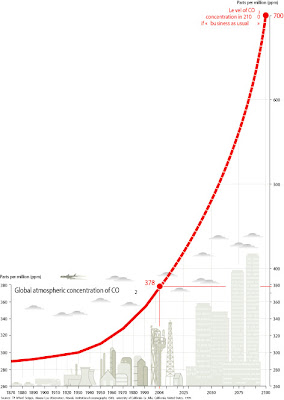
(This appeared with a few other useful charts at my previous post here.)
I would like to hear the sceptical argument against taking ocean acidification seriously, if there is one. I do, however, remain deeply sceptical about a lot of the response to greenhouse gases, especially Kyoto. Alex Robson in the Daily Telegraph recently pointed out again its glaring defects.
Yet, like windpower, many voters will warm to Labor's promises to sign up to it, as it gives that nice warm feeling of doing something. But such fiddling at the edges is probably more of a problem itself if it delays serious thinking about how real results can be achieved.
People may pooh-pooh Bush's recent emphasis on new technology being the primary way forward, but it seems to me he's probably right.
It's nearly a year since the post in which I explained that I could no longer sit on the fence over the issue of rapidly rising CO2 in the atmosphere not just because of whatever level of global warming may result, but (perhaps even more importantly) because of the effects of ocean acidification. These effects, it seemed to me, would be much more easily tested and verified.
This position seems further vindicated by these comments by an Australian scientist (see link at top):
“Analysis of coral cores shows a steady drop in calcification over the last 20 years,” says Professor Ove Hoegh-Guldberg of CoECRS and the University of Queensland. “There’s not much debate about how it happens: put more CO2 into the air above and it dissolves into the oceans.Just to remind you, the "do nothing" graph showing how quickly the earth would reach 500 ppm looks like this:
“When CO2 levels in the atmosphere reach about 500 parts per million, you put calcification out of business in the oceans.” (Atmospheric CO2 levels are presently 385 ppm, up from 305 in 1960.)
“It isn’t just the coral reefs which are affected – a large part of the plankton in the Southern Ocean, the coccolithophorids, are also affected. These drive ocean productivity and are the base of the food web which supports krill, whales, tuna and our fisheries. They also play a vital role in removing carbon dioxide from the atmosphere, which could break down.”

(This appeared with a few other useful charts at my previous post here.)
I would like to hear the sceptical argument against taking ocean acidification seriously, if there is one. I do, however, remain deeply sceptical about a lot of the response to greenhouse gases, especially Kyoto. Alex Robson in the Daily Telegraph recently pointed out again its glaring defects.
Yet, like windpower, many voters will warm to Labor's promises to sign up to it, as it gives that nice warm feeling of doing something. But such fiddling at the edges is probably more of a problem itself if it delays serious thinking about how real results can be achieved.
People may pooh-pooh Bush's recent emphasis on new technology being the primary way forward, but it seems to me he's probably right.
Wednesday, October 17, 2007
An odd way to learn about home
On the Edge in Melbourne | Cosmic Variance
An entry in a blog about physics has brought to my attention a tourist attraction in Melbourne about which I had not heard before.
Information can find its way to you by very circuitous routes in this world of the internet.
An entry in a blog about physics has brought to my attention a tourist attraction in Melbourne about which I had not heard before.
Information can find its way to you by very circuitous routes in this world of the internet.
Time for that backyard cow
The UHT route to long-life planet - Times Online
In England:
The report goes on to note that UHT milk is not popular in England. I had thought that it was much more popular there than here, but this was based on a visit in the late 1980's during which an Australian couple I stayed with routinely bought UHT milk for their tea and cereal. I remember asking them about this, and being told this was not abnormal for English people.
Turns out it was my hosts who were odd in this respect. (There were other signs of oddness too, but let's not go there.)
Anyway, the most surprising thing about The Times report is that it shows that UHT milk is very popular in some European countries. What, can't they afford refrigerators? In France and Italy, with their reputation for loving and caring deeply about their food, they use huge amounts of milk which has had its flavour boiled out of it? Here are the figures:
In England:
Officials at the Department for Environment, Food and Rural Affairs have made a serious proposal that consumers switch to UHT (Ultra-High Temperature or Ultra-Heat Treated) milk to reduce greenhouse gas emissions.Unless it's so full of chocolate or coffee flavouring that you can't taste anything else, UHT milk is best restricted to camping. (Even then, come to think of it, it's still only drinkable if cold, and if you have the ice you still may as well have fresh while in your tent.)
The report goes on to note that UHT milk is not popular in England. I had thought that it was much more popular there than here, but this was based on a visit in the late 1980's during which an Australian couple I stayed with routinely bought UHT milk for their tea and cereal. I remember asking them about this, and being told this was not abnormal for English people.
Turns out it was my hosts who were odd in this respect. (There were other signs of oddness too, but let's not go there.)
Anyway, the most surprising thing about The Times report is that it shows that UHT milk is very popular in some European countries. What, can't they afford refrigerators? In France and Italy, with their reputation for loving and caring deeply about their food, they use huge amounts of milk which has had its flavour boiled out of it? Here are the figures:
UHT milk as a percentage of total consumption:
Austria 20.3
Belgium 96.7
Czech Rep 71.4
Denmark 0.0
Finland 2.4
France 95.5
Germany 66.1
Greece 0.9
Hungary 35.1
Ireland 10.9
Italy 49.8
Netherlands 20.2
Norway 5.3
Poland 48.6
Portugal 92.9
Slovakia 35.5
Spain 95.7
Sweden 5.5
Switzerland 62.8
Britain 8.4
Subscribe to:
Comments (Atom)