Yes I'm back from the short trip to Jakarta/Yogyakarta.
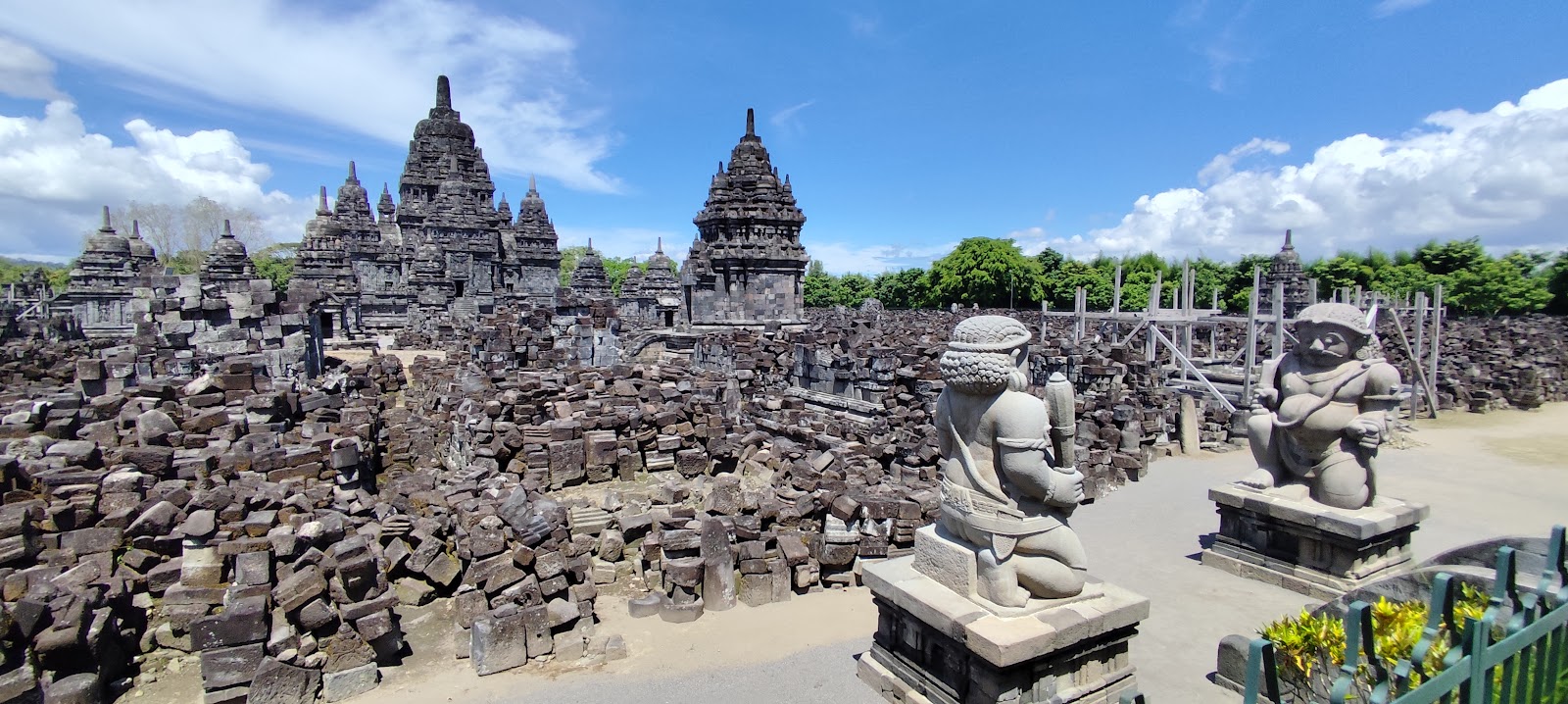
Let's start with the photo above of the Hindu (and Buddhist) temple compound at Prambanan, on the outskirts of Yogyakarta. The amount of reconstruction that had to be done is pretty amazing, putting together the blocks again after eruptions and earthquakes over the centuries. (It was built in the 9th century, but abandoned for about 900 years.)
On arriving there, this was the first "influencer in the wild" that I spotted on this trip. A simple photo of smiling and being happy to be at a grand historical site was not enough for her, obviously:
The temples are very impressive, obviously:
As you can see, the inside of each temple has a Hindu god or divine figure (if I remember correctly, the bull is Nandi, Shiva's mount and guardian.) The interior space in each temple is small and fairly dark, but I like that in an ancient temple!
We were assured by our guide (well worth paying for one) that all statues were originals. Some rocks in the temples themselves had been replaced, but not any of the carved panels (which tell Hindu stories).
After seeing the group of Hindu temples, you can take a golf buggy ride (or walk in the heat) to a separate large group of temples at the back of the compound to see the one that is believed to have been Buddhist (and yes, I think the tops look more obviously stupa like than in the Hindu temples above):
As you can see, there remains a lot of reconstruction of the smaller buildings yet to be done - although it is not entirely clear how many they think they will ever get to. (We also did not have a guide at this part of the complex, but the guardian statues did look new. Also, the Buddhist statues inside the temple had been lost.)
As with Borobudur, the grounds of this complex are very large. And it was from here that I first realised how close we were to active volcano Mt Merapi:
(I never found out who it was that were staying in the campsite set up there - they were teenagers in red uniforms, so possibly a school group, or something like scouts?)
Before moving onto Borobudur, the other famous temple complex everyone visits, how was Yogyakarta generally?
It is obviously beloved by Indonesians themselves - of course Western tourists are around, but it felt like at least 90% of tourism on the street was domestic. We stayed at a very lovely heritage hotel - The Phoenix - which was rather like a mini Raffles and which attracts a clientele of nearly all Westerners for whom, I guess, colonial style still appeals. Well, who can blame us, really :)
One minor point that surprised me - that courtyard was the main dining area, especially at breakfast, and for some reason, flies were rarely to be seen. (Even on the street, the street food vendors with their wide variety of meat and innards on sticks waiting for sale uncovered, and unrefrigerated, didn't usually attract flies. My tentative theory is that it's too hot for them!)
I doubt there are too many hotels from which you can watch an active volcano from your balcony:
(And I swear, that night I did see a brief flash of a of a red dot from lava flow on the left hand side near the peak, before it disappeared under steam. But no, the lava flow was not strong during this visit.)
The main shopping/tourist street in central Yogyakarta is Malioboro Street, which would probably have to be the world centre for batik clothes, which range in price and quality from cheap to boutique. Yes, Indonesians really, really love their batik designs. The male sarong is also popular here, and it did make me that think that it's kind of odd that the West refuses to contemplate adopting any form of male "skirt" as acceptable day to day fashion, despite there being nothing unmanly looking about an Indonesian or (say) Pacific islander wearing it. (Kilts don't count - they are a bit weird in that they are remarkably unsuited to the climate of the country they come from, and their shortness also makes them impractical.)
Malioboro street is also extremely lively at night - the shops are open til 10pm, despite the call to prayer being heard at 4.20 am, and people (nearly all Indonesian) mill about, without a drunk person to be seen (given that finding alcohol outside of a hotel bar is not easy.)
So the next key temple complex to visit is Borobudur, about an hour's drive out of the city. This place is pretty well managed: you have to go in a guided group of about a dozen or so, and the numbers on the temple itself are limited to (I think) 150 people for each 90 minutes booked time sessions, so it doesn't get too crowded. (The first morning sessions, when the day is somewhat cooler, seem to fill up days in advance on the online booking system.)
I've seen some Western visitors on Youtube grumble a bit about the entry price - it was about $45 per person for a foreign visitor to be able to enter and climb to the top of the structure. But it is a world class site with very well kept grounds; the guide was friendly and able to answer questions; and you can wander around on the grounds as long as you like after the 90 minutes with the guide is up. I have no complaints at all. Even the vendors at the souvenir stalls you have to go through to exit were not too persistent.
Anyway, here's a bunch of photos, very similar (no doubt) to those taken by all visitors:
What? Another influencer in the wild. (I can assure you the one having her photo taken was not genuinely meditating):
One of the most interesting things about the place are all the carvings, mostly telling about Buddha and related teachings. I wasn't detailed and quite sophisticated boats to feature too:
These boat reliefs have their own Wikipedia entry, given the apparent controversy of which particular region (or civilisation?) they belonged to.
Here's the classic photo showing both sides (each over 100 m long):
And a bit closer up to see some of the many, many Buddha statutes still in place:
Many are headless or armless, the guide telling us that this was their weak spot that would naturally break when the statues tumbled due to the substantial subsidence it underwent before restoration.
As with Prambaran, a combination of political unrest and natural disaster led to this huge temple being abandoned for centuries; it took decades to restore and although some new stones were needed, the relief carvings and statue are all original. There is no interior (or so they would have you believe!); it is built on a hill that partially eroded away internally during centuries of rain, leading to the subsidence problem that has apparently been permanently fixed by a new internal drainage system you can't see.
He dedicated himself to writing The History of Java, an encyclopaedic, seminal study of Java, contributing hugely to Western knowledge of the East and still used by scholars today. In 1815, undaunted by the 400-mile journey across difficult tropical terrain, he finally arrived at the jungle covered site on the fertile Kedu Plain to find a vast structure built of andesite covered with panels of exquisitely carved relief carvings – the Buddhist temple of Borobudur.
Sir Stamford Raffles was, as Collis writes, ‘captivated by it as a work of art,’ even if he was, as Collis claims, uncertain whether it was Hindu or Buddhist. ‘We are at a loss,’ wrote Raffles, ‘whether most to admire the extent and grandeur of the whole construction, or the beauty, richness and correctness of the sculpture’. Filled with awe, he organised drawing, measuring and recording details about the numinous structure with its rising four square terraces, three circular terraces,1,460 radiant relief carvings, 504 life size images of the Buddha and 72 perforated stupas culminating in a single, large, empty stupa at the top. Dating from the 9th century and the period of the Sailendra (‘Lords of the Mountain’) dynasty in Java, the exquisite narrative carvings form a divine exposition of Mahayana Buddhist doctrine, as later scholarship would reveal, with figures in meditative and graceful movement, sculpted with sublime expressions.
(Yet I note that Wikipedia says Raffles didn't personally visit the site - just that he sent the Dutchman engineer who spent a couple of months digging it out from the undergrowth and - presumably - volcanic ash. I'm not sure who is right - I haven't got to the relevant part of my own book yet!)
Anyway, it's all spectacular stuff, and as Wiki explains, all built starting around 1,300 years ago:
Hindu clerics appealed to the people of Java for generations, a fact that architect and author Jacques Dumarçay finds first mentioned in 450 AD.[25] Influence of the Sailendra and Sanjaya dynasties followed. Dumarçay says that de Casparis concluded that Sanjaya and Sailendra shared power in central Java for a century and a half, and that de Casparis traced alternating succession from 732 until 882.[26] During this time many Hindu and Buddhist monuments were built on the plains and mountains around the Kedu Plain. Buddhist monuments, including Borobudur, were erected around the same period as the Hindu Prambanan temple compound. In 732 AD, King Sanjaya commissioned a Shivalinga sanctuary to be built on the Wukir hill, only 10 km (6.2 mi) east of Borobudur.[27]
There are no known records of construction or the intended purpose of Borobudur.[28] The duration of construction has been estimated by comparison of carved reliefs on the temple's hidden foot and the inscriptions commonly used in royal charters during the 8th and 9th centuries.[28] Comparison of an Indian architectural process across temples, and acknowledgment of who was in power, enabled Dumarçay to approximately date the construction of Borobudur in five stages.[29] Loosely, the Sailendra began c. 780, and continued stages two and three c. 792 through to an unremarkable fourth stage during their decline c. 824.[30] The Sanjaya completed Borobudur's fifth stage c. 833.[30][a]
So, what else about this quick trip:
* Indonesia (or Java, at least) seems to have a sophisticated, affordable and comfortable train system, with the "Executive" class having big well padded seats with plenty of leg room. The 6 to 7 hour trip from Jakarta to Yogyakarta is about $70 one way. There is also a "luxury" class, with seats set up like airline business class, but for around $120 (I think) seems hardly worth it for a relatively quick trip.
Here's the seats, with the incidentally charming child a bonus:
And here are two station photos: the first is Yogyakarta, the second shows a chill cat in Jakarta's rather busy Gambir station:
* Jakarta: Well, I was only there for about 40 hours, but it's clearly one of those cities with massive disparities in wealth and lifestyle in different areas. (On the drive to the airport, the Grab driver avoided some traffic by going through some very narrow streets in some pretty poor looking areas. But the worst was the glimpse of some shanty slum areas on the train going to Yogyakarta.)
As lots of online commentary says, the city is not exactly very walkable, so working out how to use Grab is essential to getting around comfortably. (It's pretty easy, and not expensive.)
I reckon Hanoi might be slightly more overrun with scooters, but they are also ubiquitous in Jakarta, making for some apparent near misses on every car ride. In fact, it occurred to me, it's surprising you don't see more cars with panel damage than what you do - does such dense, weaving, traffic mean speeds are slow enough that car damage is pretty restrained?
The "good" thing for Western visitors is that you don't have to spend a lot of money to stay in luxury. Yes, another heritage hotel for the last night, The Hermitage, and it was the swankest suite I have ever stayed in:
This is the view from the rooftop bar. Live music til 10.30pm.
* Security was very high in Jakarta: Grab cars checked with mirrors for bombs underneath, and dogs, was a common feature when entering the hotels. Up market shopping malls too. Obviously, the government is taking a long time to relax about the risk of terrorist attack.
* Service in the country was, however, overall friendly and welcoming; both in Jakarta and Yogyakarta. It's a bit of a pity there is not much to see in Jakarta itself. (I believe there are some decent daytrips into the adjoining countryside, though, after overhearing a conversation in the airplane.)
* As for the countryside generally:
I have never been to Bali (always sounds like too many Australians behaving badly), so the mountain backdrops, extensive rice paddies and banana and coconut trees everywhere certainly felt exotic to me in a way that perhaps isn't new to those who get outside of Kuta. It was the end of the rainy season, so it looked probably as lush and verdant as it ever does.
The plains between Jakarta and Yogyakarta are so extensively covered in rice paddies, and Jakarta is so low lying with some rather foetid looking canals and a serious subsidence problem, that the overall impression is that most of the country that isn't mountains is barely above the water table. I can understand how badly earthquakes can affect the country.
And to finish on a trivial note, this is the biggest avocado I have ever handled. :
Well this might be a first for this illustrious blog.
Qantas wifi might allow me to post during a flight over the vast and soooo empty Australian interior, which is covered in parallel lines for hundreds of kilometres:
Large parts - and I mean enormously large parts - are also currently covered in muddy water from the recent floods:
Where am I going? I'm off to Yogjakarta, via Jakarta, for a brief visit to some ancient temples.
I do feel extraordinarily lucky that, only a few months ago, I was listening to a writer talking on Radio National (Late Night Live) about how remarkable Borobudur is and it piqued my interest; that I have a wife who was agreeable when I suggested a trip to see it; and that I have a kind sister who worked for Qantas for decades and has provided us with cheap staff travel opportunities for the last 18 months or so, such that this trip came together very quickly.
Seems to me that the American stock market is actually not taking as seriously as it should the effect of Chinese tariffs. I guess there is a fair chance that it is because of Trump's constant reversals, or pauses, but it seems to me he is not likely to make a major reversal on several key Chinese exports that are important to American manufacturing and business:
The other amazing story going on is Trump pretending it's no problem sending a guy to an El Salvador prison by mistake - in fact, he hopes to be able to do it to American born citizens!
The Trump administration insisted Sunday that it has no legal obligation to arrange for the return of a Maryland man illegally deported from the United States, arguing that a Supreme Court ruling last week only requires officials to admit him into the country if he makes it back from a high-security prison in El Salvador.
Justice Department lawyers told a federal judge that they don’t interpret the Supreme Court’s Thursday ruling — that the administration “facilitate” Kilmar Abrego Garcia’s release — as obligating the administration to do anything more than adjust his immigration status to admit him if El Salvador’s government chooses to release him.
Attorney General Pam Bondi told reporters at the White House that the fate of the father of three is now up to El Salvador.
Buekele then said that he does not have the power to return Ábrego García t the US - and that he won't.
Also on the agenda was topics including transgender people in sports, DEI and women, Iran and tariffs and Ukraine and Russia.
Temu Goebbels, as I have seen Stephen Miller called on social media, insists that the deported guy deserved it and it wasn't a mistake, contradicting court filings by the administration.
We're about a centimetre away from being able to declare the US a fascist state.
I finally got to the end of the abridged version of Journey to the West. I liked this passage in the last chapter about Buddhism:
It is difficult to comprehend fully how yin and yang pervade Heaven and Earth because the forces themselves are invisible. That images may manifest the minute is a fact that does not perplex even the foolish, whereas forms hidden in what is invisible are what confuses even the learned.
How much more difficult it is, therefore, to understand the way of Buddhism, which exalts the void, uses the dark, and exploits the silent in order to succor the myriad grades of living things and exercise control over the entire world. Its spiritual authority is the highest, and its divine potency has no equal. Its magnitude impregnates the entire cosmos; there is no space so tiny that it does not permeate it. Birthless and deathless, it does not age after a thousand kalpas; half-hidden and half-manifest, it brings a hundred blessings even now. A wondrous way most mysterious, those who follow it cannot know its limit. A law flowing silent and deep, those who draw on it cannot fathom its source. How, therefore, could those benighted ordinary mortals not be perplexed if they tried to plumb its depths?
What I like is the acknowledgement that it's not easy to understand....
In a widely shared article titled “Religius tapi Gemar Korupsi, Ada Apa?” (Religious but keen to corrupt), Kompas journalist M. Zaid Wahyudi raised a timely question: Why does corruption remain widespread in a nation so openly religious? His article highlights a common assumption, that religion guarantees morality, that belief and ritual naturally lead to ethical behavior. A paradox indeed: Indonesia ranks high in religiosity but low in clean governance. Places of worship are crowded; prayer groups flourish. Yet corruption remains a daily reality. So, if religion is not to blame, what is missing?
....
WW Howells, in The Heathens: Primitive Man and His Religions, explains that early religion was never primarily moral. It was a response to fear. Faced with death, disease and natural disasters, early humans created rituals to reduce anxiety and restore order. Religion gave comfort, not necessarily ethics.
This primitive function has not disappeared. Today’s religious practices, prayers, fasting, sacred artifacts, still serve psychological and social needs: belonging, identity and comfort.
However, these rituals do not always shape conduct. One can fear God yet cheat the system. One can wear piety as a badge yet abuse office. Religion works well as a symbol. But without inner conviction, it does not restrain wrongdoing. The psychologist Lawrence Kohlberg showed why. His six-stage model of moral development explains that people grow from a basic fear of punishment to principled reasoning. But most never reach the higher stages. Many obey rules to avoid shame or to be accepted by others, not out of justice or compassion.
Public religiosity often reinforces these early stages. One fasts only to be seen, prays to belong, avoids alcohol to gain respect. The moral compass is external. Right and wrong depend on who’s watching. And so corruption thrives, not because people lack belief, but because belief stays stuck at the surface level.
....
Ruth Benedict and Koentjaraningrat both showed that Indonesian society leans more toward a shame culture than a guilt culture. What matters is not whether something is right, but whether it is seen. The wrongdoing itself is tolerated as long as it stays hidden. When exposure comes, the shame is in being caught, not in having done wrong. So the question is not “Why are religious people corrupt?” but “Why has religious life become more about performance than formation?”
I was watching a clip from CNN this morning featuring two American women who run small businesses and their concerns about the tariffs.
One in particular had a story which would be happening in thousands of small businesses across the country. She designs and manufacturers some kind of baby products, and has them manufactured in China. It's a small business, I think with 5 employees. She has a loan secured by her house to support the business.
She said she has a shipment of products waiting to leave China, but she knows she cannot afford the massive tariff abuptly imposed on them. It means the few months of stock she has left might be the end of the business. She can't figure out a work around (she mentioned shipping them first to Australia and repackaging them before sending on to the US) because of the continuous changes in policy "every 36 hours". She also said there is no way an American factory can be expected to be geared up to make her particular products in less than (I think) 6 to 12 months. That's assuming she can find any factory that can take it on.
This all sounded very realistic and with no exaggeration for political spin.
I thought it a very effective and telling story on the turmoil which Trump and his very rich advisers, who don't have a worry in the world about how it will affect them, are causing.
Funny the things that can pop into your head while ironing a shirt. Or am I just remembering something I have already read online?
For some reason, I was thinking about the Wizard of Oz, and the song "If I only had a heart/brain/the nerve", which sums up the deficiencies of each of Dorothy's companions. Then Trump came to mind, and I realised how remarkable it is that he is like a Trinity of each of these deficiencies in the one man.
No brain - the evidence is overwhelming.
No heart - has no real interest in justice and wants to punish foreigners for all of America's woes.
No nerve - President Heal Spurs who flip flops on policy continuously.
The only way in which the analogy falls apart is in the resolution in the movie, where the characters are taught they always had what they desired within them. I try to be generous, but I can't see that happening with Trump...
[The other obvious Trump in Oz comparison was in the meme that went around a few months ago that showed Putin as the true Wizard behind the curtain controlling the fake Wizard head in the form of Trump. I liked that too.]
I would guess that like most people, I have the slimmest understanding of bond markets, but as far as I can tell, the changes in the US market may well have been the motivation for Trump to "pause" his tariff plans (on everyone except China). See this article, for example:
I don't really understand why it seems no one can tell who is selling - there was speculation by some that it was retaliatory selling by China, and denials from other finance types that the pattern indicated that this was the likely explanation.
And how disingenuous is Bessent: that this was Trump's plan all along. And he denies the bond market had anything to do with it. Not to be trusted in the slightest.
Finally: many, many people suspect a lot of insider trading happened on the Republican side. Who would be surprised? No one, given that this administration seems to be the first to think that if you do it (pretty much) in the open, it can't be corruption.
But in the body of the interview, the author seems to make the case that the decline was in stamina only, and nothing to do with mental ability when sufficiently rested:
As the 2024 campaign kicked into gear, the president couldn't hide from
public scrutiny, Whipple says. He notes that in the days leading up to
his disastrous debate with President Trump, Biden "was in a terrible state."
"He was absolutely exhausted. He was unable really to follow what was
happening in the campaign. He was tuned out," Whipple says. "Early on,
he walked out of a [debate preparation] session in the Aspen Lodge, the
president's cabin, went over to the pool, sank into a lounge chair, and
just fell sound asleep."
OK, but then further down:
On why Biden's staffers believed he could still govern
I think that this is much more interesting and not nearly as simple as
the notion of a cover-up. In other words, I am convinced that Joe
Biden's inner circle was convinced that Joe Biden was capable of
governing, and they believed that he could do it for another four years.
And we can't dismiss the fact that Biden on the very last day, July
21st, that Sunday when his aides came to hammer out his abdication
statement, Joe Biden was on the phone parsing the details of a complex
multi-nation prisoner swap. He was on top of every detail.
People who visited Biden in the Oval Office to talk about the Middle
East said he was on top of every nuance of Middle Eastern policy. ...
Joe Biden, behind closed doors, was governing, capably, whether you
liked his policies or not. So there's no question that he was a shadow
of the campaigner that he once was, and that was true from 2020 all the
way to the end. But, you can't dismiss the fact — it's an inconvenient
fact for people who say it was a cover-up — that Biden was capable.
* I still think, after viewing the extended sneak peek on Youtube, that the new Superman film does look good. It's weird, but so many people in comments on Youtube agree that it literally "looks great" - meaning the colours and CGI and cinematography overall. And there's a dog, of course. It's funny how some trailers can really still hit the spot and make a film look like it will definitely be a hit - I felt the same about the one for Everything Everywhere All at Once.
* There is also a new Wes Anderson film coming out. And again, it is in his highly, highly idiocentric and stylised, um, style, which makes the recent films play more like dryly and ironically amusing comic books than anything reflecting the real world. In fact, I reckon people now feel that his refusal to back down from this signature style has become something of a meta-joke in itself. As for me: I do think his "miss" rate has been getting higher (I didn't think much of Asteroid City, although I was watching on an jet and had interruptions), but I still am happy to try out each new one to see just how amused I am. I don't know why, but there is something pleasing about his persistent self indulgence, perhaps because you have a sense of how much he likely enjoys creating it?
* On politics: I am encouraged about the Labor policy to subsidise more home battery power. As I said a while ago - why aren't they (and solar panels, and solar hot water) a requirement on all new house builds under State construction codes? Maybe not worth it in Tasmania, but definitely for most of the country.
Sure, there are some around who tread carefully, sound socially responsible and don't go nuts.
But - Elon Musk, obviously.
And now, I'm wondering about this Scott Bessent, (worth about half a billion, apparently) who I knew nothing about until this tariff meltdown.
I mean, Wikipedia indicates that he used to have decent Democrat supporting credentials (originally worked for Soros, supported by donations Gore, Hilary Clinton and Obama.) Now he works for Trump.
Despite rumours (JC at New Catallaxy referenced them, but I think I have seen it said online too) that he's privately freaking out about how Trump has dealt with his tariff scheme, there is no indication of that at all in his public appearances - he went on Tucker Carlson to defend the whole scheme, talking about the need for a complete recreation of American trade, etc. And look at the reference to him in this article from WAPO, about how the MAGA Right has gone all Maoist:
Recently, a viral meme
in MAGA circles captured the moment, featuring a cartoon Trump
addressing a faceless American: “Your great grandfather worked the
mines, your grandfather worked in a steel plant, and you thought you
could be a ‘product manager’ ???” It’s a joke, but it’s also a worldview
— one where white-collar ambition is seen not as a step forward, but as
a fall into decadence. The meme doesn’t just mock digital work; it
exalts physical labor as the only authentic form of contribution.
What we’re seeing is a kind of MAGA Maoism, remixed for the algorithm age. Like the Chinese Cultural Revolution, it glorifies physical labor as moral purification, only now the purification is from the supposed “wokeness” of desk work, filtered through TikTok, X and Twitch. It’s not about creating jobs. It’s about creating vibes: strong men doing hard things, reshared until they become ideology. As one MAGA influencer put it, “Men in America don’t need therapy. Men in America need tariffs and DOGE. The fake email jobs will disappear.”
This style, what some might call online pastoralism, is no longer fringe. It is a governing strategy. Treasury Secretary Scott Bessent recently hinted to Tucker Carlson that the administration plans to restock America’s factories with recently fired federal workers. It’s a sharp evolution of the old MAGA line, which claimed elites abandoned the working class by offshoring jobs and hoarding the degrees that powered the new economy. Now, those same college-educated liberals once seen as the future of work are being recast as its obstacle.
This new turn is also punitive: It challenges the idea drilled into millennial and Gen Z brains — especially immigrant families, like my own — that education and meritocracy are the path to the American Dream. It says not only that you were left behind, but that you were wrong to try to get ahead. Populists used to share memes about miners who were condescendingly told to “learn to code” while their towns struggled. The coders, in this updated version, need to be thrown back in the mines.
Exploitation fears as people in extreme poverty perform stunts and beg for virtual gifts
My daughter has said that she is very close to deleting Tik Tok off her phone because she fully recognises the way it saps attention span and wastes time. I must ask her if she has done it yet...
The whole thing is worth reading, but I will extract some of it:
I think most people thought it was going to be some kind of across-the-board tariff — same on everybody. Or maybe two or three different types of tariffs.
Instead, he announced this whole complicated, different tariff for every country, at levels much higher than the smart money — or the money that thought it was smart — was betting. Something like a 23 percent average tariff now, which is huge. It’s higher than U.S. tariffs were after the Smoot-Hawley Tariff Act of 1930 was passed. And trade is a much bigger part of the economy now than it was in 1930. So this is the biggest trade shock in history.
And:
There’s a funny thing here, which is that ordinarily I would say that while tariffs are bad, they don’t cause recessions. It makes the economy less efficient. You turn to higher-cost domestic sources for stuff, instead of lower-cost foreign sources, and foreigners turn away from the stuff you can produce cheaply. But that’s a reduction in the economy’s efficiency, not a shortfall in demand.
What’s unique about this situation is that the protectionism is unpredictable and unstable. And it’s that uncertainty that is the recessionary force.
If you were a manufacturing company in the United States and your next investment is going to be, let’s say, a components plant or something — well, should you put that components plant in Mexico, where it’s cheaper? Not if there’s a 25 percent tariff. But should you put it in the United States, where it’s more expensive? What if the tariff comes off?
So either way, you run substantial risk of just having stranded investments. And that’s happening across the board. So this is the instability of policy. The fact that nobody knows what’s coming next makes a recession certainly a whole lot more likely.
And:
If you were asking what a national
security oriented industrial policy that tries to keep production of
strategically important stuff in the United States looks like, it looks
like the CHIPS Act. It looks like what the Biden people were trying to
do. Probably bigger than that — in an ideal world, we’d be doing
substantially more. But that’s how you do it.
Putting
high tariffs on imports of clothing from Bangladesh is exactly what you
shouldn’t be doing. That’s the kind of thing that is disruptive, raises
the cost of living for American consumers, does nothing to make us more
secure.
There is a national security
rationale for domestic production, but also for friendshoring and for
nearshoring, because the stuff that’s close by is a lot easier to
secure. If that’s what we were wanting to do, then we would not be
levying tariffs on Vietnam and Bangladesh, and we would certainly not be
putting tariffs on Canada and Mexico.
And this bit by Klein makes a lot of sense to me (it's in bold because that is how Klein's voice appears in the transcript):
When I try to dive into MAGA world’s thinking here, something that I tend to hear is a somewhat contradictory or troubled relationship to American power.
On the one hand, they want America to be stronger, more feared, more dominant. And on the other hand, there’s a broad view that we have overextended ourselves.
Financially, we’ve made the dollar the reserve currency. We’ve allowed all these other countries to buy our assets and buy our money even as our industrial base flowed out.
And then on the military side, we have these bases all over the world, we have all these troops in Europe, we’re part of NATO, we’re spending more as a percentage of gross national product than some of these other countries. But this is part of why we can no longer take care of our people.
And so there’s this feeling: Well, for America to be stronger, it can’t be operating this global umbrella of financial and military protection.
But then you ask: Well, do you want the dollar to not be the reserve currency? And they say: No, no, no, no. We definitely want to keep it the reserve currency.
If you ask: Do you want America’s military to be weak? Do you want people to not be tied to us in the way they are now? They say: No, we actually want more leverage over them.
There’s something here that I think is very strange and very unresolved in this movement that wants both more dominance and somehow, at the same time, to pull back from the actual architecture of that dominance and leverage.
Krugman's reply was something that I was recently saying to an overseas friend who is generally very anti-American:
We have been a kind of imperial power.
Some people say more than kind of — we’ve been an imperial power, in
many ways, since the end of World War II.
But it’s not like any previous empire. The Pax Americana starts with the Marshall Plan.
Instead
of plundering our defeated enemies, we rebuilt them. And then we built a
system of alliances: We have NATO. We have international economic
institutions like the International Monetary Fund, which do actually
kind of reflect U.S. interests, but at least on paper, we’re at most
first among equals. So we are a polite, low-key, relatively generous
imperial power.
That is a very hard role for many people to understand.
I'm sure that Krugman would, if asked, agree that there has also been a lot of awful direct foreign interference in the post war period; but America's role in re-building defeated countries after their destruction is no doubt the explanation for its continuing popularity (until now!) with much of the free world.
When I first heard the "Mar a Lago accord" I thought it might be another conspiracy theory, perhaps this time of the Left. But now I know it is a pet theory of someone in Trump's ear, and it looks like we have to put up with the chaos that happens when you have a dumb narcissist as leader who other people want to manipulate.
Here are two articles on the idea that are worth reading:
As any commentary points out - the idea that countries will trust the US under Trump so much that they will co-operate in devaluing their own currency seems wildly implausible when everything he has done and said indicates that he is completely untrustworthy.
I never actually understood why getting a conservative state Supreme Court in Wisconsin entrenched for some years was supposed to be so important anyway, but if Elon doesn't get the message that his personal brand is poison at the moment after spending millions on this pointless exercise, he'll never learn.
MADISON,
Wis. — A liberal candidate for Wisconsin’s Supreme Court glided to
victory Tuesday, overcoming a flood of political cash from tech
billionaire Elon Musk in a race seen as a referendum on him and
President Donald Trump.
The Associated Press called the race a little over an hour after the polls closed.
Musk
and groups affiliated with him invested more than $20 million in the
race. The top Trump adviser and leader of Tesla and SpaceX handed out
cash prizes to generate interest in the race. At a rally Sunday in Green Bay,
Wisconsin, he cast the election as one that could chart the course of
Western civilization because of what it could mean for Trump’s agenda.
But
Musk’s spending and hyperbolic framing weren’t enough to win the most
expensive court race in U.S. history. The contest cost more than $100
million, nearly doubling the past record and putting it in line with top
Senate races.
I've only recently found Joe Folley's philosophy Youtube channel, but I'm liking what I've watched so far.
This video, about the modern idea prevalent in self help advice, of the importance of "finding" and living in accordance with your "authentic self" is pretty good and expresses scepticism I have long had with the whole approach:
I would have liked it to reference Aristotelian virtue ethics more, and also perhaps make more of a connection to the whole free will debate as well, but it's a good start!
It also reminded me about how long "acting authentically" has been in the psychological parlance. I remember a snippet of a conversation with a priest in my teenage years who was leaving the priesthood, and I am sure that he said that the reason was that he found too many people in the church were not living "authentically." I think he was into a particular series of Catholic pop psychology books at the time, the name and author of which I now forget, because I never found them very convincing or helpful. And, who knows?, given that we are talking of the 1970's and the post sexual revolution period, he may have been making a coded reference to either him or other priests being gay (or straight) and living out a secret sex life. Anyway, I didn't quite know what the term was meant to cover then, and didn't care for the looseness of meaning, and haven't shaken that feeling for 50 odd years!
Update: I also am often reminded of CS Lewis's book Til We Have Faces whenever this issue comes to my attention.
I've noticed that the Youtube algorithm seems to refuse to notify me in the "recommended" category about lots of new videos by people I follow.
Also, it's very hard, it seems, to get Bluesky to show me all new posts by people I follow, even if I am using the "following" tab/feed.
I mean, I did manage to get Bluesky to recognise I was not interested in digital art and amateur anime drawing. But in the Discover tab, it insists of showing every single post by a handful of people who I do follow, instead of just some of them, meaning that there is not that much space to "discover" anything.
I guess, in other words, the issue I have with Bluesky is the opposite of that with Youtube.
I only just realised that by making this post. See - writing things down helps.
Yeah, ever since the Albanese election win I just haven't found Australian politics all that interesting. Sure, I thought the controversy around the Voice referendum was worth commenting on, and worried that Labor was losing support due to the priority it gave that as an issue; but since then, federal politics has seemed a bit of a bore to me.
It is interesting, though, that now that everything about indigenous policy has gone quiet, I get the feeling that a combination of the complete charmlessness of Peter Dutton and the malevolent craziness of Right wing politics on full display in the USA have enhanced Albanese's chances quite strongly.
Everyone seems to think that the moderate independents are going to do well, and the Greens should go backwards. I would be happy with the latter result - I just find that the people the Greens seems to attract as politicians here are also unappealing and way too ideological to know how to get the things they want done.
Of course I couldn't be bothered making my own ravioli, and I imagine that like the majority of the population, my main exposure to it is via the pre-made stuff from the refrigerator in the supermarket, which can make for a quick meal.
But my beef (ha, a slight pun): the filling never lives up to the description. It doesn't matter what it's alleged to be on the packet, the filling is always a disappointment: pasty, and with the slightest of flavour. The only reason to eat ravioli at all is if there is a decent sauce on the outside.
I've also been unimpressed with the filling at a restaurant.
It's just the least impressive way to eat pasta, and I think someone enterprising should do a lab test on things like alleged beef filling, because I would not be at all surprised if the protein content is hard to discern. Then sue them.
Tackling a touchy subject, genetic detective finds only 1% of European children have unexpected paternity
It notes that earlier, much higher, estimates for Western societies were just guesswork:
In the absence of reliable numbers, scientists speculated. In his 1991 book The Third Chimpanzee: The Evolution and Future of the Human Animal,
biologist Jared Diamond claimed the adultery rate among humans was
between 5% and 30%. In a widely cited 1997 paper, University of Reading
evolutionary biologist Mark Pagel argued EPP was so common in humans
that babies evolved to be indistinguishable at birth, concealing their true paternity as a protective mechanism.
Eventually, a consensus emerged, based mostly on back-of-the-envelope calculations from early genetic paternity testing. In an article in The Lancet
published the same year as Diamond’s book, researchers reported the
idea that 10% of children were the product of a clandestine affair, but
complained there were no solid data to either confirm or disprove the
figure. Nonetheless, it continued to be repeated by journalists and
researchers. Eventually it took on a life of its own.
But the new type of research seems to confirm that this was an overestimate:
Subsequent studies elsewhere in Europe by Larmuseau and others came up
with essentially the same results: In European societies since at least
the Middle Ages, the likelihood a child’s recorded father wasn’t the
genetic father was vanishingly small—typically 1%, or less.
But, there are those societies still where things are very different:
The obsession with genetic paternity isn’t universal. South American tribes such as the Yanomami believe multiple men can contribute to a child’s paternity by having sex with the same woman. Among the Nyimba of Nepal, women traditionally have multiple husbands—all of whom are expected to act as fathers to all of their spouse’s children. “There are lots of examples that counter this stereotype of wily women versus bamboozled men,” says Brooke Scelza, an evolutionary biologist at the University of California, Los Angeles.
One of the best documented is found among the Himba people of Namibia. When Scelza first visited Himba villages 15 years ago, she was surprised by how openly women discussed children fathered with partners outside of marriage. “It ran against so much of what we as evolutionary biologists think,” she says. “This looked really different from what Maarten Larmuseau and other people were finding in Europe.”
Intrigued, Scelza worked with the community to conduct anonymized paternity testing. The results showed the EPP rate among the Himba was 48%. Fathers were usually aware of which children were theirs biologically, while simultaneously considering themselves the social and legal fathers of all their wives’ children. “It’s not that they’re being duped—these men still really consider themselves the social fathers, even if they’re not the biological fathers,” Scelza says. “It really shows the importance of getting this kind of data from other regions.”
I wish I could get back to posting more often here, but many distractions continue.
I am dropping in to make a couple of not very important comments:
*I am finding the situation in the US so obviously dangerously dire that I am starting to have a bit of a problem with satire and comedy based on it. I still watch clips of the Daily Show, and some of Colbert, but it is starting to make me uncomfortable that the use of comedy underplays the seriousness in an inappropriate way.
I also feel this about Planet America, which is primarily serious commentary and criticism, but the side comedy bits now feel too trite for what was just discussed. (I did criticise them in the lead up to the election too, for not emphasising how nuts and ridiculous Trump's campaign claims were - pretty much "normalising" that a politician could now say anything regardless of connection to reality and not be called out for it. Of course, the whole MSM had the same issue.)
Maybe you could argue that late night comedy, and even ridiculous shows like Laugh In, survived the turbulent 60's and 70's, so I shouldn't expect comedy TV to stop now. But I think the show of those decades got through by largely ignoring the national politics and dire situations as the Vietnam War. That is, of course, not what topical comedy in the US does any more.
* Even though I think 1984 was a well intentioned but poorly executed book, and would love to find an online connection with someone I consider smart who shares this opinion, I continue to have a vague interest in George Orwell because he was a pretty odd character, and (who knows?) his essays and other books of reportage might convince he could write well, if ever I get around to reading them.
Hence I was interested to read an interview with his adopted son, now 80, who is happy to say plenty of nice things about his late Dad, yet it takes quite a long way into the article to get to the somewhat significant point that Richard (the son) was only 5 years old when his Dad passed away.
I mean - really - how seriously am I meant to take his memories of the period on the remote island of Jura where he Dad went to write 1984?
And on a happier note - I see that Reddit does have threads by people arguing that 1984 is not a good book. I wonder if I had looked there before?
* Speaking of books - here's a decent article at The Guardian about the way self publishing has allowed for a ridiculous number of books to be available each year:
The complaint that there are too many books is not a
new one. “My son, be warned by them: of making many books there is no
end,” reads one line in Ecclesiastes, written at least 2,000 years
before the invention of the printing press.
Now
the bestselling author Bill Bryson has added his voice to the
millennia-old chorus. There are 200,000 books published annually in the
UK alone, “more books than you could possibly read,” the writer of Notes
from a Small Island told the Times.
He is not sure that the growth in self-publishing, in particular, is “a
healthy development”. He said he gets sent “a lot of self-published
books, and most of the time it is just some anonymous person’s life, and
it is of no interest.”
Bryson is not wrong that self-publishing has contributed significantly to book slop mountain. More than 2.6 million books
were self-published in 2023 – many of which are uploaded to the
dominant platform, Amazon’s Kindle Direct Publishing – and they can’t
all be masterpieces.
The article goes on to explain that self publishing has worked for some - but the success rate is extremely small, of course. Still, I am not immune from the idea that I might have one story in me that could work as a novel - or more likely, film - it's just that I don't have the confidence that I could execute it.
The New York Times will no doubt be displeasing the Saudi royal family, and via that route, Donald Trump, with this detailed story about the remarkable number of East African workers who keep dying there:
Lured by company recruiters and
encouraged by Kenya’s government, the women have reason for optimism.
Spend two years in Saudi Arabia as a housekeeper or nanny, the pitch
goes, and you can earn enough to build a house, educate your children
and save for the future.
While the
departure terminal hums with anticipation, the arrivals area is where
hope meets grim reality. Hollow-cheeked women return, often ground down by unpaid wages, beatings, starvation and sexual assault. Some are broke. Others are in coffins.
At
least 274 Kenyan workers, mostly women, have died in Saudi Arabia in
the past five years — an extraordinary figure for a young work force
doing jobs that, in most countries, are considered extremely safe. At
least 55 Kenyan workers died last year, twice as many as the previous
year.
Sometimes, you end up watching new stuff on Youtube and learn things that are good to know, even if they might never affect you.
For example, I've never been particularly drawn to reading Dostoevsky, and The Brothers Karamazov in particular, but now I know (from watching a guy talking about one star online reviews of classic books) that the very common reaction for modern readers of Karamazov is that nothing happens for the first 300 or so pages. (It's a lot of talking, setting up the different brothers' views and philosophies, apparently.)
I also didn't realise that no one accuses him of writing particularly realistic characters - they are all somewhat over-the-top in a theatrical kind of way. Again, apparently.
I also enjoyed a video from Business Insider making the case that I always suspected was true: that 5G networking was massively oversold and may never be as significant as they claimed.
Early on Friday, Elon Musk shared a post
written by an X user about the actions of three 20th century dictators —
then quickly deleted it after it sparked a backlash.
The post falsely claimed that Joseph Stalin, the communist leader of the Soviet Union until 1953; Adolf Hitler, the leader of the Nazi party in Germany; and Mao Zedong,
the founder of the People’s Republic of China, didn’t cause the deaths
of millions of people under their watch. Instead, the post said, their
public sector workers did.
Mr. Musk
shared the post without any other comment. He removed it soon after
users on X criticized the post, saying it was antisemitic and dismissive
of genocide. Historians have widely chronicled that millions of people
died under Stalin, that millions of Jews were massacred under Hitler
during the Holocaust, and that millions of Chinese were displaced or
killed during Mao’s cultural revolution.
Bizarrely, that post that he deleted sounds like an argument for the exact opposite of what Trump wants - an independent public service that won't follow the appalling orders of the leader if they are immoral and/or illegal.
There are two immediate questions: first, will the Trump revolution collapse from its own incompetence?
And second, will an effective opposition/resistance emerge and blunt it?
The incompetence comes from "common sense".
In
his speech to Congress last week, Trump described what he is doing as a
"common-sense revolution that is now — because of us — sweeping the
entire world".
Who can argue against common sense? Sounds fine, right?
Well,
yes, except that in practice it means decisions and executive orders
are not based on data, inquiries or science, but simply what Trump
thinks.
For example, there was no Treasury
inquiry and report into the impact of 25 per cent tariffs on Mexico and
Canada, with the result — among other things — that General Motors told
him they'd be bankrupt in three months, so its parts had to be
exempted.
In fact, the whole
tariff venture has become a complete mess of U-turns and exemptions,
because it was based on common sense and not thought through. It's also
the main reason the US economy is in danger of a big slowdown.
And
of course the abandonment of efforts to reduce fossil fuels and combat
climate change — in favour of "drill, baby, drill" — are not based on
science, but simply his "common sense", along with that of other people
on the right, that the energy transition is expensive and pointless.
I have been looking at the example of Australian Trump supporters who hang out online at New Catallaxy. Look, the average age seems to be about 65 to 70, so it's not as if they are any representative cross section of the population, but reading them, as well as online Right wing America sites, makes it absolutely clear that they are so much still in the thrill of having their culture war priorities put into place by Trump that they simply don't care at all about his entirely haphazard way of governing, and his neverending stream of lies and grifting that, with 100% certainty, would have appalled them if it were being said or done by a Democrat.
In the media landscape: not that I subscribe, but from what I can gather, the Wall Street Journal is a traditionally Right wing outlet that is giving substantial pushback due to the economic damage Trump policies will cause. But it's galling that this also represents the Murdochs in his traditional fashion: making money by letting one outlet appeal to the "not on board with Trump" element of the Right, while letting its MAGA devoted night time lineup on Fox News continue to compete with North Korean media in how far they can suck up to the cult leader. Daddy Murdoch, and his Right wing son, are entirely unprincipled and happy to see the world burn as long as it makes money for them in the process.
Because my posting rate has been so slow this year, I've overlooked this blog's function of recording useful recipes I've tried.
First one - lamb shoulder cooked at low temperature for hours is something I had never got around to before, but I recently followed this recipe which featured a side of white bean puree. (I see the recipe calls it a roast - but there was lots of liquid involved, so surely it was a braise?) The most pleasant surprise was how nice the white bean puree was - another thing I never got around to making before.
Second one, as a counter to all the meat in the first: chick pea curry, using dried chickpeas. Of course I've used canned chickpeas many times, but the online cooks (especially vegan ones) all suggest that cooking your own dried pulses gives a much nicer result, so I bought a kilo of chickpeas and gave it a try.
I soaked them for 8 hours, changing the water a couple of times as someone somewhere recommended. Then boiled them for about an hour. The texture was still slightly firmer than canned, but that was fine by me. And as for using them in a curry - there are dozens of examples on line and it seems you can use virtually any curry base (dried spices, or jar paste - I used leftover Thai red curry paste), fry an onion first, add the paste or dry spices, a can of tomatoes (and maybe some fresh ones like I did), the chickpeas and a can of coconut milk. It comes out fine. (I added some spinach at the end, for colour as well as a fresh contribution.)
And I can tell you, two cups of dried chickpeas, which should cost at most about $2, together with these other ingredients (total cost maybe $4- $5 extra?) made enough for 6 very large servings.
Honestly, this experience has led me to believe that government support for the poor must include a push to getting them to learn how to cook dried beans and chickpeas. Even allowing for the cost of the electricity or gas (which may be the same for cooking a meat curry too) protein derived from this source is incredibly cheap compared to meat. And it was pretty tasty and filling.







%20Dow%20Jones%20Industrial%20Average%20Google%20Finance.png)
%20S&P%20500%20Google%20Finance.png)


