


In the real world, as reflected on Reddit:


Update: Another delusional culture war wannabe warrior who's won over by a criminal striking a pose.

Another update, cos these made me laugh:


I even find him more annoying that De Santis and his faux "let me be Queen of Camelot, please" wife.
Update: more twitter commentary:


Update 2: this is probably true, given the sophistication of Trumpists:

Anyway, the Trumpiest of Trumpsters on line already don't trust him.
They are both awful and deserve each other:

This also puts me in mind of Jonestown - cult leaders are often into encouraging belief in their gullible followers that someone is out to kill them.
The idea of the cardio vascular system polypill for the general promotion of longevity doesn't seem to be in the news much lately, although I still see there are fans.
In any case, I've been thinking comparative religion again, and strategies for making sure you stand the best chance of getting into Heaven (or something like it) from your death bed.
This has particularly been brought to mind by the simple formula offered in Pure Land Buddhism, which is from Amitabha's 18th vow:
If, when I attain Buddhahood, sentient beings in the lands of the ten directions who sincerely and joyfully entrust themselves to me, desire to be born in my land, and call my Name, even ten times, should not be born there, may I not attain perfect Enlightenment. Excluded, however, are those who commit the five gravest offences and abuse the right Dharma.
Just to be clear, let's check the list of the 5 greatest offences:
The first one is killing your father. The second is killing your mother. The third is killing someone who seeks the way of awakening. The fourth is physically injuring the Buddha. The fifth is disturbing the peace and harmony of the Sangha community. Any one of these is considered a serious offense in Buddhism, so in the 18th Vow, Amida Buddha also admonishes us never to commit them.
Well, I think I can manage to avoid those.
So, to make it clear, Pure Land Buddhists believe that, for most people, being able to recite Amitabha's name 10 times is a guarantee to re-born into the Pure Land, which sounds a cool place:
Sukhavati is expressively described in the Pure Land sutras as being a joyous world, soft and glowing, filled with the music of birds and the tinkling of trees adorned with precious jewels and garlands of golden bells. Amitabha sits on a lotus in the midst of a terraced pond, attended by the bodhisattvas (“buddhas-to-be”) Avalokiteshvara and Mahasthamaprapta. The newly dead enter into lotus buds, which unfold when the occupants have become entirely purified and have attained enlightenment. Many are said to be reborn on Earth after leaving Sukhavati to become bodhisattvas working toward the liberation (moksha) of all sentient beings.
The exact way to recite Amitabha's name depends on which language you follow, as explained at this Wikipedia page (and also this page).
I like the Sanskrit version which is easy to remember. Form the last link: " 'Namo Amitabha Buddha' which literally mans 'Homage to the Amitabha Buddha ' or 'I seek refuge in the Amitabha Buddha'."
Anyway, this is taking me a long time to get to the point: for someone who remains open to the possibility of entry into an afterlife, but doesn't know which religion gets it right, what's the best practice on a death bed?
I would guess as follows:
a. recite "Namo Amitabha Buddha" ten times;
b. have a Catholic priest handy and make a confession; or if that's not possible, at least make your own mental confession, and recite ten Hail Mary's and the Lord's Prayer;
c. to cover the evangelicals, cry out "I accept Jesus as my Lord and Saviour!", I guess?
d. I was thinking about now making a bad taste joke about doing something that would count as matyrdom for a Muslim, but that is hotly contested as a legitimate part of their religion.
e. As for Hindu's, it seems they believe you'll be reincarnated one way or the other, and there is this advice on an American website (the last surprising bit is my bold):
The condition of one’s consciousness at the moment of death is considered very important in determining the state of the next life. Because of this, it’s traditional for Hindus to die at home, where they can be more easily surrounded by family and friends who can help create a spiritual atmosphere conducive in helping a soul depart the body in an auspicious manner. Of course, as it’s become more and more common for people to die in hospitals — whether out of necessity or choice — loved ones strive to create a spiritual environment as best as possible.
The goal of the departing is to die while concentrating on a preferred mantra that invokes the presence of the Divine. Because it’s common for the dying to lose control of their faculties, including the ability to focus, loved ones provide support by singing prayers and hymns, and also reading from scripture. As a person becomes fully unconscious and stops breathing, indicating death’s arrival, a family member will usually softly chant the preferred mantra in the person’s ear.
Pouring a few spoons of water from the Ganges — a river in India considered to be sacred — into the mouth also brings auspiciousness. The personified deity of Ganga is worshipped as a Divine being, hence her presence at the time of death helps to ensure a soul’s transition to a spiritually favorable next life.
So, I guess to be safe, you carry around a vial of Ganges water when you get to old age?
Anyhoo, that's my "polypill" procedures suggestions for guaranteed salvation.
Don't say I'm not a useful blog...
I've been reading some interesting stuff about the origins of the story of Amitabha Buddha, the Sutras for which seem to date within the range of perhaps 150 - 400 CE.
The story moved from India to China, and later to Japan, with the religious doctrine morphing along the way. This is something I hadn't known before:
Karl Barth, one of the great theologians of the twentieth century, does a wonderful comparison in Church Dogmatics between Reformed Christianity and Pure Land Buddhism as taught by Honen and Shinran.
He surveyed the religious traditions of the world in search of doctrinal parallels to Christianity and concluded that it was the Japanese Pure Land tradition that provided “the most exact, comprehensive, and plausible ‘pagan’ parallel to Christianity” (Barth 1961, 1,2: 342). He expresses some shock at the depth and specificity of resemblance, commenting that the Pure Land thought of Hōnen and Shinran, in particular, “parallels not so much Roman or Greek Catholicism but rather, of all things, the Christianity of the Reformation, and therefore confronts Christianity with the question of its truth precisely in its form as a consistent religion of grace” (2).
Update: Google has turned up an extract of a book with a chapter about the rise of Pure Land Buddhism, but I can't even see who the author is. Nevertheless, this section about the various arguments for how it arose is of interest:
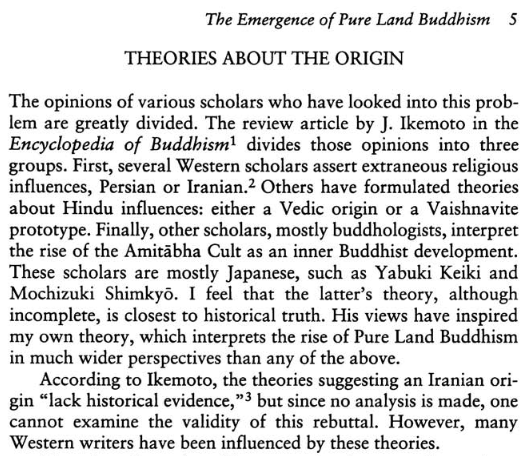
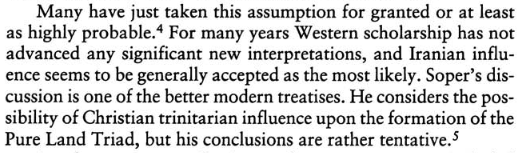
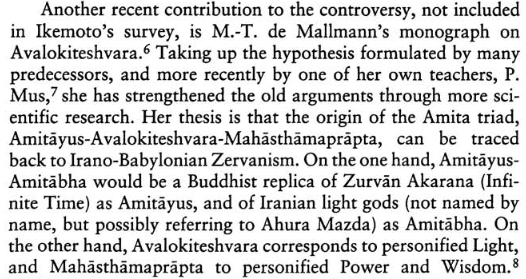
I have to say, it is interesting to note that a major evolution within Buddhism was going on at the same time as the various strains of Christian belief were also in competition. And both end up with a (kind of) Trinity, as well.
I mentioned once before that it is in fact quite likely that Indian Buddhists had travelled to the Middle East region before and around the time of Christ.
As for Christians heading East, I don't believe I have noted this before:
In A.D. 781, a Christian monk named Jingjing composed an inscription of roughly 1,800 Chinese characters on a large stone tablet, called a stela, which would become one of the richest sources of information ever discovered about early Christianity in China.
According to the stela, unearthed in the early 1600s, Christianity came to China in A.D. 635, when a Nestorian monk named Aluoben entered the ancient capital of Chang’an -- now modern-day Xi’an -- in central China. His arrival must have been the source of some excitement because the e mperor sent his minister of state to greet the guest and bring him to the palace. Although we do not know where Aluoben came from or why he visited China, some scholars believe that he arrived from Persia and was part of an important foreign delegation. Whatever the case, the Tang emperor issued an imperial edict three years later allowing Aluoben to build a monastery in Chang’an and to settle there with a handful of missionaries.
By the time Aluoben’s story was commemorated in stone almost 150 years later, the Old and New Testaments had been translated into Chinese, and monasteries had been founded in several cities throughout China. But in 845, an imperial edict limited all foreign religion, including Christianity. The edict triggered a period of persecution, and, by the end of the Tang Dynasty in 907, Christianity had all but disappeared from China.
A significant presence did not reappear until the 13th century, when Mongols conquered China and founded the Yuan Dynasty.
It would be neat to find some Christian influence on the development of Mahayana Buddhism in Indian in the second century, but seems like no one has found evidence of such visitors...

I know, I will ask Perplexity!
Oh damn, it claims not to know either. It notes that there is some recent content along those lines on Youtube (and a whole book published about it in 2019), but I wonder if it goes back to some obscure science fiction writer.
Update: See, this is why I keep a blog: so I can search it to remind myself of things I already knew!
Back in 2013, I had a post noting that the Time Travellers from the Future theory seems to go back to the 1950s, and one (apparently real) guy in particular. (Googling his name, I just came up with another page about it.)
Mind you, this guy is supposed to have said Roswell was real (as in, involved aliens of some kind), which I don't believe at all.
So yeah, people with high gullibility seem to go for the "from the future" theory. I still like it as a fun idea, though.
This 15 minute PBS show about how Singapore deliberately chose to go green and lush in its urban environment is a good explanation of why I love visiting there. It's basically like a techno/green, capitalist/socialist vision of how the future should look (and work):
I also gather from the enthusiastic comments following (mostly from Americans) that a lot of people hadn't realised that the place looks like this now. And its nice to see that so many who have visited it are big fans of the place, like me.
And a final comment: it's a little amusing to watch the poor host start to show clear sweat on his shaved head during the interview with the Chinese woman architect/planner who looks cool and composed throughout. I guess it has something to do with acclimatisation. (He could also have taken his coat off.)
I was killing time yesterday when I looked at Google Play for any new apps to play with on my phone, when I saw one called Perplexity. It had very high ratings, so I tried it.
What is it?:
Perplexity AI is an answer engine that uses large language models to provide precise answers to questions.Sure, I have fiddled with ChatGPT and marvelled at some of its imagined information. But a search engine with an LLM that provides footnoted links to the sources of its information?
I'm finding it very, very impressive. I'm not saying it's guaranteed to be 100% accurate, but it's pretty much blowing my mind as to how quickly it gathers information from several sources, bundles together a summary from all of them, writes it up coherently, and presents a further series of questions that might be useful to go into the topic deeper.
I guess I used to be amazed at the speed of search engines generally when they first came out. But now the systems work like someone scanning a half dozen websites related to a question asked in a normal human sentence, pulling bits of content from each of them, and writing a coherent summary, all in about 2 or 3 seconds.
I see now that you can use it (free) on the web too, at https://www.perplexity.ai/ (But it doesn't save a history of your previous questions, like the app does, until you "clear history".)
Go on, try it....
It is truly shocking to read the BBC article that came out after Lucy Letby's conviction for murdering 7 babies (and trying to kill 6 others). It starts:
Hospital bosses failed to investigate allegations against Lucy Letby and tried to silence doctors, the lead consultant at the neonatal unit where she worked has told the BBC.
The hospital also delayed calling the police despite months of warnings that the nurse may have been killing babies.
The unit's lead consultant Dr Stephen Brearey first raised concerns about Letby in October 2015.
No action was taken and she went on to attack five more babies, killing two.
Further down in the report (my bold):
We spoke to the lead consultant in the unit - who first raised concerns about Letby - and also examined hospital documents. The investigation reveals a catalogue of failures and raises serious questions about how the hospital responded to the deaths.
Dr Brearey says he demanded Letby be taken off duty in June 2016, after the final two murders. Hospital management initially refused.
The BBC investigation also found:
- The hospital's top manager demanded the doctors write an apology to Letby and told them to stop making allegations against her
- Two consultants were ordered to attend mediation with Letby, even though they suspected she was killing babies
- When she was finally moved, Letby was assigned to the risk and patient safety office, where she had access to sensitive documents from the neonatal unit and was in close proximity to senior managers whose job it was to investigate her
- Deaths were not reported appropriately, which meant the high fatality rate could not be picked up by the wider NHS system, a manager who took over after the deaths has told the BBC
It just seems incredible that hospital management clung for so long to "it's just a coincidence" that the rate of death (and near death) of neonatal babies had soared in that unit, and all happened when Letby was on shift:
Before June 2015, there were about two or three baby deaths a year on the neonatal unit at the Countess of Chester Hospital. But in the summer of 2015, something unusual was happening.
In June alone, three babies died within the space of two weeks. The deaths were unexpected, so Dr Stephen Brearey, the lead consultant at the neonatal unit, called a meeting with the unit manager, Eirian Powell, and the hospital's director of nursing Alison Kelly....
...by October 2015, things had changed. Two more babies had died and Letby had been on shift for both of them. ...
And it wasn't just the unexpected deaths. Other babies were suffering non-fatal collapses, meaning they needed emergency resuscitation or help with breathing, with no apparent clinical explanation. Letby was always on duty.
I can't imagine how some of the families of babies who died late in her killing spree must feel...

I was very surprised to hear from my son yesterday that he went on (what to me is) the most terrifying looking carnival ride at the Brisbane Ekka. This one:

He did survive, but said he'll never go on it again.
I'm pretty chicken when it comes to fast rides, and am not a fan of the falling sensation. But by a coincidence, this week's Science magazine has a charming story about how the urge to voluntarily engage in unusual, repetitive motion goes back a long way down the chain of evolution:
Nearly everyone has fun on a carousel—including, possibly, fruit flies. Scientists observed some flies embarking on a spinning platform voluntarily and repeatedly, suggesting the animals may find the movement appealing for some reason, according to a study posted on the bioRxiv preprint server earlier this month.
“The flies are fulfilling all the criteria of play as we understand it in other animals,” says Samadi Galpayage, a behavioral scientist at Queen Mary University of London who discovered bumble bees play with objects and who was not involved in the work. “There isn't really an alternative explanation so far. Whether that’s [evidence of] fun in itself—that’s the next question.”
Sergio Pellis, a behavioral scientist at the University of Lethbridge, says he finds the study—which has yet to be peer reviewed—“very exciting.” If confirmed, he notes, it would add to the small but growing pile of evidence for play in invertebrates—and would be the first instance of a type called “locomotor play” in these animals. Locomotor play involves the movement of one’s own body, such as running, jumping, or swinging. It’s different from object play, as bees have been observed doing, or social play, which has been observed in certain wasps and spiders.
The idea behind the study was inspired, ultimately, by a duck. Years before co-author Wolf Hütteroth became a neurobiologist, he remembers one day seeing a lone duck floating down a fast-moving river. Just as the animal was nearly out of sight, it flew back upriver, alit on the water, and floated back down—over and over again. “I never stopped wondering what motivated the duck to perform such curious behavior,” he says.
In February 2016, Hütteroth attended a symposium where researchers were discussing whether insects can act with intention. He pondered how to test whether flies would do something similar to the rapids-running duck.
He and Tilman Triphan, a colleague then at the University of Konstanz, decided to build a carousel of sorts. They’d offer male laboratory fruit flies (Drosophila melanogaster) the chance to hop onto a spinning section of floor in a stress-free, if otherwise unexciting, environment. He didn’t think the flies would actually go for it. “My expectations were extremely low,” he says. Some of the flies ignored the contraption. But a small group of them acted as if they’d just discovered Disneyland.
Triphan and Hütteroth—who have both since moved to the University of Leipzig—report in their preprint that a subset of the flies spent 5% or more of their time on the turning wheel. When the researchers put two disks in the arena that alternated spinning every 5 minutes, some flies spent their time bouncing back and forth between whichever carousel was spinning.Towards the end of the story, there's another "play" behaviour that I didn't need to know about:
Pellis notes there has been resistance to the idea that animals outside of mammals engage in play. He recalls research in the 1970s on roughhousing in cockroaches, for example, that would immediately be considered an example of play if puppies were doing it.
Maybe Mortein suppressed publicity about that research, because I sure don't remember it...
An article at The Conversation looks broadly at the matter of which Buddhists eat meat. Don't think I knew this (about the convenience factor of Muslims in Tibet):
Geography is a crucial factor in explaining why Tibetans have traditionally been big meat-eaters. Rice, vegetables and fruit were impossible to cultivate at the high elevations of the Himalayan mountains and plateaus. Altitude combined with the inaccessibility of much of Tibet thus prevented a diverse source of nutrition and so goat or yak meat, and various milk products, all high calorie foods, ensured survival.
To get around the direct responsibility for killing, Tibetan villages traditionally had resident Muslims who butchered the animals. Understandably, some might suggest this was a rather convenient arrangement.
It continues with the excuse making:
Meat-eating in the Theravadin tradition may have been justified partly because of legal precedent or permissibility. Firstly, the monks are required to dutifully accept whatever food is given to them by the laity to avoid attachment to any particular tastes, so if somebody offers meat to a monk, he has to consume it.
Secondly, a monk is allowed to consume meat if it is deemed “pure” on three grounds: if the killing of the animal has not been witnessed or heard by that monk and if it is not suspected to have been killed on purpose for them.
But perhaps the "best" rationalisation is the one given here:
Buddhism presents two conflicting views. All sentient beings deserve compassion and have Buddha-Nature. However, humans are a higher life-form by virtue of their capacities to pursue ethical and meditational practices leading to enlightenment.
The inherent Buddha Nature of any animal or even insect is the same as that of a human being. Nonetheless, some Buddhists would argue that meat-eating is acceptable for health as long as the energy gained from the dead animal is dedicated to pursuing an ethical life, which ultimately benefits all sentient beings.
Indeed it is said in the tantric tradition of Buddhism, that when a highly realised teacher eats meat it serves to benefit the dead animal in the next life. Within the context of tantric ritual practice, both meat and alcohol are consumed. However, a tiny meat morsel, as well as a finger-dip of alcohol, is sufficient.
Buddhist meat-eaters thus invoke a very particular form of human exceptionalism grounded in metaphysics and in the spiritual aspirations and capacities of humans.
I mean, I learnt today about a drug addiction which surprised me - to ether.
This was, apparently, significant in Ireland and then (mainly) Eastern Europe, back in the day. There's a Wikipedia article about it, but I learnt about it from this Youtube video:
From the Washington Post:
The prosecution of Trump and the others in Fulton County will stand out for one distinct reason: Unlike the federal trials (unless the rules change), it should be televised.
That will seemingly bring a measure of transparency to the high-stakes proceedings and create appointment viewing — just as the House Jan. 6 committee hearings did last year but potentially with even greater numbers.
But unlike the other trials, that spectacle is less likely to play out when it matters politically. The many defendants and Trump’s already crowded legal calendar make this a strong candidate for getting delayed past the 2024 election. Willis says she will ask for a trial date within six months, but that’s ambitious.
That doesn’t mean it won’t matter politically. As noted above, the charges against Trump allies could matter when it comes to how the federal prosecution takes shape. Trump’s attacks on witnesses could create problems under Georgia’s witness intimidation laws, which allow bail only if there is “no significant risk of intimidating witnesses.”
And there remains the possibility of Trump’s winning the 2024 election and facing this trial as a sitting president.
I think it would be pretty hilariously disastrous for Republicans to be insane enough to endorse Trump as a candidate while he is in jail awaiting trial.
Surely, if he ends up in jail because he refuses to stop deriding and trying to intimidate witnesses and judges, at least some of the lickspittle politicians who have sold their souls to MAGA might have to actually say "this is painful to admit, but we need another candidate"?
It's pretty pathetic that serious news organisations have to spend time noting, and debunking, loony Right wing conspiracies about the tragic firestorm at Maui:
Hawaii wildfires: 'Directed energy weapon' and other false claims go viral
