Ready for her close up:
Monday, May 04, 2020
Sunday, May 03, 2020
What's going on in Aussie wingnut land?
Why has Catallaxy stopped taking comments? It still has wrong and useless posts, but no more comments. Overall, that's an improvement.
Now just get rid of 95% of the posts, and it might gain a skerrick of credibility as a "centre right" blog again.
Update: all back to it's now standard role - a Facebook substitute for a cluster of Australian conservatives to say obnoxious things they won't or can't say in front of their relatives or workplace. It was just Sinclair having a dummy spit that the group was being too nasty to each other, whereas he thinks they should only be nasty to their "enemies", who haven't bothered showing up there for a decade or so anyway.
Now just get rid of 95% of the posts, and it might gain a skerrick of credibility as a "centre right" blog again.
Update: all back to it's now standard role - a Facebook substitute for a cluster of Australian conservatives to say obnoxious things they won't or can't say in front of their relatives or workplace. It was just Sinclair having a dummy spit that the group was being too nasty to each other, whereas he thinks they should only be nasty to their "enemies", who haven't bothered showing up there for a decade or so anyway.
Friday, May 01, 2020
The Buddhists head West - far West
The other night, SBS showed the Buddhist action/comedy movie Journey to the West: The Demons Strike Back. (I didn't stay up for all of it, but it's a sequel to what I think was the much better Stephen Chow movie Journey to the West: Conquering the Demons.)
The journey the movies (and novel, and TV series Monkey) references is from China to India. But I didn't realise that Buddhists from India had been heading quite far West, even before the time of Christ.
Indian emperor Ashoka apparently sent Buddhist missionaries West in the 3rd century BC, and it appears possible that there were some in Alexandria in Egypt. This Ashoka guy sounds pretty interesting, and he is the subject of a lengthy Wikipedia entry. I've heard the name before, probably, but us Westerners don't pay much heed to anything that was going on in India if it didn't involve Europeans there, do we?
He apparently had a reputation for violence, but converted to Buddhism after getting the guilts over a particularly big war of conquest. From his Wikipedia entry:
Anyway, getting closer to the time of Christ, there was the "Pandion embassy"incident which is well attested:
I find it blackly amusing that it seems Indians had a habit of travelling to the West and burning themselves alive to impress the locals:
Anyway, I'll end by noting that it's been an improbable (probably Theosophical?) idea for a century or so that Jesus headed East before his public ministry and got some ideas from Indian religions.
As it turns out, though, it was the other way around: the East really came to him, or his region, before his time.
Update:
I see that in the Wikipedia entry on the self immolating Kalanos, he is said to be Hindu, rather than Buddhist:
The journey the movies (and novel, and TV series Monkey) references is from China to India. But I didn't realise that Buddhists from India had been heading quite far West, even before the time of Christ.
Indian emperor Ashoka apparently sent Buddhist missionaries West in the 3rd century BC, and it appears possible that there were some in Alexandria in Egypt. This Ashoka guy sounds pretty interesting, and he is the subject of a lengthy Wikipedia entry. I've heard the name before, probably, but us Westerners don't pay much heed to anything that was going on in India if it didn't involve Europeans there, do we?
He apparently had a reputation for violence, but converted to Buddhism after getting the guilts over a particularly big war of conquest. From his Wikipedia entry:
Ashoka waged a destructive war against the state of Kalinga (modern Odisha),[7] which he conquered in about 260 BCE.[8] He converted to Buddhism[7] after witnessing the mass deaths of the Kalinga War, which he had waged out of a desire for conquest and which reportedly directly resulted in more than 100,000 deaths and 150,000 deportations.[9] He is remembered for the Ashoka pillars and edicts, for sending Buddhist monks to Sri Lanka and Central Asia, and for establishing monuments marking several significant sites in the life of Gautama Buddha.[10]Now, it would seem that the idea that Ashoka's monks set up shop near Alexandria in Egypt has some pretty slender evidence. I haven't read all of this paper, but it's an interesting one about the identity of a particular religious community. It all seems very up in the air, even though everyone agrees that the occasional Indian is likely to have been in Alexandria at the time, and it wouldn't be completely surprising if at least the odd monk was amongst them.
Anyway, getting closer to the time of Christ, there was the "Pandion embassy"incident which is well attested:
Roman historical accounts describe an embassy sent by the "Indian king Porus (Pandion (?) Pandya (?) or Pandita (?)[citation needed]) to Caesar Augustus sometime between 22 BC and 13 AD. The embassy was travelling with a diplomatic letter on a skin in Greek, and one of its members was a sramana who burned himself alive in Athens to demonstrate his faith. The event made a sensation and was described by Nicolaus of Damascus, who met the embassy at Antioch (near present day Antakya in Turkey) and related by Strabo (XV,1,73 [2]) and Dio Cassius (liv, 9).The problem is, it seems no one is 100% sure if this guy was like your average Indian, Hindu holy man, or a Buddhist.
I find it blackly amusing that it seems Indians had a habit of travelling to the West and burning themselves alive to impress the locals:
Plutarch (died 120 AD) in his Life of Alexander, after discussing the self-immolation of Calanus of India (Kalanos) writes:We all know of modern cases of Buddhist self immolation as a form of protest. These ancient cases seem to be more about how impressing people with how seriously they take their religion. On this topic, I see there is a 2015 paper in the Journal of the Oxford Centre for Buddhist Studies about the matter:
The same thing was done long after by another Indian who came with Caesar to Athens, where they still show you "the Indian's Monument."[16]
The Self-immolation of Kalanos and other Luminous Encounters Among Greeks and Indian Buddhists in the Hellenistic WorldIs he trying to be a bit witty by use of the word "luminous" like that. (I haven't read it yet.)
Anyway, I'll end by noting that it's been an improbable (probably Theosophical?) idea for a century or so that Jesus headed East before his public ministry and got some ideas from Indian religions.
As it turns out, though, it was the other way around: the East really came to him, or his region, before his time.
Update:
I see that in the Wikipedia entry on the self immolating Kalanos, he is said to be Hindu, rather than Buddhist:
Kalanos, also spelled Calanus (Ancient Greek: Καλανὸς)[1] (c. 398 – 323 BCE), was a gymnosophist, a Hindu Brahmin[2][3][4][5] and philosopher from Taxila[6] who accompanied Alexander the Great to Persis and later self-immolated himself by entering into a Holy Pyre, in front of Alexander and his army. Diodorus Siculus called him Caranus (Ancient Greek: Κάρανος).[7] He did not flinch while his body was burning. He bode goodbye to the soldiers but not to Alexander. He communicated to Alexander that he would meet him in Babylon. Alexander died exactly a year later in Babylon. [8] It was from Kalanos that Alexander came to know of Dandamis, the leader of their group, whom Alexander later went to meet in the forest.[9]And the reason for his suicide? Just old and tired, it seems:
He was seventy-three years of age at time of his death.[18] When the Persian weather and travel had weakened him, he informed Alexander that he would prefer to die rather than live as an invalid. He decided to take his life by self-immolation.[19] Although Alexander tried to dissuade him from this course of action, upon Kalanos' insistence the job of building a pyre was entrusted to Ptolemy.[18] Kalanos is mentioned also by Alexander's admirals, Nearchus and Chares of Mytilene.[20] The city where this immolation took place was Susa in the year 323 BC.[13] Kalanos distributed all the costly gifts he got from the king to the people and wore just a garland of flowers and chanted vedic hymns.[21][22][3] He presented his horse to one of his Greek pupils named Lysimachus.[23] He did not flinch as he burnt to the astonishment of those who watched.[14][24][25]Couldn't he just sneak off and drink some hemlock or something? Seems a bit of an attention seeker.
Pretty accurate prediction
Remember how I wrote a month ago that the RMIT economists' urgent book on how to "unfreeze" the economy would say this:
My point a is their point 1.
Their point 2 and 4 is part of my point 1.
I would bet that blockchain turns up in their points 3 and 4.
My point d is bound to be part of their 3.
The only thing I missed is perhaps the point 5 - but it's an old small government trope that decentralising power our of federal government hands always works best. Just like Kansas showed with their failed experiment with Laffernomics, hey?
I think I was close enough to claim vindication. And I did save everyone the time.
PS: I am also reminded of that bit in Hitchhiker's Guide to the Galaxy wherein Zapod proposes replacing Arthur's brain with a microchip that just says "What?" "I don't understand" and "Where's the tea?" and no one would know the difference. The three catchphrases for Sinclair would be "Lower Taxes!" "Blockchain!" "Deregulate!" (and an occasional "Free Speech!")
It will be 200 pages devoted to the urgent need for the Australian governments to:Sinclair Davidson posts today the book cover, with this:
a. deregulate everything, as fast as possible;
b. start using blockchain technologies, they're terrific;
c. urgently reduce all government spending on things other than the temporary workforce support, with public broadcasting getting special mention;
d. reduce taxes.
Done and dusted.
My point a is their point 1.
Their point 2 and 4 is part of my point 1.
I would bet that blockchain turns up in their points 3 and 4.
My point d is bound to be part of their 3.
The only thing I missed is perhaps the point 5 - but it's an old small government trope that decentralising power our of federal government hands always works best. Just like Kansas showed with their failed experiment with Laffernomics, hey?
I think I was close enough to claim vindication. And I did save everyone the time.
PS: I am also reminded of that bit in Hitchhiker's Guide to the Galaxy wherein Zapod proposes replacing Arthur's brain with a microchip that just says "What?" "I don't understand" and "Where's the tea?" and no one would know the difference. The three catchphrases for Sinclair would be "Lower Taxes!" "Blockchain!" "Deregulate!" (and an occasional "Free Speech!")
Counting the flu
I found a useful discussion of the complexity of assigning cause of death to things like the flu or COVID-19 at an Allahpundit post at Hot Air. Interestingly, he pointed to a post by an American doctor at Scientific American, who pointed out that the number of cases the CDC assigns to the fly is a very rubbery figure itself:
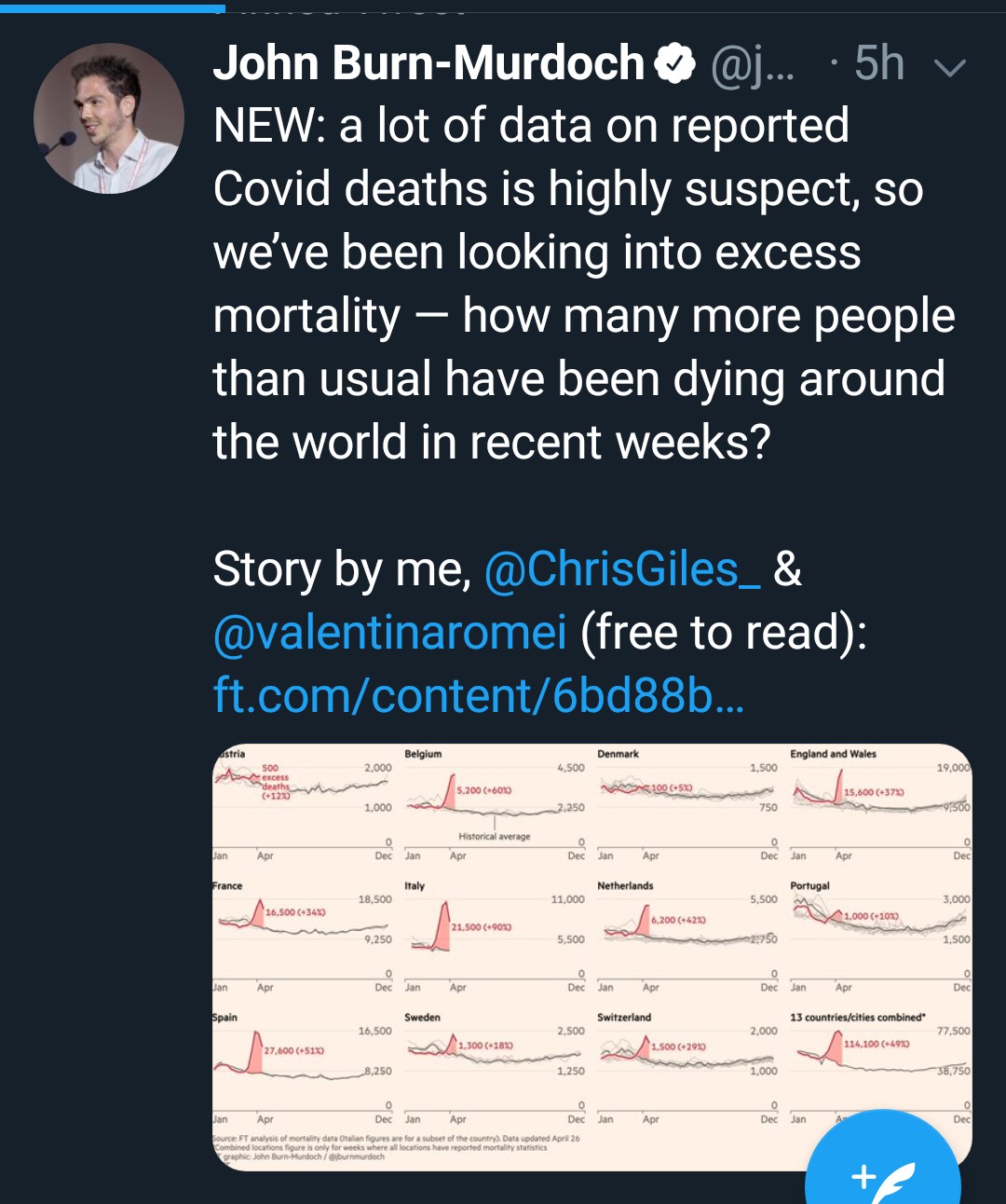
I think it should be clear that the true way of assessing the seriousness of a pandemic has to be looking at "excess deaths" compared to same period, and those figures are not looking good. The Financial Times has been doing good work in that regard.
When reports about the novel coronavirus SARS-CoV-2 began circulating earlier this year and questions were being raised about how the illness it causes, COVID-19, compared to the flu, it occurred to me that, in four years of emergency medicine residency and over three and a half years as an attending physician, I had almost never seen anyone die of the flu. I could only remember one tragic pediatric case.That really blows up the comparisons made by those on the Right who try to downplay the seriousness of COVID-19 by comparing it to (say) 60,000 a year allegedly dying of the flu ("and we don't close down the economy", yells Creighton.)
Based on the CDC numbers though, I should have seen many, many more. In 2018, over 46,000 Americans died from opioid overdoses. Over 36,500 died in traffic accidents. Nearly 40,000 died from gun violence. I see those deaths all the time. Was I alone in noticing this discrepancy?
I decided to call colleagues around the country who work in other emergency departments and in intensive care units to ask a simple question: how many patients could they remember dying from the flu? Most of the physicians I surveyed couldn’t remember a single one over their careers. Some said they recalled a few. All of them seemed to be having the same light bulb moment I had already experienced: For too long, we have blindly accepted a statistic that does not match our clinical experience.
The 25,000 to 69,000 numbers that Trump cited do not represent counted flu deaths per year; they are estimates that the CDC produces by multiplying the number of flu death counts reported by various coefficients produced through complicated algorithms. These coefficients are based on assumptions of how many cases, hospitalizations, and deaths they believe went unreported. In the last six flu seasons, the CDC’s reported number of actual confirmed flu deaths—that is, counting flu deaths the way we are currently counting deaths from the coronavirus—has ranged from 3,448 to 15,620, which far lower than the numbers commonly repeated by public officials and even public health experts.
I think it should be clear that the true way of assessing the seriousness of a pandemic has to be looking at "excess deaths" compared to same period, and those figures are not looking good. The Financial Times has been doing good work in that regard.
I have my doubts
Just saw this on Twitter:
and while there are not many comments following it yet, I really have my doubts about the accuracy of that figure for renting in Tokyo.
Why? Because I like to watch the ever cheerful Paolo from Tokyo on Youtube (and his other channel Tokyo Zebra) , and he talked a lot about renting (or buying) an apartment in Tokyo recently, and I am pretty sure it was no where near as cheap as this guy claims. (There are a lot of extra costs that you don't get in Australia, as well.)
I don't have time to watch and check now, but I'm pretty I am right about this...
Update: yeah, I just checked on this video, where he and his wife are looking for a new 2 bedroom rental, and the cost seems to be around $2700 - $2900USD a month. This site indicates you can do much cheaper, but I still suspect that as an average, $1000 a month is just not right, at all.
and while there are not many comments following it yet, I really have my doubts about the accuracy of that figure for renting in Tokyo.
Why? Because I like to watch the ever cheerful Paolo from Tokyo on Youtube (and his other channel Tokyo Zebra) , and he talked a lot about renting (or buying) an apartment in Tokyo recently, and I am pretty sure it was no where near as cheap as this guy claims. (There are a lot of extra costs that you don't get in Australia, as well.)
I don't have time to watch and check now, but I'm pretty I am right about this...
Update: yeah, I just checked on this video, where he and his wife are looking for a new 2 bedroom rental, and the cost seems to be around $2700 - $2900USD a month. This site indicates you can do much cheaper, but I still suspect that as an average, $1000 a month is just not right, at all.
Thursday, April 30, 2020
Speaking of Right wing cranks...
...don't you love the way they like to proclaim they live in a bubble world of narrow Right Wing information as if that's a good thing.
Steve Kates notes:
Steve Kates notes:
His final line is “Television, like most things, seems to be more fun when it’s Australian”. Since the only television I watch is Bolt and The Outsiders, from that perhaps small sample I could not agree more.And, as I have said a million times before - you basically can blame Rupert Murdoch for this, because he found creating a bubble world of "only trust us" was a good way to make money.
Right wing hyperbolic whiner of the day award...
...goes to Andrew Bolt, who wins it probably every second day:
And amongst other Right wing twittery, James Morrow is just so dumb, stupid and transparent here. After obviously advocating for this drug only because he has to defend Trump at every opportunity, he tries to pretend that he wasn't the one politically motivated to talk up an unverified treatment:
Yeah, sure.
And amongst other Right wing twittery, James Morrow is just so dumb, stupid and transparent here. After obviously advocating for this drug only because he has to defend Trump at every opportunity, he tries to pretend that he wasn't the one politically motivated to talk up an unverified treatment:
Yeah, sure.
Putin has problems
According to this Vox article, the COVID-19 outbreak is getting worse in Russia and Putin acknowledges it.
And in other "so you thought you could do better than America in sorting this out?" news:
President Vladimir Putin is letting his impatience show with Syrian ally Bashar al-Assad, who isn’t proving as grateful for being kept in power by Russian intervention in his country’s brutal civil war as the Kremlin leader needs him to be.
Consumed at home by the twin shocks of collapsing oil prices and the coronavirus epidemic, and eager to wrap up his Syrian military adventure by declaring victory, Putin is insisting that Assad show more flexibility in talks with the Syrian opposition on a political settlement to end the nearly decade-long conflict, said four people familiar with Kremlin deliberations on the matter.
Assad’s refusal to concede any power in return for greater international recognition and potentially billions of dollars in reconstruction aid prompted rare public outbursts against the Syrian president this month in Russian publications with links to Putin.
“The Kremlin needs to get rid of the Syrian headache,” said Alexander Shumilin, a former Russian diplomat who runs the state-financed Europe-Middle East Center in Moscow. “The problem is with one person -- Assad -- and his entourage.”
Wednesday, April 29, 2020
The things you learn
Well, as readers would know, I have been looking at various Buddhist related stuff recently, which is how I found the (not actually Buddhist, but Indian) Spiritual Science Research Foundation.
Some of things I have learnt there are pretty remarkable:
That's handy to know. Next:
Huh.
And as for the spiritual realm and its effect on us all, the pie graphs makes it all very scientific and convincing:
There you go.
Some of things I have learnt there are pretty remarkable:
That's handy to know. Next:
Huh.
And as for the spiritual realm and its effect on us all, the pie graphs makes it all very scientific and convincing:
There you go.
Just putting it out there
In my experience, the most arrogant, reluctant to help anyone with a genuine enquiry about something they know about, businesses in Australia are body corporate management companies.
They seem to rely on having fixed, multi-year contracts to the body corporate as meaning they don't have to take calls or provide a skerrick of information to anyone (including the residents of the building) other than the current Chairman of the body corporate.
They are terrible.
They seem to rely on having fixed, multi-year contracts to the body corporate as meaning they don't have to take calls or provide a skerrick of information to anyone (including the residents of the building) other than the current Chairman of the body corporate.
They are terrible.
COVID-19 depressing news
Noted this morning:
Update: why are Iranians so prone to the spread of crank rumours?:
Singapore reported 528 new COVID-19 cases as of noon on Tuesday (Apr 28), bringing the national total to 14,951.And also on the CNA website:
The vast majority of the new cases are work permit holders residing in foreign worker dormitories, the Ministry of Health (MOH) said in its preliminary update.
In a later update, MOH said there were 10 cases in the community, of which seven were Singapore citizens or permanent residents; there were also two work pass holders and one visit pass holder who were infected.
Rome: Deaths from the COVID-19 epidemic in Italy climbed by 382 on Tuesday (Apr 28), against 333 the day before, the Civil Protection Agency said, while the total of people infected since the start of the outbreak topped 200,000.Over in Indonesia, no one really knows what is going on, it seems:
The daily tally of new infections stood at 2,091, higher than the 1,739 recorded on Monday.
The actual number of COVID-19 deaths in Indonesia may be substantially higher than officially reported as several regions have recorded hundreds of fatalities among patients under surveillance (PDPs), who are suspected of having contracted the highly contagious coronavirus.No one seems to understand why the UK has done so badly, too. Now they are worried about kids getting a dangerous condition possibly related to the virus:
Patients under surveillance refer to people with COVID-19 symptoms who have not been confirmed as having the disease, meaning that they are waiting either to be tested or for their test results to come back.
The central government's daily count of fatalities, at 773 as of Tuesday, does not include all PDPs who have died.
More than a dozen children have fallen ill with a new and potentially fatal combination of symptoms apparently linked to Covid-19, including a sore stomach and heart problems.On the upside: it's good to live in Australia, which does not seem to be getting the international attention it deserves for having apparently taken effective action that looks likely to all but eliminate it.
The children affected appear to have been struck by a form of toxic shock syndrome. All have been left so seriously unwell that they have had to be treated in intensive care.
At least one has received extra corporeal membrane oxygenation (ECMO) treatment, which is used when someone’s life is at risk because they can no longer breathe for themselves.
NHS bosses are so concerned that they have written to doctors alerting them to the emergence of these cases and asked them to urgently refer any children with similar symptoms to hospital.
Update: why are Iranians so prone to the spread of crank rumours?:
TEHRAN, Iran (AP) — The false belief that toxic methanol cures the coronavirus has seen over 700 people killed in Iran, an official said Monday.That represents a higher death toll than so far released by the Iranian Health Ministry.An adviser to the ministry, Hossein Hassanian, said that the difference in death tallies is because some alcohol poisoning victims died outside of hospital.“Some 200 people died outside of hospitals”, Hassanian told The Associated Press.Alcohol poisoning has skyrocketed by ten times over in Iran in the past year, according to a government report released earlier in April, amid the coronavirus pandemic.
As Hillary said "what difference does it make?"
I don't quite understand the Australian bipartisan take on an independent inquiry into the origin of the current pandemic, with its big question mark over the role of China.
Doesn't everyone just take it as a given that the Chinese government is not to be entirely trusted in such matters? It's a fantasy to think they would pay reparations for not disclosing details sooner, or trying to cover it up, or whatever they did. And even if there was something really big to be found (escape of a bioweapon, for example, which no one serious seems to believe), the rest of the world is more likely to discover that via espionage or secret sources that would never expose themselves in an independent inquiry.
It just seems pretty pointless to me...
Doesn't everyone just take it as a given that the Chinese government is not to be entirely trusted in such matters? It's a fantasy to think they would pay reparations for not disclosing details sooner, or trying to cover it up, or whatever they did. And even if there was something really big to be found (escape of a bioweapon, for example, which no one serious seems to believe), the rest of the world is more likely to discover that via espionage or secret sources that would never expose themselves in an independent inquiry.
It just seems pretty pointless to me...
Tuesday, April 28, 2020
The tortilla project
Huh. I was "cooking" (toasting in a dry frying pan) some pre-made corn totillas the other night from a Mexican meal kit, and thinking how much I liked them. I didn't realise that making your own just involves a special cornmeal flour, and water:
Here's a short video by a woman originally from Mexico. They are simple - although it seems salt should be added too:
Of course, I don't have a tortilla press lying around at home. Maybe my next birthday present?
I will report in due course.
Homemade Tortillas Only Take Two IngredientsThis sounds like a cooking experiment worth trying.
Tortillas start with a dough made from regular old tap water and masa harina, a corn flour made from kernels that have been nixtamalized—soaked in an alkaline solution that softens them and makes them easier to digest. Then, those softened kernels are ground into a paste which is dried and sold as masa harina. All you have to do is add hot water to the dried corn to rehydrate—the resulting dough is similar to clay, and it’s quite easy to work with.
Here's a short video by a woman originally from Mexico. They are simple - although it seems salt should be added too:
Of course, I don't have a tortilla press lying around at home. Maybe my next birthday present?
I will report in due course.
An odd Buddhist thing
Here's something that I did not know about Buddhism. (Or some Buddhists.)
I just had someone explaining to me that they would want their death (assuming it is from a terminal illness) to be according to Buddhist principles, which are that a dying person does not have their close family around the death bed, for concern that it makes them more reluctant to give up their spirit (or consciousness, or whatever.) Apparently, the Buddhist way is that it is OK to have a couple of Buddhist people who aren't close to you in the room saying prayers, but the family (spouse included) stays outside. I asked about pain relief, and he said no, Buddhists are supposed to work through the pain as part of the natural order of things. (!) Having a clear mind at the point of death is important as it can affect the metaphysical outcome. So, no morphine for dying Buddhist cancer sufferers, apparently.
I have no time to check today how widespread within Buddhism this view is. I do not know well the person who was telling me this, but he seemed to be well into Buddhist belief. It's certainly pretty unappealing to our Western ideas of the value of close relatives being with their loved one as they die.
I wonder: I am aware that the Japanese medical system, in certain respects, is much less into pain relief than we are in Australia. (Endoscopy into the stomach with no twilight sedation; have to go to a special birth clinic if you expect gas or epidural to give pain relief.) Is this partly because of Buddhist pain stoicism?
Update: on the matter of pain relief, here is an extract from a nursing website discussing it in 2003. The attitude of the person I was speaking to today is very consistent with this:
I just had someone explaining to me that they would want their death (assuming it is from a terminal illness) to be according to Buddhist principles, which are that a dying person does not have their close family around the death bed, for concern that it makes them more reluctant to give up their spirit (or consciousness, or whatever.) Apparently, the Buddhist way is that it is OK to have a couple of Buddhist people who aren't close to you in the room saying prayers, but the family (spouse included) stays outside. I asked about pain relief, and he said no, Buddhists are supposed to work through the pain as part of the natural order of things. (!) Having a clear mind at the point of death is important as it can affect the metaphysical outcome. So, no morphine for dying Buddhist cancer sufferers, apparently.
I have no time to check today how widespread within Buddhism this view is. I do not know well the person who was telling me this, but he seemed to be well into Buddhist belief. It's certainly pretty unappealing to our Western ideas of the value of close relatives being with their loved one as they die.
I wonder: I am aware that the Japanese medical system, in certain respects, is much less into pain relief than we are in Australia. (Endoscopy into the stomach with no twilight sedation; have to go to a special birth clinic if you expect gas or epidural to give pain relief.) Is this partly because of Buddhist pain stoicism?
Update: on the matter of pain relief, here is an extract from a nursing website discussing it in 2003. The attitude of the person I was speaking to today is very consistent with this:
Gee. If I was a Western nurse/doctor, I would probably be a tad annoyed that I had to go to a lot more trouble with a Buddhist patient than just dosing them up with enough pain relief that they stop feeling pain.QUESTION: My patient is a Buddhist with end-stage colon cancer who keeps refusing pain medication. How can I help him manage his pain without infringing on his religious beliefs?ANSWER: Buddhism is an Eastern religion that's taken root in the United States. Its followers have a unique perspective on pain. Buddhists believe that suffering is part of life, to be expected, and that if a person experiences pain calmly, without becoming emotionally distressed, he can attain greater states of being.Preparation for death is an important part of Buddhism. Many religious practices focus on the moment of death and the immediate transition to the next life. Because Buddhists believe the mind must be as alert as possible at the time of death, many may decline pain medication or limit its use.Pain assessment for a Buddhist patient is the same as for any other patient. And, as with any patient, you should understand his pain control goals. A Buddhist patient may wish to withhold or limit the use of drugs that can cause drowsiness, such as opioids, so educate him about pain control choices that won't interfere with his goals. (Explain that drowsiness, for example, subsides after the first few days of opioid use.)Use the World Health Organization pain ladder to step up analgesic therapy for pain control. Using adjuvant medications, such as nonsteroidal anti-inflammatory drugs, lets you give lower doses of opioids and so limit adverse opioid reactions, such as drowsiness. Obtain orders for additional pain relief, even if the patient initially declines it. You'll be ready to provide immediate relief if his pain suddenly intensifies and he changes his mind. Be sure to document his statements about pain control interventions and goals and monitor the effectiveness of any alternative interventions used.From a Buddhist perspective, pain can be offered as a sacrifice to benefit all beings and has long-term benefits in reaching a higher state of consciousness. Your patient may wish to perform religious rituals such as quiet reflection, chanting, meditation, and prayer. Allow him periods of time alone for these rituals.Quiet reflection is one of the most important practices for Buddhists. Help the patient create a small space in his room for pictures of religious leaders or ancestors, prayer beads, and flowers. This area helps him focus his energy and can help him manage pain.Chanting involves quietly repeating specific prayers or mantras many times. Other members of the religious community may participate in this practice with the patient. If he can't chant himself, the family may bring in tapes from services, which you can play for him during the day. An alternative intervention is to encourage him to slowly breathe deeply and focus on inhalation and exhalation.Meditation can provide the most satisfying and effective religious expression for Buddhists. Allow the patient quiet time to empty his mind of thoughts, or to visualize specific images, depending on his tradition. If possible, put him in a room away from noisy areas, such as the nurses' station. Document your interventions to show that you're individualizing the patient's care plan. Contact religious representatives as requested by the patient.
Movie reviews you didn't need
From my Netflix viewing:
* tried to watch 1922, based on a Stephen King short story. It got mostly good reviews, it seems, but I couldn't stick with it. My biggest issue was with the lead actor: his Southern drawl was actually hard to understand at many points, and his acting generally seemed to be just "too much". I didn't like the narration, either. As I have explained before, I am, generally speaking, a Stephen King sceptic - it is pretty rare that I find any project sourced in his stories to be anything more than just passable. (The one exception - Kubrick's version of The Shining - King hated.) This movie did nothing to swing my judgement about his oeuvre.
* Johnny English Strikes Again: the first two Rowan Atkinson vehicles were much better than I had expected. The third outing, form 2018, shows that they have run out of ideas, and Atkinson's acting seemed more desperate and Mr Bean than in the previous ones. (I am not so keen on the Mr Bean character, incidentally.) Not offensively bad; just a case of a franchise out of steam.
* Veronica: a Spanish 2017 supernatural thriller, this story of a teenage girl who seemingly has invited a haunting into her apartment by virtue of use of a ouija board with friends is actually pretty good, despite that set up sounding like it owes too much to The Exorcist or various other films whereby teenagers invite supernatural trouble into their lives that way. It's well directed, and well acted by its mainly young cast. (The movie made me realise -I think that Spanish movies often do very well with their child actors. Now that I think about it, it also confirmed another thing about Spanish language films - they have probably the least reluctance of any culture to showing full frontal - adult - male nudity.) The only slight downside is that it was said to be "based on a true story" which was well known in Spain (because of police involvement), but checking later revealed that the movie had exceptionally few actual similarities to the real story. Oh well.
* tried to watch 1922, based on a Stephen King short story. It got mostly good reviews, it seems, but I couldn't stick with it. My biggest issue was with the lead actor: his Southern drawl was actually hard to understand at many points, and his acting generally seemed to be just "too much". I didn't like the narration, either. As I have explained before, I am, generally speaking, a Stephen King sceptic - it is pretty rare that I find any project sourced in his stories to be anything more than just passable. (The one exception - Kubrick's version of The Shining - King hated.) This movie did nothing to swing my judgement about his oeuvre.
* Johnny English Strikes Again: the first two Rowan Atkinson vehicles were much better than I had expected. The third outing, form 2018, shows that they have run out of ideas, and Atkinson's acting seemed more desperate and Mr Bean than in the previous ones. (I am not so keen on the Mr Bean character, incidentally.) Not offensively bad; just a case of a franchise out of steam.
* Veronica: a Spanish 2017 supernatural thriller, this story of a teenage girl who seemingly has invited a haunting into her apartment by virtue of use of a ouija board with friends is actually pretty good, despite that set up sounding like it owes too much to The Exorcist or various other films whereby teenagers invite supernatural trouble into their lives that way. It's well directed, and well acted by its mainly young cast. (The movie made me realise -I think that Spanish movies often do very well with their child actors. Now that I think about it, it also confirmed another thing about Spanish language films - they have probably the least reluctance of any culture to showing full frontal - adult - male nudity.) The only slight downside is that it was said to be "based on a true story" which was well known in Spain (because of police involvement), but checking later revealed that the movie had exceptionally few actual similarities to the real story. Oh well.
Monday, April 27, 2020
Rare sights in Japan
Just stumbled across a site with links to live Youtube feeds in Japan.
This one which I find the most remarkable: a near deserted looking entry to Sensoji Temple in Asakusa. Just the occasional person walking through what is probably the busiest tourist temple in Tokyo:
There is another live feed, with a nice view of the actual temple area, but I can't embed it. The link is here though.
The relative lack of pedestrians, and depleted vehicle traffic, at the famous Shibuya crossing is also worth a look:
This one which I find the most remarkable: a near deserted looking entry to Sensoji Temple in Asakusa. Just the occasional person walking through what is probably the busiest tourist temple in Tokyo:
There is another live feed, with a nice view of the actual temple area, but I can't embed it. The link is here though.
The relative lack of pedestrians, and depleted vehicle traffic, at the famous Shibuya crossing is also worth a look:
Consequences
A headline at Vox:
Governors say Trump’s disinfectant comments prompted hundreds of poison center calls
Governors from both parties warn that people take what the president says seriously, even if he doesn’t.
He's got an excuse and he's sticking to it
Seems pretty clear that someone around Trump has said "It's easy - whenever you make a silly mistake or want to walk back from something you said, just say you were being 'sarcastic'", and he is sticking to that for all it's worth. (Which is, nothing.)
Excess deaths noted
This is important:
And here is the link to the story:
According to the FT analysis, overall deaths rose 60 per cent in Belgium, 51 per cent in Spain, 42 per cent in the Netherlands and 34 per cent in France during the pandemic compared with the same period in previous years. Some of these deaths may be the result of causes other than Covid-19, as people avoid hospitals for other ailments. But excess mortality has risen most steeply in places suffering the worst Covid-19 outbreaks, suggesting most of these deaths are directly related to the virus rather than simply side-effects of lockdowns.
Track me
I have downloaded the government's COVID 19 tracking app, with my only concern being how much battery use it takes when you leave Bluetooth on all day every day.
However, given that I am itching for a new phone amyway, this may be the perfect excuse. JB Hi Fi should be running some ads along those lines...
A perfect cartoon
I see that in lieu of Trump getting his face on TV at his useless briefings, he has been rage tweeting about the media overnight. Which led to someone re-tweeting this cartoon. It is a near perfect summation of why Covid-19 is politically hurting him:
Sunday, April 26, 2020
Confirmation of another thing we already knew
It appears from this article that John Roskam, long standing IPA head who can't get a Lib nomination to Parliament when younger twerps in his organisation have, has long been personally invested in attacking the COVID-19 semi lockdown.
He is a wanker, and a dangerous one at that.
I would still like to know, though, whether he is being prodded by a wealthy donor into aggressively campaigning on this. Or is it just his own very bad idea?
He is a wanker, and a dangerous one at that.
I would still like to know, though, whether he is being prodded by a wealthy donor into aggressively campaigning on this. Or is it just his own very bad idea?
COVID and graphs
If the COVID-19 crisis has demonstrated anything convincingly, it's that analysing information, in particular with graphs, is rife with potential to mislead. I guess we all knew that, but still.
I thought this thread on the issue was pretty interesting. (Link is to a threadreader compilation.)
Friday, April 24, 2020
A brief interlude from other topics...
I have an urge to write about Android and mobile phones.
Every 6 to 12 months I post about how astounded I am about the improvements in mobile phones, especially in low to mid level range where my buying choices have always been. (Carry an easily breakable $1300 computer in my pocket every day? No thanks.)
I remain pretty happy with my Moto G5 Plus, but I am a bit puzzled about Android and the way apps seem to rapidly accumulate memory. My phone has 16GB internal memory, and after my last phone had, what, 4 or 8GB?, this sounded like a luxurious amount which would take a long time to use up.
However Android apps seem to take up quite ridiculous amounts of memory for what they do. Photos and video go to the sd card, so they can't be blamed, but my internal memory is now always hovering at about 15 to 15.5GB, meaning I am forever being urged by my phone to delete files and apps I haven't used for a while.
When I check on my phone as to the size of certain apps, I just don't understand why they can take up so much space. A couple of hundred MB used to be considered an enormous size for a program of any description. Now, to take an example, the Flipboard app, which I quite like as a sort of news and magazine aggregator, takes up 42 MB plus 179 MB of user data, and 51MB of cache. I can delete the cache, but I presume I lose my topic preferences if I delete the user data.
Line, a chat and call app that I sometimes use, but not that often, takes up 220 MB in the app itself, plus has 342MB in user data! That's huge. But even the internet browser I like to use now - Brave - takes up 112MB and shows 70MB of user data. Why so much?
Anyway, this has made me consider a new phone, just for the internal memory increase. I see that I can now get $399 phones with 128MB of internal memory - again, a huge leap forward in the space of a couple of years.
I do love Android, and would never consider going to Apple.
But as I say, I still would like to know how Android Apps have become the incredible memory bloat software that they are.
One other thing: it's really weird what sensors various phone companies choose to put in their phones, and how they can be completely inconsistent across their range. There are two Moto phones I was considering buying, which until one went on sale recently, were both $399 and both in the same series. Yet one has NFC capability, and one doesn't. My current Moto, which is getting up to 2 years old now, had one and I don't think it cost more than $400.
OPPO phones, which are very popular in Asia and my son loves his, at the cheaper end at least, do not seem generally to have NFC (needed to use your phone in lieu of your credit card), and a lot of other cheaper Chinese phones don't have it either. Yet when I checked the specs on a cheaper OPPO model currently on sale at JB Hi Fi, it does have it.
Then the other day I wanted to put a compass app on my phone, only to discover it doesn't have the magnetic sensor to allow that. Websites written years ago say that nearly all phones have it, but not Moto in their midrange. It seems all OPPO phones in the mid range have it, but even the new Moto with 128GB I am considering buying - a 2019 model - does not.
It is really odd the way companies seem to play around with what they can provide. All part of the fun of buying Android, though, I guess.
Every 6 to 12 months I post about how astounded I am about the improvements in mobile phones, especially in low to mid level range where my buying choices have always been. (Carry an easily breakable $1300 computer in my pocket every day? No thanks.)
I remain pretty happy with my Moto G5 Plus, but I am a bit puzzled about Android and the way apps seem to rapidly accumulate memory. My phone has 16GB internal memory, and after my last phone had, what, 4 or 8GB?, this sounded like a luxurious amount which would take a long time to use up.
However Android apps seem to take up quite ridiculous amounts of memory for what they do. Photos and video go to the sd card, so they can't be blamed, but my internal memory is now always hovering at about 15 to 15.5GB, meaning I am forever being urged by my phone to delete files and apps I haven't used for a while.
When I check on my phone as to the size of certain apps, I just don't understand why they can take up so much space. A couple of hundred MB used to be considered an enormous size for a program of any description. Now, to take an example, the Flipboard app, which I quite like as a sort of news and magazine aggregator, takes up 42 MB plus 179 MB of user data, and 51MB of cache. I can delete the cache, but I presume I lose my topic preferences if I delete the user data.
Line, a chat and call app that I sometimes use, but not that often, takes up 220 MB in the app itself, plus has 342MB in user data! That's huge. But even the internet browser I like to use now - Brave - takes up 112MB and shows 70MB of user data. Why so much?
Anyway, this has made me consider a new phone, just for the internal memory increase. I see that I can now get $399 phones with 128MB of internal memory - again, a huge leap forward in the space of a couple of years.
I do love Android, and would never consider going to Apple.
But as I say, I still would like to know how Android Apps have become the incredible memory bloat software that they are.
One other thing: it's really weird what sensors various phone companies choose to put in their phones, and how they can be completely inconsistent across their range. There are two Moto phones I was considering buying, which until one went on sale recently, were both $399 and both in the same series. Yet one has NFC capability, and one doesn't. My current Moto, which is getting up to 2 years old now, had one and I don't think it cost more than $400.
OPPO phones, which are very popular in Asia and my son loves his, at the cheaper end at least, do not seem generally to have NFC (needed to use your phone in lieu of your credit card), and a lot of other cheaper Chinese phones don't have it either. Yet when I checked the specs on a cheaper OPPO model currently on sale at JB Hi Fi, it does have it.
Then the other day I wanted to put a compass app on my phone, only to discover it doesn't have the magnetic sensor to allow that. Websites written years ago say that nearly all phones have it, but not Moto in their midrange. It seems all OPPO phones in the mid range have it, but even the new Moto with 128GB I am considering buying - a 2019 model - does not.
It is really odd the way companies seem to play around with what they can provide. All part of the fun of buying Android, though, I guess.
We live in extraordinary times
He also went on about sunlight and heat killing the virus quickly, which led to this (via Hotair):
The really funny part was when he circled back to it later and put Birx on the spot. What do you think, doctor? Think we can scrap the vaccine and hit this virus with a little internal heat and light instead?I am half expecting Trump to endorse nudism, at least for women, as a protective measure.
Update: there are going to be many funny tweets about this. Here's one:
A genuine QAnon nutcase on the Gold Coast
I was looking at a Twitter thread about Tom Hanks giving a typewriter to a boy when I saw this:
Unusually, for a nutter, he appears to put his face to his account, which is good in that it gives all of us who live close enough to the Gold Coast to step to the other side of the street if we think we spot him.
Here's his twitter account. He appears to be as big an un-ironic believer in the most lurid, religiously tinged, American based conspiracy theories as it is possible to be. I wonder if he is American?
Unusually, for a nutter, he appears to put his face to his account, which is good in that it gives all of us who live close enough to the Gold Coast to step to the other side of the street if we think we spot him.
Here's his twitter account. He appears to be as big an un-ironic believer in the most lurid, religiously tinged, American based conspiracy theories as it is possible to be. I wonder if he is American?
Jerks worried about bias against uber jerk
Honestly, the cesspit for obnoxious commentators, ageing crank climate change denialists and Trump cult membership has become the most risible joke on the Australian internet. I offer as proof a post by uber Catholic CL in which he expresses concern about bias in The Australian for the biggest and most obnoxious jerk to come to the nation's attention in at least a decade. And nearly every comment following agrees with him. Many are willing to suggest blame on the police, even though the full details of how the deaths happened are not yet 100% clear. (As far as I can tell, though, the police and stopped vehicle were in the emergency lane, and the truck that killed then did veer from a normal lane into the emergency lane, suggesting the "medical episode" of the driver may well be behind his actions.)
The Daily Mail, from which CL routinely gets his news, gives a lengthy history of Richard Pusey's history of awful, sometimes criminal, behaviour; yet this is the guy they decide to go all "hey, let's be fair" about?
I think there are two threads of motivation here: first, lots of people at that place, from Sinclair Davidson down, hate the Victorian Police in particular with a passion, so of course they are inclined to look for a way to blame the police themselves. Second, just as it has long been clear that a lot of wingnut enthusiasm for Trump is because he gives jerks a thrill when they hear someone at the top of political power talk openly like they wish they could, jerks just feel drawn to defend other jerks.
Update: there's a comment in the thread by a guy who's avatar is a MAGA cap, who claims to be ex police, which includes this line:
The cap is the label of an idiot.
The Daily Mail, from which CL routinely gets his news, gives a lengthy history of Richard Pusey's history of awful, sometimes criminal, behaviour; yet this is the guy they decide to go all "hey, let's be fair" about?
I think there are two threads of motivation here: first, lots of people at that place, from Sinclair Davidson down, hate the Victorian Police in particular with a passion, so of course they are inclined to look for a way to blame the police themselves. Second, just as it has long been clear that a lot of wingnut enthusiasm for Trump is because he gives jerks a thrill when they hear someone at the top of political power talk openly like they wish they could, jerks just feel drawn to defend other jerks.
Update: there's a comment in the thread by a guy who's avatar is a MAGA cap, who claims to be ex police, which includes this line:
At best, they had a guy in a Porsche turbo doing 140 which isn’t that fast on a quiet freewayThe accident happened late afternoon, not at freaking 3 am. There's more from MAGA man:
Sure: morally he’s bereft. But legally, and barrister worth his salt will have this guy walking and he will get bail. What threat to the community does he represent?I note on the ABC, after Pusey's court appearance this morning:
Mr Pusey has been remanded in custody and is expected to reappear in July.
The cap is the label of an idiot.
Thursday, April 23, 2020
Making an exception
I'm not generally one to suggest that an opinion writer warrants being dragged out of his office and beaten up on the street by a mob of Leftists, but a tweet like this motivates me strongly to make an exception:
The argument put by this IPA wanker is not new - it's the routine, conspiracy heavy, argument that has been deployed against climate change action and environment protecting regulation generally. Namely, that you can't believe warnings of danger and harm to human life and nature - because it's really just all a front for enforcing socialism.
And I am also curious about this paragraph from the article:
The argument put by this IPA wanker is not new - it's the routine, conspiracy heavy, argument that has been deployed against climate change action and environment protecting regulation generally. Namely, that you can't believe warnings of danger and harm to human life and nature - because it's really just all a front for enforcing socialism.
And I am also curious about this paragraph from the article:
It is not surprising then that, far from recommending revolution, the pandemic has reinforced the value of traditional goods. Stay-at-home orders, for example, might not be quite so harsh were more people homeowners than renters of small apartments. The alienation of social distancing might not be so severe were more adults married with children. Expert rule might be more effective had the academy and media class not been engaged in generations-long ideological mission creep. Perhaps borders and self-sufficiency might also have renewed credibility now that globalism has gone viral.This seems quaintly dogmatically conservative for someone from the IPA: he seems to be against relaxing planning laws to build whatever developers want; thinks more people should be married with children; and is dubious about globalism? Has he run this past Gina Rinehart, given that she doesn't have much of a business left if she can't ship away gigantic chunks of Australian dirt to other parts of the globe.
John Oliver is right
Lots of sites are noting John Oliver's critique of the appalling Fox News/conservative media - Trump feedback loop. It's particularly sickening to see the patent money-hungry hypocrisy of running one line on the screen and a completely different one within the corporation:
Fox News underestimated the danger of the coronavirus early on but as the death toll mounted, they were behind the scenes suspending non-essential business travel and had their employees cancel in-person meetings and summits. They also encouraged them to conduct business via Skype. According to Oliver, they did this because “they only tend to believe these things on television for money.”
Wednesday, April 22, 2020
Parisian poo points the way forward
I refer to this, from Science:
By sampling sewage across greater Paris for more than 1 month, researchers have detected a rise and fall in novel coronavirus concentrations that correspond to the shape of the COVID-19 outbreak in the region, where a lockdown is now suppressing spread of the disease. Although several research groups have reported detecting coronavirus in wastewater, the researchers say the new study is the first to show that the technique can pick up a sharp rise in viral concentrations in sewage before cases explode in the clinic. That points to its potential as a cheap, noninvasive tool to warn against outbreaks, they say.I wonder if it is sensitive enough a test if there is a flu catching on as well? This method of testing for community spread of illness is better established than I knew, however:
Another advantage of wastewater sampling is that it picks up virus associated with the vast number of people who are infected with SARS-CoV-2 but do not present symptoms for the disease, says Paul Bertsch, science director of land and water at the Commonwealth Scientific and Industrial Research Organisation in Australia. Although viral shedding varies among individuals and over the course of their infection, he says, a sewage system blends these variations into an average that represents the wider community. And depending on the sewage system, the warnings can come quickly. He points out that wastewater monitoring in Israel, for example, picked up a polio outbreak before any clinical cases appeared at all, according to a 2018 study.Brisbane gets a mention in the next paragraph:
Building on similar studies in the Netherlands and the United States, Bertsch’s group last week reported the first detection of coronavirus in Australian sewage. He and his colleagues sampled wastewater in Brisbane representing 600,000 people, in March and April. In contrast to the study in Paris, they found a peak of viral shedding that corresponded to the peak detected through direct human testing. The difference might be explained by more prevalent human testing in Australia, he says.Fascinating...
Bertsch says he hopes to “tap into” Australia’s existing systems for monitoring wastewater for illegal drugs to develop a national COVID-19 monitoring system that could be in place within 1 month. Later, it might even be feasible to “go up-pipe” with specialized sampling portals allowing finer-scale community sampling. “We could test by postal code, for example,” he says.
Things that are attracting little attention due to COVID-19
* that Canadian mass shooting, which sounds to have some pretty unusual details:
This year is on track to be Earth’s warmest on record, beating 2016, NOAA says
Police say the hunt for the gunman was hampered by the fact he was driving a vehicle that looked like a police cruiser and was wearing a police uniform. How he procured both is part of the investigation.* the US Senate Intelligence Committee, in a bi-partisan report, acknowledges that Trump won with the help of Russia's "unprecedented interference", which was approved by Putin. Trump wingnut denialism will continue, regardless. The Axios summary:
The search ended around midday on Sunday when the suspected shooter was located by police at a service station in Enfield, north of the provincial capital of Halifax. He was shot and later died.
Police have faced criticism for failing to issue a province-wide emergency alert to warn residents of the danger during the rampage.
The Senate Intelligence Committee on Tuesday released the fourth volume of its report on Russian interference in the 2016 election, which focused on a December 2016 intelligence community assessment provided to President Obama.* There has been news about ocean temperatures being high around the globe, with the Gulf of Mexico causing Florida to have a very warm spring. Indicates some big, wet hurricanes to come, which is just what the US needs after an economic slow down. And the whole planet is still hot:
Why it matters: The bipartisan report affirms the intelligence community's conclusion that Russia interfered in the election to help President Trump defeat Hillary Clinton, noting that the assessment "reflects proper analytic tradecraft despite being tasked and completed within a compressed timeframe."
The big picture: The highly redacted report breaks with an investigation by the GOP-led House Intelligence Committee in 2018, which disagreed with the intelligence agencies' assessment and concluded that the Russian government did not explicitly intend to help Trump win the election.
Worth noting: The report finds that U.S. intelligence agencies did not use information from the infamous Steele dossier to support its findings. The dossier was included in a highly classified annex to the assessment, which was in line with President Obama's directive.
- The Senate committee found "specific intelligence reporting to support the assessment that Putin and the Russian Government demonstrated a preference for candidate Trump," and that Putin "approved and directed" aspects of the interference.
- The Senate committee also disagreed with the House's claim that the intelligence agencies did not comply with analytical standards, noting: "The Committee found the ICA presents a coherent and well-constructed intelligence basis for the case of unprecedented Russian interference in the 2016 U.S. presidential election."
- "The Committee did not discover any significant analytic tradecraft issues in the preparation or final presentation of the ICA."
This year is on track to be Earth’s warmest on record, beating 2016, NOAA says
Tuesday, April 21, 2020
On Malcolm (and Peta and Tony)
I don't have much sympathy for Malcolm Turnbull, but this quote about Abbott and Credlin is pretty amusing:
Even other people within the party hated her style:
“Peta has always strongly denied that she and Tony were lovers. But if they were, that would have been the most unremarkable aspect of their friendship.”For a couple not having an affair, it is pretty hilarious that so many people - on their own side of politics - found it hard to believe that they were not lovers. Remember this?:
According to an extract published in The Australian, Senator Fierravanti-Wells went to Mr Abbott the night before the failed first attempt to unseat him last February.This must make Credlin's list of Liberal politicians she dislikes pretty long.
She told the then-prime minister he had to remove Ms Credlin, arguing colleagues considered her responsible for many of the government's problems, and they were prepared to take out their frustrations on him.
Senator Fierravanti-Wells is quoted in the book as telling Mr Abbott "politics is about perceptions".
"Rightly or wrongly, the perception is that you are sleeping with your chief of staff. That's the perception, and you need to deal with it.
"I am here because I care about you, and I care about your family, and I feel I need to tell you the truth, the brutal truth. This is what your colleagues really think."
According to the book, Mr Abbott responded calmly and said the rumours were not true.
Even other people within the party hated her style:
Tony Abbott’s chief of staff, Peta Credlin, has been described as a “horsewoman of the apocalypse” as further leaks emerge from within the Liberal party executive.Everyone can see that there have been, shall we say, less than laudatory aspects of Turnbull's personality over the years; but the condemnation of Peta's has many more vouching for it. And poor old Tony ended up its political victim. Funny old world...
ABC’s Four Corners program has obtained a text message sent from federal Liberal party treasurer Philip Higginson to a senior party figure, in which he describes Credlin as the “horsewoman of the apocalypse” with “black robes flowing”.
The text message continues: “I do hope you can negotiate the removal of Credlin. That would be a huge win in itself,” the ABC reports.
Didn't see this coming
So, it appears that a liberal trying to stop Right wing astroturfing was mistaken for a Right wing astroturfer? And he was an old guy prepared to spend $4,000 doing that? What a strange story.
It should be said that people, Left or Right, who do social media doxing and pile ons really need to stop.
Subscribe to:
Comments (Atom)